
|
IN NEWS: The long wait for a government job
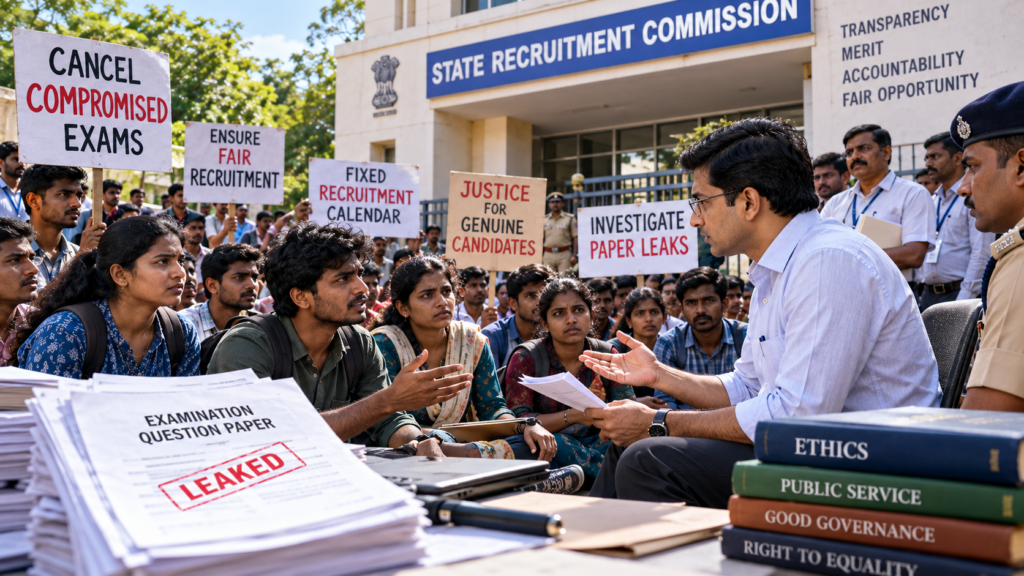
QUESTION: You are the District Collector of a district that has emerged as a major centre for competitive examination preparation. A large number of young aspirants from economically weaker rural families reside in the district, spending their savings and borrowing money to prepare for government recruitment examinations.
Recently, allegations surfaced that question papers for two examinations conducted by the State Recruitment Commission had been leaked. In one examination, results had already been declared, while candidates selected for another recruitment process were awaiting interviews. Preliminary reports suggest the involvement of a private coaching network, although the role of certain officials is also under suspicion.
Hundreds of aspirants have started a peaceful protest demanding an independent investigation, cancellation of compromised examinations, a fixed recruitment calendar and accountability of the Commission’s leadership. Some candidates have undertaken a hunger strike. The police have registered cases against protest organisers, citing violations of public-order restrictions.
The State government is under pressure to fill thousands of vacancies in public departments. Cancelling all examinations may delay recruitment and impose further financial hardship on genuine candidates. However, allowing potentially compromised results to stand could undermine meritocracy and public confidence in government institutions.
A senior political functionary privately advises you to persuade the protesters to withdraw their agitation and avoid measures that could embarrass the government. The police recommend strict enforcement of restrictions, while the aspirants fear that participation in protests could prejudice their future selection.
As District Collector, you must address the situation without compromising public order, institutional integrity or the rights of genuine candidates.
Questions
(a) What are the ethical issues involved in this case? (10 marks)
(b) Discuss the options available to you as District Collector. Identify the course of action you would adopt and justify it. (10 marks)
ANSWER:
(a) What are the ethical issues involved in this case? (10 marks)
The case presents a conflict between administrative responsibility, ethical governance and the legitimate aspirations of young job seekers.
- Integrity and probity: Paper leaks undermine meritocracy and public trust. This violates the duty-based ethics of Immanuel Kant, which requires officials to act according to principles that can be universally applied.
- Impartiality and political neutrality: Political pressure tests the District Collector’s independence. Max Weber’s bureaucratic ethics emphasises rule-bound, impersonal and politically neutral administration.
- Justice and equality of opportunity: Economically weaker candidates suffer disproportionately from recruitment malpractice. John Rawls’ theory of justice, particularly fair equality of opportunity, requires institutions to ensure genuinely fair access to public employment.
- Accountability and transparency: Allegations against officials demand impartial investigation and answerability, reflecting the principles of probity and ethical governance.
- Empathy and compassion: Aspirants face financial hardship and uncertainty. Aristotle’s virtue ethics emphasises practical wisdom, compassion and fairness in administrative decision-making.
- Freedom of expression versus public order: The administration must protect peaceful protest while maintaining law and order, applying proportionality and respect for individual rights.
- Fairness and due process: Cancelling all examinations without adequate evidence may punish innocent candidates. Consequentialist ethics requires assessing the likely harms and benefits of alternative decisions.
- Public trust and social responsibility: Recruitment institutions must serve the public interest rather than political or private interests.
The central dilemma is to balance justice, administrative efficiency, political neutrality and public order without compromising the dignity and rights of genuine candidates.
(b) Discuss the options available to you as District Collector. Identify the course of action you would adopt and justify it. (10 marks)
Options available
Option 1: Suppress the protest and prioritise recruitment continuity.
- Merit: May restore short-term public order and reduce recruitment delays.
- Ethical limitation: Violates the spirit of democratic participation and may disregard legitimate grievances. It conflicts with Kantian duty ethics, which requires respect for persons rather than treating them merely as instruments of administrative convenience.
Option 2: Cancel all examinations immediately.
- Merit: Demonstrates responsiveness and a commitment to clean recruitment.
- Ethical limitation: May harm innocent candidates and waste public resources. Under utilitarianism, the decision must consider the overall consequences for all affected stakeholders, not merely the immediate demands of protesters.
Option 3: Adopt a transparent, evidence-based and proportionate response.
- Merit: Balances justice, accountability, public order and administrative continuity.
- Ethical limitation: Requires time, resources and coordination.
Course of action
I would adopt Option 3, guided by the following ethical frameworks.
- Justice — John Rawls: Ensure fair equality of opportunity by investigating the leaks and protecting candidates who followed the rules. Cancel and reconduct only examinations whose integrity is demonstrably compromised.
- Duty ethics — Immanuel Kant: Resist political pressure and discharge official responsibilities impartially. Apply the same standards to influential officials and ordinary citizens.
- Utilitarianism — Jeremy Bentham and J.S. Mill: Minimise the overall harm caused by recruitment delays, wrongful cancellation, corruption and suppression of peaceful dissent.
- Virtue ethics — Aristotle: Exercise practical wisdom, courage and compassion while engaging student representatives and maintaining public order proportionately.
- Gandhian ethics — Mahatma Gandhi: Prioritise dialogue, non-violence and moral accountability in resolving the protest.
- Good governance: Recommend an independent, time-bound investigation; preserve evidence; communicate verified findings; establish a fixed recruitment calendar; and introduce secure examination procedures and effective grievance redressal.
PYQ REFERENCE UPSC 2026 MAINS ETHICS CASE STUDIES
SOURCE: The Hindu epaper – The long wait for a government job