
|
IN NEWS: BRICS in a fragmented world order, a test of relevance
QUESTION: Examine the implications of China’s growing economic and political dominance within BRICS for India’s strategic interests.(250 words)
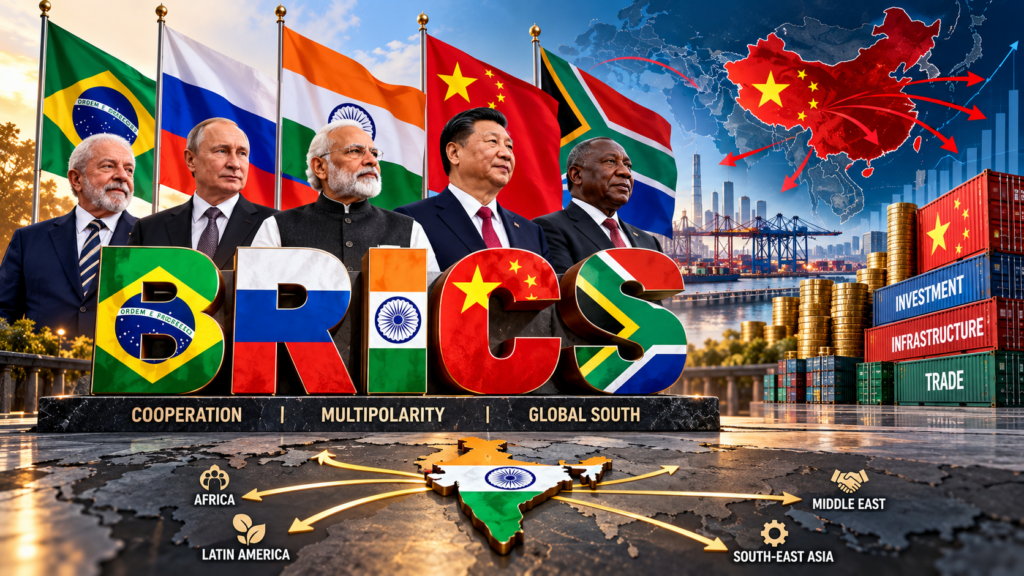
ANSWER: BRICS (Brazil, Russia, India, China, and South Africa, alongside expanded members) was established to promote a multipolar world order and represent the collective interests of the Global South. However, China’s massive economic weight—accounting for over 60% of the bloc’s combined GDP—along with its diplomatic clout, has increasingly shifted BRICS toward a Beijing-centric vehicle. For India, which seeks a multipolar world without a unipolar Asia, China’s growing hegemony within the grouping poses significant strategic, diplomatic, and economic challenges.
Strategic Implications for India
Geopolitical Alignment and Ideological Divergence
- Anti-Western vs. Non-Western Orientation: India envisions BRICS as a “non-Western” platform aimed at reforming global governance structures (such as the UN, IMF, and World Bank). Conversely, China, often backed by Russia, seeks to transform BRICS into an “anti-Western” geopolitical coalition to counter the US-led international order.
- Dilution of Strategic Autonomy: An aggressively anti-Western stance by BRICS undermines India’s foreign policy of multi-alignment, complicating its strategic partnerships with Western groupings like the Quad and I2U2.
Global South Leadership and Agenda Setting
- Contest for Leadership: India positions itself as a democratic, consensus-driven voice of the Global South. China leverages its Belt and Road Initiative (BRI) and vast capital to bring newly admitted and prospective BRICS members into its sphere of influence, threatening to marginalize India’s leadership role.
- Membership Expansion Dynamics: China has actively pushed for rapid BRICS expansion to institutionalize its influence. For India, an influx of Beijing-leaning or heavily indebted states risks turning the bloc into an echo chamber for Chinese foreign policy.
Economic and Institutional Asymmetry
- Financial Dominance in NDB: Within the New Development Bank (NDB), China’s financial leverage gives it disproportionate influence over project choices, funding standards, and lending priorities.
- De-Dollarization and Currency Friction: While India supports trade settlement in national currencies to reduce transaction costs, Beijing pushes for the broader internationalization of the Chinese Yuan (RMB) or a Yuan-backed trade basket, which could deepen regional financial dependency on Beijing.
- Trade Disparity: India already faces a massive trade deficit with China ($99.2 billion in 2024–25). China’s dominance within BRICS limits India’s capacity to negotiate preferential trade terms that protect domestic manufacturing.
Way Forward
- Enforcing Criteria-Based Expansion: India must continue to advocate for strict, transparent, and consensus-based criteria for future member and partner admissions to prevent the group from becoming a unilateral anti-West coalition.
- Promoting Digital Public Infrastructure (DPI): India can counter Chinese capital-heavy infrastructure (BRI) by offering scalable, low-cost Digital Public Infrastructure (such as UPI and open-source tech stacks) to fellow BRICS members, highlighting an alternative model of development.
- Strengthening Bilateral Partnerships Within BRICS: Deepening bilateral ties with non-aligned members like Brazil, South Africa, the UAE, and Indonesia helps build internal consensus coalitions to balance Chinese dominance.
- Preserving Multi-Alignment: India must maintain clear boundaries, ensuring its participation in BRICS supports global institutional reform without compromising its security partnerships in the Indo-Pacific or its strategic autonomy.
China’s growing economic and political dominance presents a paradox for India: BRICS offers a vital platform to push for global governance reform, yet risks being weaponized as a tool for Beijing’s hegemony. India’s strategic interest lies in preventing BRICS from devolving into an anti-Western bloc. By leveraging democratic credentials, digital leadership, and multi-alignment, India can remain a key balancing force, ensuring BRICS serves an equitable, multipolar world order.
|
SOURCE: The Hindu epaper – BRICS in a fragmented world order, a test of relevance