
SYLLABUS: Ethics General Studies – : IV Ethics and Human Interface: Essence, determinants and consequences of Ethics in-human actions; dimensions of ethics; ethics – in private and public relationships. Human Values – lessons from the lives and teachings of great leaders, reformers and administrators; role of family society and educational institutions in inculcating values.
IN NEWS: What was the Chemistry Nobel Prize given for?
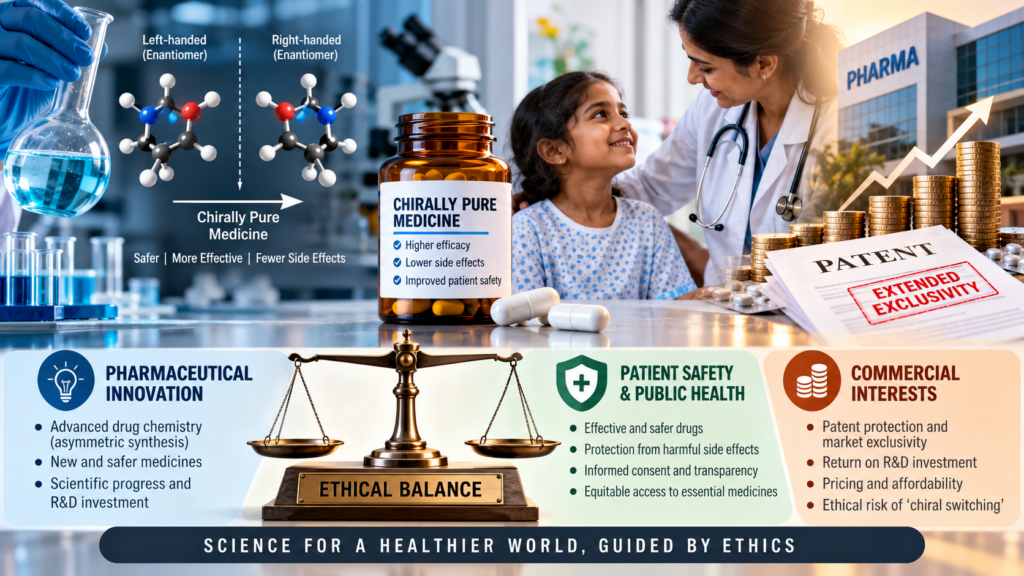
QUESTION: Discuss the ethical implications of balancing pharmaceutical innovation, patient safety and commercial interests in the development of chirally pure medicines.(150 words)
ANSWER: The ethical dilemma of chirally pure medicines cuts to the core of what the pharmaceutical enterprise is meant to be: a moral commitment to healing human suffering versus a commercial engine driven by profit maximization.
Key Ethical Considerations and Theoretical Frameworks
1. Patient Safety, Efficacy, and Bioethical Principles
- Principlism (Beauchamp and Childress):
- Beneficence & Non-Maleficence: Eliminating the toxic or harmful enantiomer directly satisfies the duty of non-maleficence (e.g., preventing teratogenic risks seen in racemic thalidomide). Generating safer, more efficacious drugs fulfills the duty of beneficence.
- Autonomy: Informed consent in clinical trials for chiral switches requires full disclosure: patients must understand whether a single-enantiomer trial offers a genuine therapeutic leap or merely incremental benefits over an existing, tested racemic drug.
2. Commercial Interests, “Chiral Switching,” and Ethical Theories
- Deontology & Kantian Ethics (Immanuel Kant):
- Kant’s Categorical Imperative dictates that individuals must be treated as ends in themselves, never merely as means to an end.
- “Chiral switching”—patenting a single enantiomer just as the original racemic patent expires—is ethically problematic under Kantian ethics if the primary motive is extending market exclusivity rather than delivering meaningful clinical benefits. Using patients and public healthcare systems as revenue-generating vehicles violates the requirement to act out of duty to human dignity.
- Utilitarianism (Jeremy Bentham & John Stuart Mill):
- Utilitarianism evaluates actions based on maximizing overall happiness and well-being (the greatest good for the greatest number).
- Rule Utilitarianism supports patent protections as a rule to incentivize high-risk financial investments in pharmaceutical R&D, which ultimately benefits society.
- Act Utilitarianism, however, critiques evergreen patents that lack clinical superiority: keeping prices artificially high and delaying cheap generic competition reduces overall social welfare and causes net harm to healthcare systems.
3. Equitable Access and Distributive Justice
- Theory of Justice (John Rawls):
- Rawls’s Difference Principle allows social and economic inequalities only if they work to the maximum benefit of the least advantaged members of society.
- Single-enantiomer drugs are cost-intensive to synthesize and commercialize. High pricing structures that make essential medicines inaccessible to economically vulnerable populations violate Rawlsian justice, as corporate profits fail to benefit the least advantaged.
- Ethics of Care (Carol Gilligan):
- Emphasizes empathy, relational responsibilities, and responsiveness to human suffering rather than purely transactional economic logic.
- Diverting R&D capital toward re-purposing existing racemic mixtures into single enantiomers—rather than addressing unaddressed global health crises or neglected tropical diseases—neglects the relational responsibility of the pharmaceutical sector to vulnerable global populations.
Governance Frameworks and Balancing Strategies
- Strict Superiority Standards (Deontological Alignment): Regulatory authorities and patent offices should enforce rigorous thresholds requiring proof of substantial clinical advantage—such as significantly reduced side effects or improved therapeutic indices—before granting new exclusivity periods for chiral switches.
- Value-Based Pricing (Utilitarian Alignment): Health Technology Assessment (HTA) bodies should utilize value-based pricing, linking drug reimbursement levels directly to measurable health outcomes to prevent price gouging on minor molecular modifications.
- Tiered Pricing and Fair Distribution (Rawlsian Alignment): Pharmaceutical companies should adopt differential pricing models in low- and middle-income countries to ensure chirally pure medicines are accessible across diverse socio-economic strata.
- Green Chemistry and Cost-Effective Synthesis: Investing in scalable biocatalysis and continuous flow asymmetric synthesis can drastically lower manufacturing costs, ensuring commercial viability without transferring high costs to patients.
Evaluating the development of chirally pure medicines through ethical frameworks highlights that technological refinement must be paired with moral responsibility. While single enantiomers offer genuine clinical advancements when grounded in non-maleficence and beneficence, using chiral isolation primarily as a mechanism for patent evergreening conflicts with Kantian dignity and Rawlsian distributive justice. An ethically sound governance model must ensure that commercial incentives remain aligned with the fundamental goal of human well-being.
Discuss the ethical dilemma involved in balancing the Intellectual Property Rights (IPR) of pharmaceutical innovator companies with the Right to Health of poor populations in developing nations. |
SOURCE: The Hindu epaper – What was the Chemistry Nobel Prize given for?