
|
IN NEWS: The paradox of self-reliance: India-China trade dynamics
QUESTION: What is the ‘assembly trap’ in manufacturing? Examine how excessive dependence on imported components can limit the development of domestic manufacturing capabilities.
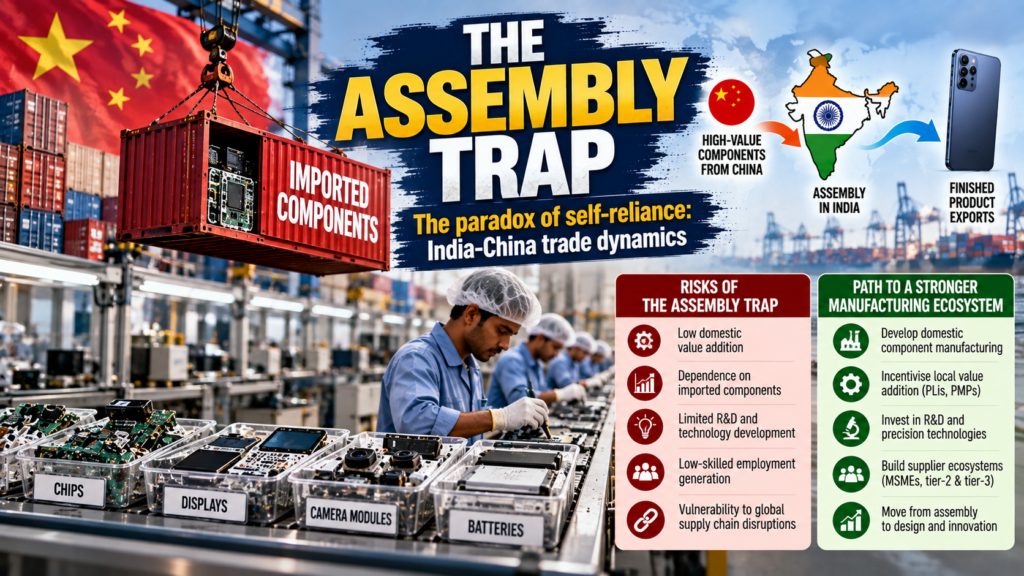
ANSWER: The ‘assembly trap’ occurs when a manufacturing sector relies predominantly on assembling imported components rather than developing domestic design, engineering, and raw material processing. While it enables quick integration into global value chains, it limits domestic value addition (DVA) and prevents technologically self-reliant industrial growth.
Mechanics of the Assembly Trap
- Low Domestic Value Addition: Local contributions remain confined to low-skilled assembly, packaging, and basic testing, while high-value intellectual property, chip design, and precision engineering remain abroad.
- Distorted Trade Metrics: High gross export figures mask low net exports, as every finished export requires importing expensive intermediate inputs.
- Minimal Skill & Tech Spillovers: Pre-fabricated foreign sub-assemblies offer domestic workers and engineers limited exposure to R&D, product redesign, and foundational technical skills.
How Dependent Component Imports Limit Domestic Capabilities
- Suppression of Local Ecosystems: Dominance of imported components starves domestic tier-2 and tier-3 suppliers of demand, preventing them from scaling up or investing in quality certifications.
- Stagnation of R&D and Technical Upgrading: Importing finished modules deprives domestic industry of hands-on learning in metallurgy, microelectronics, and precision tooling, keeping domestic R&D investment low.
- Heightened Vulnerability: Heavy import dependency exposes domestic industries to geopolitical tensions, exchange rate swings, and external supply chain disruptions.
- Employment Skill Ceiling: Assembly lines demand low-skilled manual labor, limiting the creation of high-value engineering jobs and contributing to brain drain.
- Capital Starvation: Foreign component suppliers capture the bulk of the profit margin, leaving local assembly firms with insufficient capital to reinvest in technology or workforce training.
Strategic Policy Imperatives
- Phased Manufacturing Programs (PMP): Use targeted tariff structures to progressively incentivize local component sourcing over defined timelines.
- Targeted Production Incentives: Align industrial schemes (like PLIs) directly with high-value component manufacturing rather than final product assembly alone.
- R&D and Capital Support: Fund shared testing facilities, industrial clusters, and capital subsidies for domestic precision tooling and sub-system design.
- Domestic Supplier Integration: Mandate or incentivize foreign OEMs to onboard and mentor local suppliers into their global supply chains.
Assembling imported parts provides an initial entry into global trade, but long-term industrial strength requires moving beyond it. Sustainable growth depends on deepening local value addition, building domestic component ecosystems, and mastering core technologies.
|
SOURCE: The Hindu e-paper – The paradox of self-reliance: India-China trade dynamics