
|
IN NEWS: India’s real rate moment, the cost of delay
QUESTION: “Monetary policy must balance price stability with growth, but the nature of the inflation shock determines the appropriate balance.” Examine.
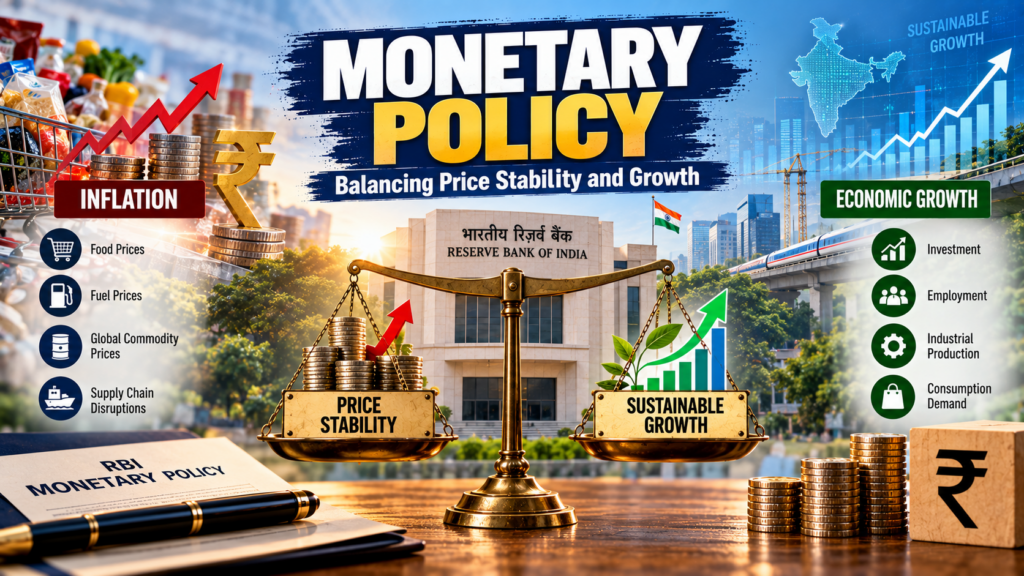
ANSWER: Monetary policy refers to the central bank’s management of money supply, interest rates, and credit conditions to achieve macroeconomic goals. The primary dilemma for central banks globally—and specifically for the Reserve Bank of India (RBI)—is managing the inherent trade-off between curbing inflation and fostering economic growth. The macroeconomic environment, specifically whether an inflation shock originates from the demand side or the supply side, dictates how aggressive or nuanced monetary policy must be.
The Dual Mandate: Price Stability vs. Economic Growth
- Price Stability as a Prerequisite for Sustainable Growth: High and volatile inflation erodes purchasing power, reduces real yields on savings, creates economic uncertainty, and discourages long-term business investment. Moderate, predictable inflation is necessary to anchor inflation expectations, maintain market confidence, and support stable economic expansion.
- The Growth Dimension: Monetary policy influences aggregate demand through interest rates and credit flow. Excessive tightening to curb inflation elevates borrowing costs, slows business investment, depresses consumer spending, and risks inducing an economic slowdown or recession. Conversely, maintaining overly loose policy to boost growth during elevated inflation can lead to hyperinflation and severe economic distortion.
- The Core Trade-off: The short-run Phillips Curve illustrates this dilemma—actions taken to bring down inflation often temporarily increase unemployment or slow output growth, requiring central banks to navigate a delicate balance based on target inflation bands (e.g., RBI’s flexible inflation targeting framework of 4% pm ).
How the Nature of Inflation Shocks Determines the Policy Response
1. Demand-Pull Inflation Shocks
- Nature: Driven by excessive aggregate demand exceeding the economy’s potential output capacity (e.g., rapid post-pandemic economic reopening, aggressive fiscal stimulus, or excessive credit expansion).
- Appropriate Policy Response: Standard contractionary monetary policy is highly effective against demand-pull shocks.
- Mechanism: The central bank increases policy interest rates (e.g., Repo rate), raises reserve requirements, or conducts open market operations to absorb excess liquidity. Higher borrowing costs curb consumer spending and corporate capital expenditure, aligning aggregate demand back with aggregate supply.
- Impact on the Balance: Because high demand is overheating both prices and economic activity, curbing demand lowers inflation without creating a prolonged trade-off against potential long-term growth.
2. Supply-Side / Cost-Push Inflation Shocks
- Nature: Driven by unexpected contractions in production or supply chain disruptions (e.g., geopolitical conflicts driving up global crude oil prices, weather anomalies causing domestic food shortages, or semiconductor shortages).
- Appropriate Policy Response: Supply shocks create a direct conflict between price stability and growth, often leading to stagflationary pressures. Monetary tightening cannot produce more oil or grow more crops; it can only depress aggregate demand to match a constrained supply.
- Nuanced Stance:
- Transient Supply Shocks: If the shock is temporary (e.g., seasonal food price spikes), central banks typically look through the headline inflation numbers and maintain a supportive or neutral stance to avoid harming growth unnecessarily.
- Persistent/Broad-Based Supply Shocks: If supply disruptions are prolonged and risk unanchoring inflation expectations or spilling over into non-food, non-fuel core inflation (second-round effects), central banks are forced to raise rates. The policy focus shifts toward anchoring long-term expectations, accepting a temporary sacrifice in near-term growth to prevent chronic high inflation.
3. Import-Induced and External Financial Shocks
- Nature: Driven by exchange rate depreciation or imported commodity price spikes (e.g., global central banks rapidly raising interest rates, triggering capital outflows from emerging market economies).
- Appropriate Policy Response: Central banks must balance interest rate differentials to prevent currency depreciation, which exacerbates imported inflation, while avoiding excessive domestic rate hikes that could crush domestic credit growth.
Key Operational Tools for Achieving Balance
- Flexible Inflation Targeting (FIT): Allows central banks to operate within a specified tolerance band rather than a rigid fixed target, granting them flexibility to accommodate short-term supply shocks without immediate, heavy-handed rate increases.
- Calibrated Stance Management: Communicating changes in policy stance (e.g., moving from “accommodative” to “withdrawal of accommodation” or “neutral”) helps guide market expectations without inducing sudden rate shocks.
- Targeted Credit and Sectoral Measures: Utilizing targeted long-term repo operations, priority sector lending guidelines, or macroprudential norms to support growth in sensitive sectors while keeping overall monetary conditions disciplined.
- Coordination with Fiscal Policy: Addressing supply-side shocks requires primary intervention from fiscal policy (e.g., import duty cuts, fuel excise reductions, food buffer stock releases) so that monetary policy is not forced to bear the full burden of supply stabilization alone.
Monetary policy cannot follow a one-size-fits-all formula. While demand-driven inflation requires decisive interest rate hikes to rein in overheating, supply-driven inflation requires calibrated, measured responses that prevent second-round effects without prematurely stifling economic recovery. Achieving a sustainable balance between price stability and growth ultimately relies on accurately diagnosing the origin of the inflation shock and coordinating monetary actions with complementary fiscal supply-side interventions.
|
SOURCE: The Hindu e-paper – India’s real rate moment, the cost of delay