
|
IN NEWS: Decoding the transition to alternative fuels
QUESTION: “A rise in the share of alternative-fuel vehicles does not necessarily imply an equivalent transition towards electrification.” Discuss in the context of India’s automobile sector.
(10 marks, 150 words)
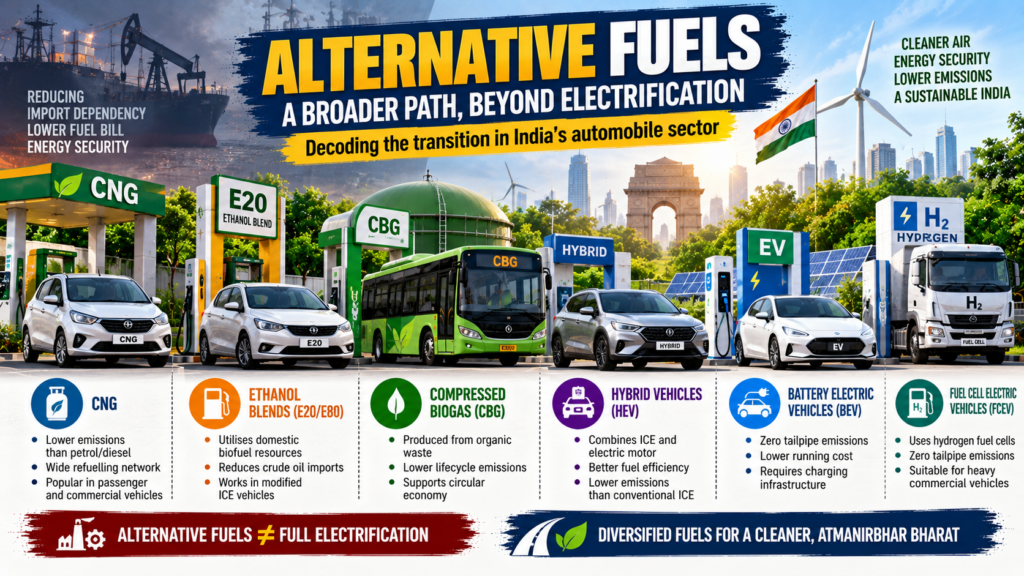
ANSWER: The expansion of Alternative-Fuel Vehicles (AFVs) in India’s automotive landscape reflects a strategic attempt to lower the nation’s fuel import bill—currently exceeding $100 billion annually—and meet its Nationally Determined Contributions (NDCs) under the Paris Agreement. However, equating the market growth of alternative fuels with a seamless transition toward zero-emission electrification creates a policy misnomer, as engine diversification does not automatically translate into powertrain transformation.
- Technological and Conceptual Divergence
- Alternative-Fuel Vehicles (AFVs): Encompass a wide spectrum of internal combustion engine (ICE) variations—including Compressed Natural Gas (CNG), Compressed Biogas (CBG), Flex-Fuels (E20/E80 ethanol blends), and Strong/Mild Hybrids (HEVs)—alongside pure Battery Electric Vehicles (BEVs).
- Electrification: Refers specifically to zero-tailpipe-emission, electric-motor-driven platforms relying on high-voltage battery storage (BEVs) or fuel cells (FCEVs).
While all electric vehicles qualify as alternative-fuel vehicles, the vast majority of AFVs sold in India remain dependent on fossil-fuel or biofuel combustion.
- Empirical Reality in India’s Automotive Market
- Dominance of Gas over Watts: Alternative-fuel powertrains constitute over 40% of passenger vehicle retail sales. However, CNG vehicles alone account for roughly 25% of the total passenger market, driven by expanding City Gas Distribution (CGD) networks and lower operating costs.
- Prevalence of Hybrids: Hybrid electric vehicles (HEVs) account for nearly 8–9% of passenger sales. Although they utilize electric motors, they fundamentally rely on gasoline-fueled internal combustion engines.
- Lag in Passenger BEVs: Pure Battery Electric Vehicles hold a market share of under 8% in the passenger segment, meaning CNG vehicles alone outsell pure electric cars by more than three to one.
- Biofuel Roadmap: The mandatory E20 (20% ethanol blending) rollout modifies fuel chemistry to burn within modified ICE platforms, leaving the underlying mechanical architecture unaltered.
- Why AFV Growth Does Not Equal Electrification
- Capital Expenditure and Platform Costs: CNG and flex-fuel cars utilize established ICE manufacturing facilities and supply chains with minimal capital expenditure. In contrast, pure electrification demands dedicated EV architectures, localized high-voltage cell manufacturing under the Advanced Chemistry Cell (ACC) PLI scheme, and capital-intensive charging infrastructure.
- Upfront Price Parity and TCO: CNG vehicles offer middle-income consumers immediate purchase-price accessibility and fast Total Cost of Ownership (TCO) recovery without heavy fiscal reliance. BEVs, despite schemes like PM E-DRIVE, carry significant initial cost premiums due to battery pack economics.
- Segmental Disparity: While two-wheelers (>10% share) and three-wheelers (>65% share) show rapid electrification due to low battery sizes and high daily utilization, Medium & Heavy Commercial Vehicles (M&HCVs) rely on LNG and CNG due to range limitations and payload capacity constraints.
- Structural Bottlenecks Inhibiting True Electrification
- Well-to-Wheel Carbon Emissions: With over 70% of India’s power grid powered by coal, charging a BEV on thermal electricity offers muted lifecycle carbon reductions compared to efficient hybrids on a Well-to-Wheel (WTW) evaluation.
- Critical Mineral Dependencies: Shifting completely to BEVs trades crude oil import risks for battery supply chain vulnerabilities, exposing India to concentrated global markets for Lithium, Cobalt, and Nickel.
- Grid and Charging Readiness: The low density of public fast chargers and slower grid upgrade cycles in non-metro areas restrict consumer confidence in full battery reliance.
The surge in alternative-fuel vehicles in India marks an effective mid-term strategy for energy security and incremental decarbonization. However, true electrification requires moving beyond ICE-based fuel substitution toward zero-tailpipe-emission mobility. Aligning power grid decarbonization, localizing battery gigafactories, and developing highway charging corridors remain essential steps to ensure that fuel diversification culminates in genuine automotive electrification.
|
SOURCE: The Hindu e-paper – Decoding the transition to alternative fuels