
|
IN NEWS: The Houthis vs Saudi Arabia | The new lords of the Red Sea
QUESTION: Houthi control over Yemen’s Red Sea coastline and the Bab el-Mandeb strait threatens global maritime trade. Discuss its strategic implications for India. (10 Marks, 150 Words)
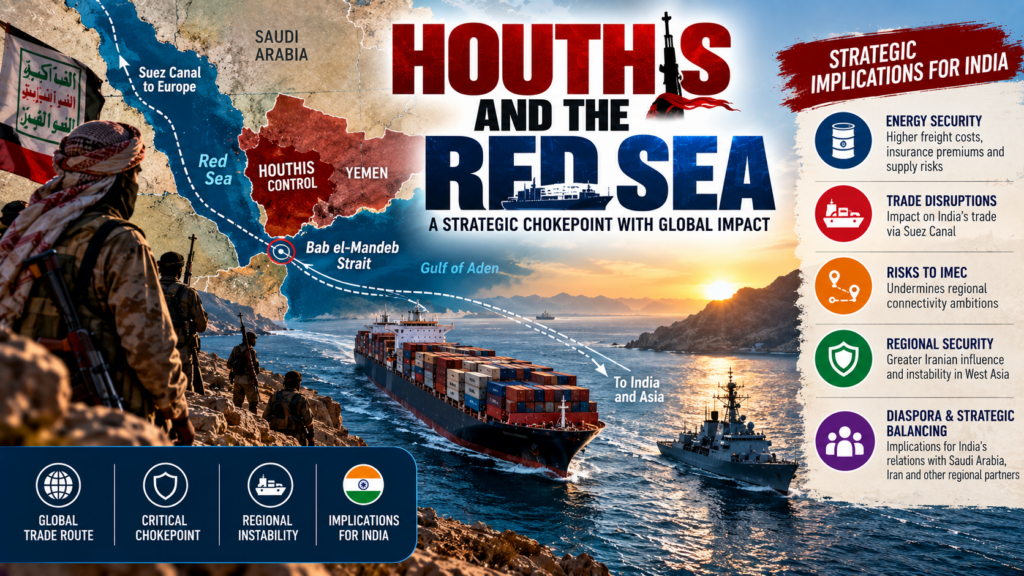
ANSWER: The Bab el-Mandeb strait and the Red Sea corridor carry a significant share of the Asia–Europe trade routed through the Suez Canal. With the Houthis now controlling Yemen’s entire Red Sea coastline having captured Mokha, Dhubab, and the Perim Island in the strait itself a non-state actor aligned with Iran has acquired direct leverage over one of the world’s most critical maritime chokepoints, with direct consequences for India’s trade and energy security.
- Nature of the strategic shift
- The Houthis have transformed from an insurgent group into a “formidable territorial army and naval force,” controlling the Red Sea coastline and the Bab el-Mandeb strait, the narrow chokepoint linking the Red Sea to the Gulf of Aden.
- This capability rests on four pillars:
- A parallel state in northern Yemen since 2014
- An ideologically committed base among Zaydi Shias,
- Sustained Iranian support
- Years of war that a Saudi-led coalition (since 2015) failed to dislodge them from.
- Control over two global chokepoints simultaneously:
- Iran over the Strait of Hormuz and its ally Ansar Allah (Houthis) over Bab el-Mandeb gives the Iran-aligned axis leverage over routes carrying 12-15% of global maritime trade and a significant share of seaborne oil trade.
- The renewed conflict of Houthi attacks on Saudi cities and the capture of Mokha and Dhubab shows the ceasefire’s fragility and the risk of the corridor becoming a permanent zone of instability.
- Implications for India
Economic/Energy security:
- India imports the bulk of its crude oil via Gulf routes; disruption to Red Sea/Bab el-Mandeb shipping raises freight costs, insurance premiums, and transit times for India-bound and India-origin cargo (as already seen during 2023-24 Houthi attacks on commercial shipping).
- Instability compounds India’s existing exposure to Strait of Hormuz risk, creating a “double chokepoint” vulnerability given India’s heavy dependence on Gulf energy.
Strategic/Connectivity concerns:
- The India-Middle East-Europe Economic Corridor (IMEC), envisaged as an alternative connectivity route, depends on regional maritime stability; sustained Houthi disruption undermines its viability.
- Growing Iranian-aligned non-state leverage over global chokepoints affects the broader balance of power in West Asia, a region central to India’s “Link West” policy and its ~9 million-strong diaspora.
Diplomatic balancing:
- India maintains ties with Saudi Arabia, Iran, and Israel simultaneously; escalation between these poles (as seen with U.S.-Israel strikes on Iran, Saudi-Houthi conflict) tests India’s strategic autonomy and neutrality-based diplomacy.
Way Forward
- Strengthen Indian Navy’s anti-piracy/escort presence in the Gulf of Aden and Red Sea, building on its existing Operation Sankalp-type deployments to secure shipping lanes.
- Diversify crude oil sourcing (Russia, U.S., Latin America) to reduce structural dependence on Hormuz/Bab el-Mandeb-routed Gulf supplies, in line with India’s energy security strategy under the Ministry of Petroleum and Natural Gas.
- Fast-track IMEC implementation with alternative overland/multimodal segments to reduce dependence on any single maritime chokepoint.
- Leverage India’s balanced relations with Saudi Arabia, Iran, and the U.S. to play a quiet facilitatory role, consistent with India’s positioning at platforms like the Indian Ocean Rim Association (IORA).
- Enhance intelligence-sharing and coordination with the Combined Maritime Forces (CMF) and like-minded Indian Ocean partners (Quad, France, UAE) to monitor chokepoint security in real time.
The Houthi consolidation over the Red Sea coastline signals a structural shift in West Asian security, where non-state actors now hold leverage once reserved for states. For India, safeguarding energy security and connectivity ambitions like IMEC will require a mix of naval preparedness, diplomatic balancing and diversification reflecting India’s evolving role as a net security provider in the Indian Ocean Region.
|