
|
IN NEWS: How AI firms are destroying physical books to train their models
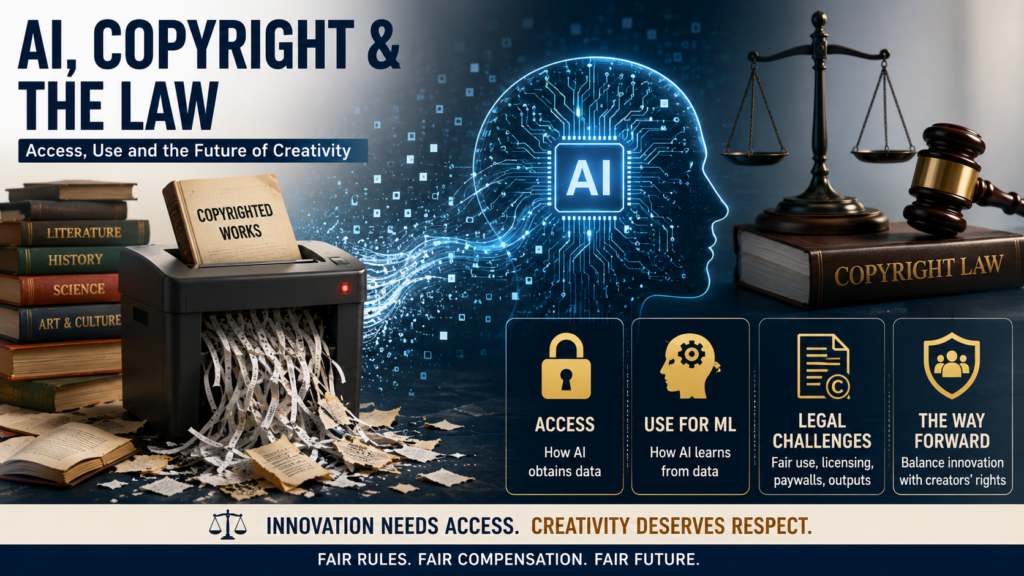
QUESTION: With the proliferation of generative AI, should copyright law continue to distinguish sharply between ‘access to a work’ and ‘use of a work for machine learning’? Examine the emerging legal and policy challenges.
(15 marks, 250 words)
ANSWER: The legal tension between access to copyrighted works (how AI models obtain training data) and use of works for machine learning (how models extract patterns, weight parameters, and generate outputs) has become the central battleground of 21st-century intellectual property law.
Traditionally, copyright law treats “access” (lawful possession or viewing) and “use” (reproduction, adaptation, performance) as distinct concepts. However, generative AI blurs this boundary because machine learning requires the wholesale copying and ingestion of digital works just to “read” or “learn” from them.
The Traditional Paradigm: Access vs. Use
In traditional copyright frameworks, the distinction served clear legal functions:
- Access: Refers to obtaining entry to a work (e.g., buying a book, streaming a song, or bypassing a paywall). Access alone does not trigger copyright infringement unless accompanied by an unauthorized reproduction or public performance.
- Use: Refers to actions governed by exclusive rights under copyright (e.g., copying, modifying, distributing). Reading a book to learn writing techniques is a non-infringing “use,” while scanning and printing thousands of copies is infringing.
Why Machine Learning Collapses the Distinction
Generative AI disrupts this dichotomy because of the technical reality of training foundational models:
- Ingestion Requires Intermediate Copying: Unlike a human who can read a book visually without reproducing it, a computer must create digital copies (scraping, downloading, parsing) to convert raw text or images into mathematical representations (vectors and embeddings).
- Access Dictates Capacity: The line between lawful access and unauthorized use becomes razor-thin when models scrape publicly accessible data that is nevertheless protected by copyright or subject to Terms of Service (ToS) anti-scraping provisions.
- Extraction of Unprotectable Ideas via Expressive Copying: Copyright protects expression, not ideas, facts, or styles. ML training uses copyrighted expressions strictly to extract unprotectable statistical relationships. Rights holders argue the copy itself is an unauthorized “use,” while AI developers argue it is merely an operational step toward non-infringing pattern learning.
Key Legal & Policy Challenges
1. The Elasticity of Fair Use and TDM Exceptions
- United States (Fair Use – Section 107): Litigants debate whether ML ingestion qualifies as “transformative use” (similar to search engine indexing in Authors Guild v. Google) or constitutes market substitution. While the intermediate copying serves a transformative function, the output can directly compete with the creators whose work was ingested.
- European Union & Other Jurisdictions: The EU Digital Single Market Directive (Articles 3 & 4) provides explicit Text and Data Mining (TDM) exceptions, distinguishing between commercial and research uses while allowing rights holders to “opt-out.” This explicitly decouples basic access from commercial ML extraction rights.
2. Mass Market Licensing vs. Market Failure
If every instance of ML training requires an explicit license, transaction costs could lock out open-source developers and entrench tech monopolies capable of paying blanket royalties. Conversely, failing to require licenses risks delegitimizing creators’ economic interests, leading to systemic market failure for human artists.
3. Technical Measures and Paywalls (“Access Controls”)
When AI companies use web crawlers to bypass anti-scraping tools, robots.txt files, or paywalls, claims shift from standard copyright infringement to violations of the Digital Millennium Copyright Act (DMCA Section 1201 – Circumvention of Technological Measures) and breach of contract (ToS violations). This shifts the dispute entirely back to the “access” domain.
4. The Output Problem: Memorization and Substantial Similarity
While training involves ingestion (access/use), outputs occasionally reproduce copyrighted snippets verbatim (“memorization”). This exposes AI developers to direct infringement claims, proving that access and output use remain intertwined.
Policy Pathways: Should the Law Maintain the Sharp Distinction?
- Maintain the Sharp Distinction (Status Quo / Fair Use Focus): This approach treats intermediate ingestion as non-infringing fair use, focusing copyright scrutiny strictly on market-competing outputs. While it strongly encourages technological innovation, it risks depleting the economic incentives for human creators.
- Collapse the Distinction (Strict Permission Model): Under this model, explicit authorization is required for both initial access and subsequent ML training uses. This protects creator rights but creates high transaction costs and risks monopolizing AI development among well-funded tech giants.
- Hybrid Statutory Frameworks (Compulsory Licensing & Opt-Outs): This framework allows broad access for training by default, coupled with statutory remuneration schemes or machine-readable opt-outs (similar to the EU model). It balances AI scaling with creator compensation, though it requires complex international enforcement mechanisms.
Copyright law should not completely abandon the distinction between access and use, as doing so risks establishing a monopoly over reading, observing, and extracting factual knowledge. However, relying on a rigid, pre-digital binary is no longer workable.
Policy must evolve toward remunerative middle-ground regimes—such as standardized statutory licensing, robust opt-out standards, and transparency mandates—that permit functional access for data processing while ensuring creators share in the economic value generated by machine learning.
|
SOURCE: The Hindu e-paper – How AI firms are destroying physical books to train their models