
|
IN NEWS: Why elephants need long corridors, and why SC has stepped in for them
QUESTION: “Elephant corridors are critical ecological infrastructure for conserving India’s elephant population.” Examine their significance and discuss the major threats affecting their functionality.
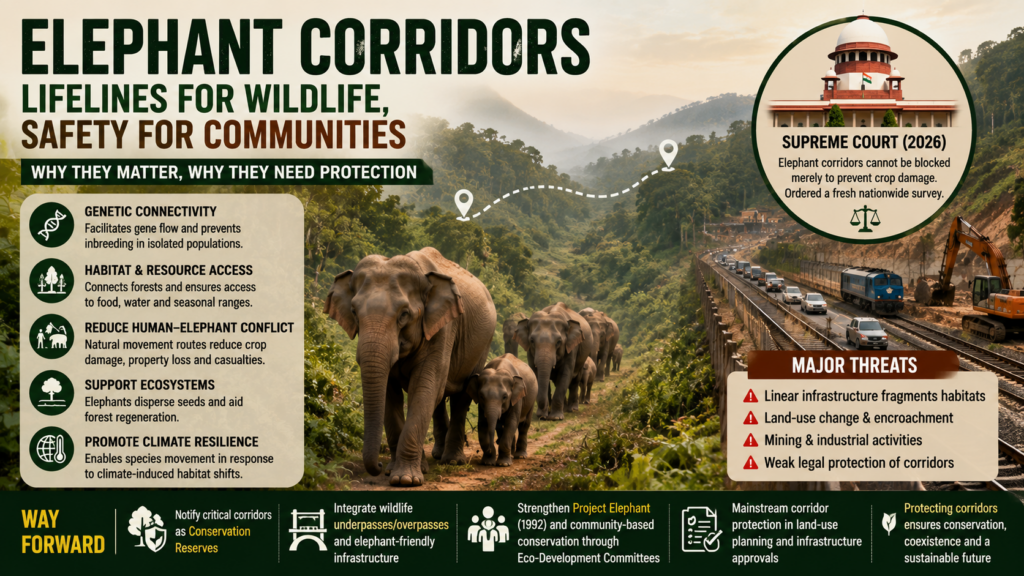
ANSWER: Elephant corridors are narrow stretches of land connecting larger elephant habitats, facilitating movement of the Asian Elephant (Elephas maximus), India’s National Heritage Animal. According to the MoEFCC’s 2023 Elephant Corridor Report, India has 150 identified elephant corridors across 15 elephant-range states, making them indispensable for landscape-level conservation.
Significance of Elephant Corridors
1. Ensure Genetic Connectivity
- Corridors facilitate gene flow between isolated elephant populations and prevent inbreeding depression.
- This is particularly important in fragmented landscapes such as the Western Ghats, which support over 50% of India’s elephant population (22,446 elephants).
2. Facilitate Habitat Continuity and Resource Access
- Elephants require extensive home ranges of 300–800 sq km and undertake seasonal movements in search of food and water.
- Corridors connect protected areas and allow uninterrupted access to critical resources.
3. Reduce Human–Elephant Conflict (HEC)
- The MoEFCC Report on Human-Elephant Conflict in South India highlights that blocked corridors force elephants into agricultural fields and settlements.
- Maintaining natural movement routes reduces crop depredation, property damage and casualties.
4. Support Ecosystem Functioning
- As an umbrella and keystone species, elephants disperse seeds over long distances and aid forest regeneration.
- Conserving elephant corridors therefore protects entire ecosystems and associated biodiversity.
5. Promote Climate Resilience
- Corridors allow species movement in response to climate-induced habitat shifts, enhancing landscape resilience.
Major Threats Affecting Corridor Functionality
1. Linear Infrastructure
- Highways, railway lines, canals and transmission corridors fragment habitats.
- The Supreme Court (2026) observed that elephant corridors cannot be blocked merely to prevent crop damage and ordered a fresh nationwide survey.
2. Land-Use Change and Encroachment
- Expansion of tea and coffee plantations, resorts, settlements and agriculture narrows corridors into bottlenecks.
- The Western Ghats landscape has witnessed significant fragmentation due to such changes.
3. Mining and Industrial Activities
- Mining belts in Jharkhand, Odisha and Chhattisgarh have altered traditional migratory routes and triggered elephant dispersal into new areas.
4. Weak Legal Protection
- Many corridors traverse private and revenue lands and lack notification as Conservation Reserves under Section 36A of the Wildlife (Protection) Act, 1972.
Way Forward
- Notify critical corridors as Conservation Reserves.
- Integrate wildlife underpasses, overpasses and elephant-friendly infrastructure in development projects.
- Strengthen Project Elephant (1992) and community-based conservation through Eco-Development Committees.
- Mainstream corridor protection in land-use planning and infrastructure approvals.
Elephant corridors are the lifelines of elephant conservation, ensuring ecological connectivity, genetic viability, and coexistence between humans and wildlife. Protecting them advances the constitutional mandate under Article 48A and Article 51A(g) and is essential for sustainable landscape management.
|
SOURCE: The Indian Express – Why elephants need long corridors