
|
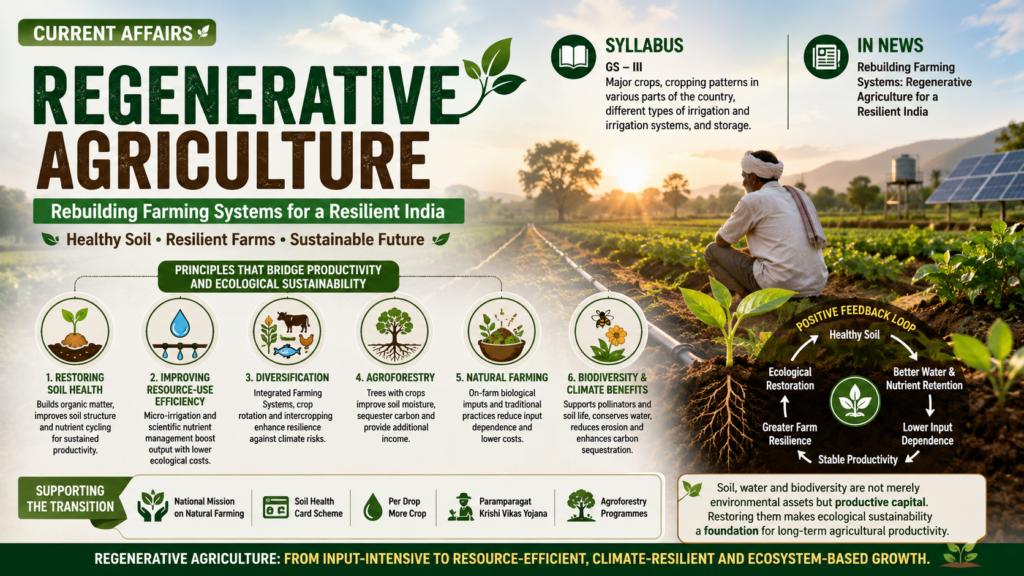
IN NEWS: Rebuilding Farming Systems: Regenerative Agriculture for a Resilient India
QUESTION: What is regenerative agriculture? How can its principles help India reconcile the twin objectives of agricultural productivity and ecological sustainability? Discuss.
(15 Marks)
ANSWER: Indian agriculture faces the challenge of raising productivity while conserving its natural resource base. This challenge is evident from the fact that 87% of India’s total groundwater extraction is used for irrigation, while fertiliser nutrient-use efficiency remains only 30–45% for nitrogen and 15–25% for phosphorus.
With declining soil health and increasing climate variability adding to these pressures, regenerative agriculture seeks to restore soil health, improve resource-use efficiency and strengthen ecological resilience while sustaining agricultural productivity.
What is regenerative agriculture?
Regenerative agriculture is a holistic farming approach centred on restoring soil health and enhancing biodiversity while ensuring long-term productivity and resilience. Unlike conventional sustainability, which primarily seeks to maintain existing conditions, regenerative agriculture seeks to actively improve them.
How can it reconcile productivity with ecological sustainability?
- Restoring soil health → sustained productivity
Practices such as green manuring, cover cropping and mulching increase organic matter, improve soil structure, conserve moisture and strengthen nutrient cycling. - Improving resource-use efficiency → productivity with lower ecological costs
Micro-irrigation delivers water closer to plant roots, reducing wastage and improving water-use efficiency. Similarly, scientific nitrogen management improves fertilizer-use efficiency while reducing environmental losses and nitrous oxide emissions. - Diversification → resilience against climate risks
Integrated Farming Systems (IFS) combine crops with livestock, fisheries, horticulture, agroforestry and other allied activities. Crop rotation, intercropping and multi-cropping diversify production and reduce the risk of total crop failure during droughts or floods. - Agroforestry → ecological restoration with additional income
Integrating trees with crops improves soil moisture, regulates local temperatures and enhances carbon storage, while simultaneously providing farmers with additional sources of income. This is particularly relevant for degraded and rainfed areas. - Natural farming → reduced input dependence
Natural farming uses on-farm biological inputs, traditional seed varieties, botanical pest management, mulching and multi-cropping. Such practices can reduce dependence on synthetic inputs and consequently lower cultivation costs while improving ecological balance. - Biodiversity and climate benefits → long-term sustainability
Greater crop and biological diversity supports pollinators, beneficial insects and soil microorganisms. Healthier soils also retain more water, reduce runoff and erosion, and enhance carbon sequestration, thereby linking farm productivity with environmental conservation.
Regenerative agriculture can therefore create a positive feedback loop:
Healthy soil → better water & nutrient retention → lower input dependence → stable productivity → greater farm resilience → ecological restoration
India’s transition can be supported through location-specific regenerative practices, scientific soil testing, farmer training, financial incentives and convergence of existing schemes.
Existing initiatives such as the National Mission on Natural Farming, Soil Health Card Scheme, Per Drop More Crop, Paramparagat Krishi Vikas Yojana and Agroforestry programmes can be converged to support this transition.
Thus, Regenerative agriculture can help India move from an input-intensive model of agricultural growth towards a resource-efficient, climate-resilient and ecosystem-based model. The key is to recognise that soil, water and biodiversity are not merely environmental assets but productive capital. Restoring these assets can therefore make ecological sustainability a foundation for, rather than a trade-off against, long-term agricultural productivity.
|