
UPSC Syllabus: GS Paper III – Indian Economy: Indian Economy and issues relating to planning, mobilisation of resources, growth, development and employment.
Why in News?
The Centre’s fiscal outlook is facing geopolitical and revenue-related risks, bringing renewed attention to the state of fiscal federalism in India.
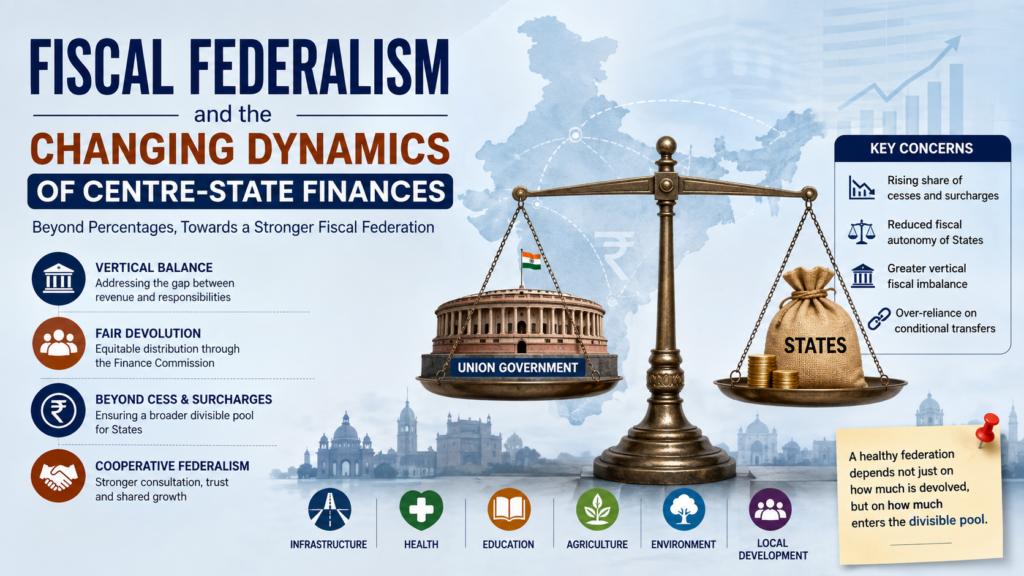
Fiscal federalism is influenced not only by the percentage of taxes devolved to States through the Finance Commission, but also by the composition of the Union’s tax revenues and the growing reliance on cesses and surcharges.
What is Fiscal Federalism?
Fiscal federalism refers to the distribution of financial powers, taxation responsibilities and expenditure functions between different levels of government.
In India, the Union generally has greater revenue-raising capacity, while States carry substantial expenditure responsibilities in areas such as health, education, agriculture and local development. This creates a vertical fiscal imbalance that is addressed partly through tax devolution and grants.
Role of the Finance Commission
The Finance Commission plays a central role in maintaining fiscal balance between the Centre and the States.
- Article 280 mandates the Finance Commission to recommend the distribution of the net proceeds of Union taxes between the Union and the States.
- The 15th Finance Commission retained the States’ share at 41% of the divisible pool for 2021–26.
- This constitutes vertical devolution, addressing the imbalance between the revenue capacities and expenditure responsibilities of the two levels of government.
- The Finance Commission also undertakes horizontal devolution, distributing the States’ share among individual States using criteria such as income distance, population, area, forest and ecology, demographic performance and tax effort.
Why Does the Composition of Central Tax Revenue Matter?
A crucial aspect of fiscal federalism is the distinction between shareable taxes and non-shareable levies.
- Article 270 provides for the distribution of specified Union taxes between the Union and States.
- Article 271 permits the Union to impose a surcharge, with the entire proceeds accruing to the Union.
- Cesses imposed for specific purposes are also excluded from the divisible pool.
Therefore, an increase in the Centre’s gross tax revenue does not necessarily translate into a proportional increase in resources available to States if the growth comes disproportionately from cesses and surcharges.
The Concern over Cesses and Surcharges
The proliferation of cesses and surcharges can reduce the effective resources available to States even when the States’ nominal share of the divisible pool remains unchanged.
The 15th Finance Commission noted concerns regarding the impact of cesses and surcharges on resources available to States. The 16th Finance Commission has also recorded concerns raised by several States regarding the declining share of the divisible pool in Gross Tax Revenue, along with proposals to include or cap cesses and surcharges.
Implications for Cooperative Federalism
The changing composition of Union tax revenues has wider implications for Centre-State relations:
1. Reduced fiscal autonomy
States may have less untied revenue to determine their own development priorities.
2. Vertical fiscal imbalance
The Union gains greater fiscal flexibility while States continue to shoulder substantial expenditure responsibilities.
3. Conditionality concerns
Greater dependence on centrally sponsored schemes may restrict States’ policy flexibility.
4. Inter-State tensions
Revenue-rich and revenue-poor States may have differing perspectives on devolution, efficiency and redistribution.
5. GST dimension
Following the introduction of GST, States have surrendered several independent indirect-tax handles, making predictable and adequate transfers increasingly important.
Why Does the Union Use Cesses and Surcharges?
Cesses and surcharges also serve legitimate fiscal purposes. They enable the Union Government to mobilise targeted resources for national priorities such as:
- Infrastructure
- Health
- Education
- Environmental programmes
They also provide fiscal flexibility without permanently changing the Finance Commission’s devolution formula.
Thus, while cesses and surcharges are constitutionally permissible, excessive dependence on them can weaken the spirit of fiscal federalism.
Way Forward
1. Greater transparency
Provide greater transparency regarding the purpose, collection and utilisation of cesses.
2. Reasonable ceiling
Consider a reasonable ceiling on cesses and surcharges as a proportion of Gross Tax Revenue.
3. Broader divisible pool
Consider transferring collections beyond such a ceiling to the divisible pool, as suggested by several States.
4. Strengthen untied devolution
Greater emphasis should be placed on untied tax devolution rather than excessive reliance on conditional transfers.
5. Strengthen States’ own revenues
States should improve their own-tax capacity through better GST compliance, property taxation and digital tax administration.
6. Institutional consultation
The GST Council, Inter-State Council and Finance Commission processes can be used to strengthen dialogue and cooperative fiscal decision-making.
Conclusion
Fiscal federalism cannot be assessed merely by asking “What percentage of taxes is devolved?” The more fundamental question is “What proportion of the Union’s overall tax resources actually enters the divisible pool?”
A healthy federation requires both adequate vertical devolution and a sufficiently broad divisible pool. The objective should be to preserve the Union’s fiscal capacity while ensuring that States have adequate, predictable and untied resources to fulfil their constitutional and developmental responsibilities.
UPSC Relevance
PYQ Reference – UPSC CSE 2025
Marks: 15
“Examine the evolving pattern of Centre-State financial relations in the context of planned development in India. How far have the recent reforms impacted the fiscal federalism in India?”
SOURCE: The Hindu e-paper, Centre’s fiscal outlook faces geopolitical, revenue risks
Key Takeaway
Fiscal federalism is not merely about the percentage of tax devolution; it is also about the size and composition of the divisible tax pool. A stronger fiscal federation requires adequate resources, greater transparency and meaningful Centre-State consultation.