
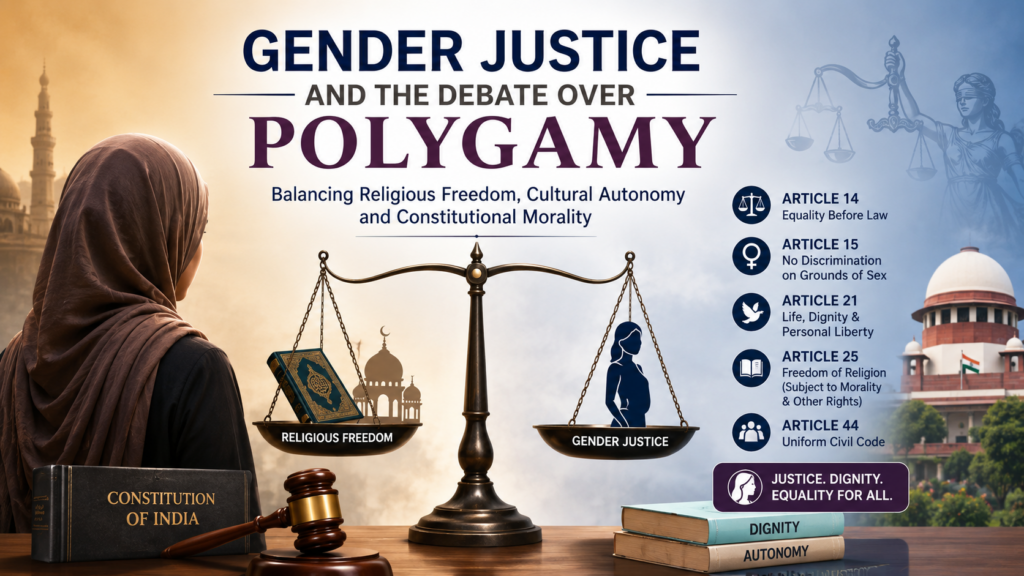
Gender Justice and the Debate over Polygamy
UPSC Syllabus:GS Paper II – Social Justice & Polity: Structure, organisation and functioning of the Executive and Judiciary; Ministries and Departments of the Government; pressure groups and formal/informal associations and their role in polity.
Why in News?
The Supreme Court’s examination of the issue of polygamy has brought renewed attention to the relationship between religious freedom, cultural autonomy and gender justice.
The debate raises an important constitutional question: how can India protect religious and cultural pluralism while ensuring that discriminatory practices do not undermine equality, dignity and individual autonomy?
Constitutional Dimensions
The issue involves a delicate balance between Article 25 and the constitutional guarantees of equality and dignity.
- Article 25: Protects freedom of conscience and religious practice, but subjects it to public order, morality, health and other Fundamental Rights.
- Article 14: Guarantees equality before the law.
- Article 15: Prohibits discrimination, including discrimination on grounds of sex.
- Article 21: Protects dignity, autonomy and personal liberty.
- Article 44: Envisages a Uniform Civil Code and provides a constitutional basis for reform of personal laws.
- Article 51A(e): Calls upon citizens to renounce practices derogatory to the dignity of women.
Why Does Gender Justice Require Scrutiny?
The issue is not merely about the prevalence of polygamy but about its potential impact on substantive equality and women’s dignity.
- Polygamy may create unequal marital bargaining power.
- It can have implications for maintenance, inheritance, emotional security and women’s economic autonomy.
- According to NFHS-5 (2019–21), around 1.4% of currently married women had a husband with another wife or wives.
- Therefore, the issue remains relevant as a question of rights even though the practice is relatively limited.
Judicial Approach
The Supreme Court has addressed related questions concerning marriage, conversion and personal law through several important judgments.
Sarla Mudgal v. Union of India (1995)
The Supreme Court held that conversion to Islam merely to contract another marriage does not dissolve an existing Hindu marriage, thereby preventing misuse of personal law.
Javed v. State of Haryana (2003)
The Court held that polygamy is not an essential religious practice, recognising the State’s power to regulate it.
Shayara Bano v. Union of India (2017)
Although the case concerned triple talaq, the judgment strengthened constitutional scrutiny of personal-law practices affecting women’s dignity and equality.
Important distinction:
The Supreme Court has not declared Muslim polygamy per se unconstitutional. This distinction is crucial when analysing the issue.
Arguments for Reform
Reform of discriminatory practices can:
- Promote gender equality and dignity.
- Prevent exploitation and fraudulent conversion.
- Create clearer rights relating to maintenance, inheritance and children.
Concerns Regarding Reform
However, reform must also account for India’s constitutional commitment to pluralism.
- A blanket prohibition may be perceived as cultural homogenisation.
- Criminalisation alone cannot address women’s economic dependence or lack of legal awareness.
- Reform must avoid replacing one form of inequality with another.
Way Forward
1. Universal marriage registration
Strengthen marriage registration and legal documentation across communities.
2. Common minimum standards of gender justice
Develop minimum standards that protect equality, dignity and women’s rights across communities.
3. Women’s economic empowerment
Strengthen women’s economic independence, legal literacy and access to justice.
4. Institutional support
Schemes such as Mission Shakti, including One Stop Centres, provide integrated support to women facing violence and vulnerability.
5. Gender-just approach to UCC
Any Uniform Civil Code should be gender-just, consultative and constitutionally grounded, rather than majoritarian.
Constitutional Perspective
The appropriate constitutional approach can be described as “reform without cultural erasure.”
Religious freedom deserves constitutional protection, but it cannot override the guarantees of equal citizenship, dignity and autonomy. The challenge for India is therefore to reconcile its pluralistic social structure with a non-negotiable floor of gender justice.
UPSC Relevance
GS Paper II: Social Justice, Fundamental Rights, Judiciary, personal laws, religious freedom, gender equality and Uniform Civil Code.
PYQ Reference – UPSC CSE 2019
“What are the challenges to our cultural practices in the name of secularism?”
Marks: 10
Word Limit: 150 words
SOURCE: The Hindu – Why is the Supreme Court examining polygamy again?
Key Takeaway
Gender justice requires a careful balance between religious freedom, cultural pluralism and constitutional morality. Legal reform should protect women’s equality, dignity and autonomy while remaining consultative, constitutionally grounded and sensitive to India’s pluralistic character.