
SYLLABUS: Indian Economy General Studies – : III Indian Economy and issues relating to planning, mobilization of resources, growth, development and employment.
IN NEWS: Putting people in economics
QUESTION: Explain the concept of sticky prices. How does it affect inflation management?(250 words)
ANSWER: Sticky prices (or price rigidity) refers to a macroeconomic situation where nominal prices of goods and services resist changing rapidly in response to shifts in supply or demand. Even when overall economic conditions warrant a price adjustment—such as during an economic downturn, an unexpected inflation spike, or a change in input costs—prices tend to adapt slowly over time rather than instantaneously.
Causes of Sticky Prices
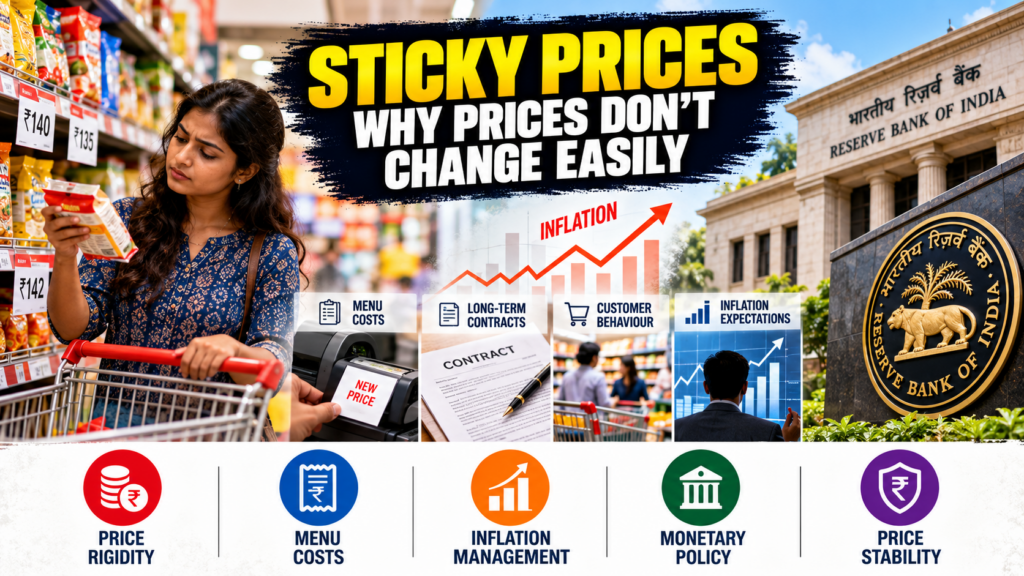
- Menu Costs: The physical or operational costs associated with changing prices, such as updating software, printing new catalogues, changing price tags, or retraining staff.
- Long-Term Contracts: Fixed-term wage agreements, supply contracts, or service agreements lock prices or input costs in place for predetermined periods (e.g., 1–3 years).
- Customer Relations & Imperfect Information: Businesses often avoid frequent price adjustments to prevent customer frustration, brand damage, or loss of market share, preferring price stability over short-term optimization.
- Coordination Failure: Firms in oligopolistic markets may hesitate to lower or raise prices individually, fearing that competitors will not follow suit, leaving their relative market position compromised.
Impact on Inflation Management
1. Transmission Delays in Monetary Policy
When a central bank alters interest rates to curb inflation or boost growth, the effect on real economic output and overall price levels is not immediate. Because prices are sticky, monetary policy operates with variable time lags (often taking 12 to 18 months to fully pass through the economy).
2. Output and Employment Volatility
- An abrupt monetary contraction designed to curb inflation initially reduces aggregate demand and real output before full price adjustments occur.
- This can lead to temporary increases in unemployment and economic slowdowns (a phenomenon illustrated by the Short-Run Phillips Curve).
3. Core vs. Headline Inflation Tracking
- Flexible prices: Fresh agricultural produce, fuel, and commodities fluctuate daily based on market conditions.
- Sticky prices: Manufactured goods, services, education, and health costs change slowly.
Central banks frequently monitor Core Inflation (excluding volatile items like food and energy) or Sticky-Price CPI indices. High inflation among sticky-price goods indicates that inflationary pressures are becoming deeply entrenched, requiring sustained policy action rather than short-term adjustments.
4. Anchoring Inflation Expectations
Because sticky prices mean firms cannot easily reverse price changes without incurring costs, their pricing decisions depend heavily on their long-term expectations of future inflation. If public expectations become unanchored, firms will build higher projected costs into long-term contracts, making high inflation persistent and structurally difficult to bring down.
Policy Implications for Central Banks
- Gradualism vs. Pre-emptive Action: Central banks often take pre-emptive steps to raise interest rates at the earliest signs of demand-pull inflation, aiming to halt sticky-price adjustments before long-term wage and service contracts lock in higher rate hikes.
- Managing the Sacrifice Ratio: Policy planners must balance the trade-off between bringing inflation down to its target rate and minimizing the loss of output and employment caused by price rigidity.
Price stickiness creates a critical gap between short-term economic shocks and long-term market adjustments. Because prices and wages do not adapt instantaneously, changes in monetary policy inevitably impact real economic variables—such as production, employment, and overall demand—before they influence price stability.
|