
|
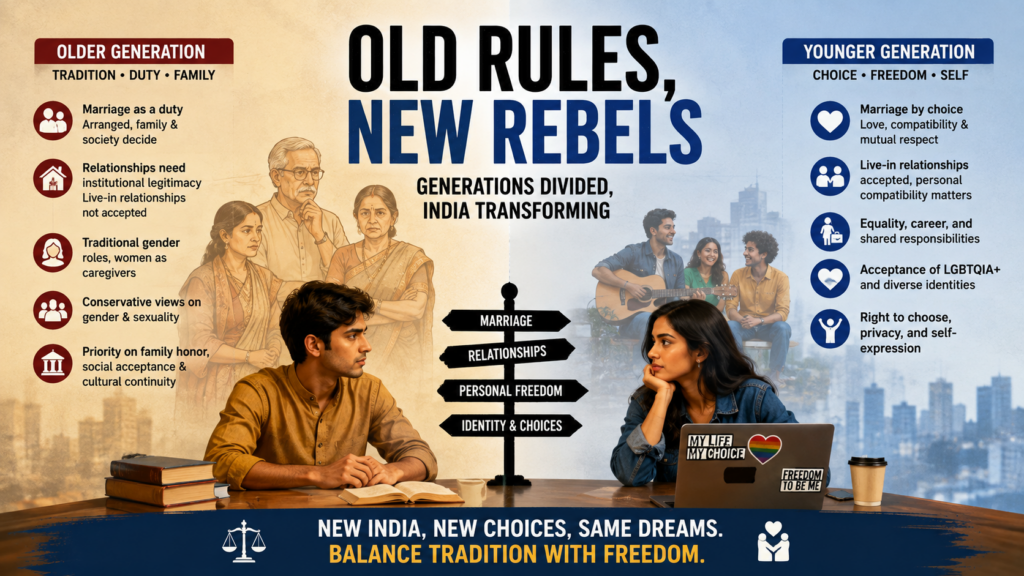
IN NEWS: Old rules,New rebels
QUESTION: Social change in India is increasingly producing a generational divide in attitudes towards marriage, relationships and personal freedom. Discuss.
ANSWER: The accelerated pace of social change in India—driven by urbanization, economic independence, digital connectivity, and higher educational attainment—has created a stark generational divide. This friction is most pronounced in attitudes toward marriage, romantic relationships, and personal freedom, marking a transition from a collectivist family framework toward an individual-centric model of rights and self-expression.
Key Spheres of Generational Divide
- Marriage: Sacred Custom vs. Individual Choice
- Older Generation: Views marriage as a non-negotiable social duty (Samskara), primarily intended to consolidate caste, class, and family alliances through arranged matches. Family approval and social compatibility take precedence over individual romantic compatibility.
- Younger Generation: Views marriage through the lens of personal compatibility, emotional partnership, and individual consent. There is a growing preference for self-chosen (love) marriages, inter-caste unions, delayed marriages, or remaining single altogether.
- Relationships: Living Together vs. Institutional Legitimacy
- Older Generation: Considers cohabitation outside wedlock (live-in relationships) as socially unacceptable and a threat to family honor and moral order.
- Younger Generation: Increasingly embraces live-in relationships as a pragmatic pre-marital step to test emotional and financial compatibility. This shift is supported by landmark judicial rulings (e.g., S. Khushboo v. Kanniammal, 2010 and Badri Prasad v. DY. Director of Consolidation, 1978), which recognized live-in relationships between consenting adults as legally protected under Article 21.
- Personal Freedom and Gender Roles
- Older Generation: Expects women to prioritize domestic responsibilities and adapt to traditional patriarchal family structures, often viewing career pursuits as secondary to household stability.
- Younger Generation: Educated young men and women demand equal division of labor, career mobility, spatial autonomy, and reproductive choice (including child-free choices). Autonomy in dressing, lifestyle choices, and social interactions is defended as a fundamental right rather than a moral compromise.
- Acceptance of Non-Conforming Identities
- Older Generation: Tends to hold traditional views on gender and sexuality, often struggling to accept LGBTQIA+ identities due to deep-seated social taboos.
- Younger Generation: Displays far greater acceptance of diverse sexual orientations and gender identities, heavily influenced by global discourse, digital activism, and the decriminalization of Section 377 (Navtej Singh Johar v. Union of India, 2018).
Sociological Drivers of the Divide
- Economic Independence & Female Labor Participation: Financial autonomy allows young individuals—especially women—to resist unwanted family pressure, exit incompatible relationships, or delay marriage.
- Digital Hyper-Connectivity & Media: Exposure to global values via digital platforms has normalized individual choice, privacy, and self-actualization among Gen Z and Millennials.
- Urbanization and Nuclearization: The transition from joint family networks to nuclear and single-person households in urban centers reduces the daily supervisory control of extended family elders.
- Judicial Affirmation of Constitutional Morality: Supreme Court judgments upholding privacy (K.S. Puttaswamy), bodily autonomy, and freedom of choice in marriage (Lata Singh, Hadiya Case) have provided legal backing to young citizens asserting their rights against familial pressure.
Social Implications and Manifestations
- Increased Intergenerational Friction: Family tension often surfaces over life choices, leading to emotional distress or, in extreme cases, social boycott and extra-judicial intervention by traditional bodies.
- Rising Rates of Marital Dissolution: As young individuals refuse to tolerate toxic marriages or unequal gender dynamics, divorce and legal separation rates in urban India are gradually rising, despite remaining low by global standards.
- The Rise of “Semi-Arranged” Marriages: A hybrid compromise has emerged where parents facilitate initial introductions via matrimonial platforms or social networks, but the final decision rests entirely on the mutual consent and dating period of the individuals.
The generational divide in India is not merely a clash of age groups, but a reflection of a society in structural transition. While the older generation seeks to preserve social cohesion and cultural continuity, the younger generation seeks personal dignity, equality, and self-determination. A balanced resolution relies on fostering intergenerational dialogue that respects core cultural values while upholding the constitutional rights and individual autonomy of young citizens.
|