
SYLLABUS: Governance General Studies – : II Important aspects of governance, transparency and accountability, e-governance- applications, models, successes, limitations, and potential; citizens charters, transparency & accountability and institutional and other measures.
IN NEWS: Rights and wrongs
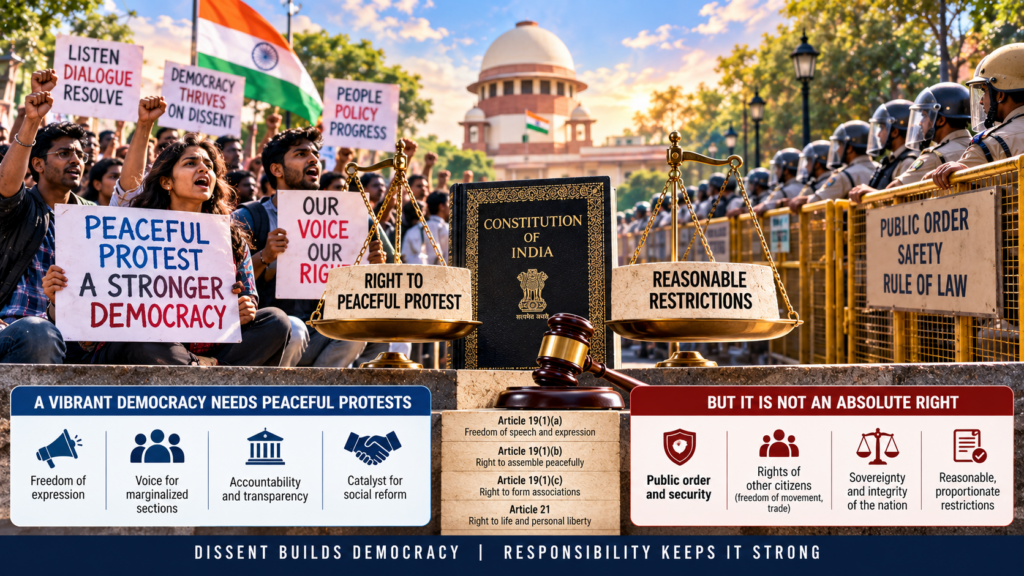
QUESTION: “The right to peaceful protest is an essential component of a vibrant democracy, but it is not an absolute right.” Examine
ANSWER: The right to dissent is the lifeblood of a vibrant constitutional democracy, providing a vital safety valve for public grievances and a platform for marginalized voices. However, absolute rights inherently lead to absolute license, where the rights of one group can infringe upon the fundamental freedoms—such as movement and trade—of the rest of society.
1. Constitutional Foundations of the Right to Protest
In constitutional democracies (such as India), the right to protest is derived from fundamental freedoms guaranteed under Part III of the Constitution:
- Article 19(1)(a) – Freedom of Speech and Expression: Protects citizens’ rights to voice grievances, criticize policy, and convey dissent publicly.
- Article 19(1)(b) – Right to Assemble Peacefully: Explicitly guarantees the right of citizens to assemble peacefully and without arms, forming the bedrock for rallies, demonstrations, and marches.
- Article 19(1)(c) – Right to Form Associations and Unions: Enables citizens, civil society groups, and trade unions to organize collective protest movements.
- Article 21 – Protection of Life and Personal Liberty: Interlinked by judiciary rulings, establishing that the right to peaceful dissent is integral to a dignified human life.
2. Constitutional Grounds for Reasonable Restrictions
No fundamental right in a constitutional democracy is absolute. To prevent public disorder and uphold collective welfare, the Constitution permits the State to impose “reasonable restrictions”:
- Article 19(2) & 19(3) Clauses: Allow restrictions on speech and assembly based on specific legal grounds:
- Sovereignty and Integrity: Actions threatening state sovereignty or inciting secessions.
- Public Order and Security: Measures to prevent rioting, violent clashes, or destruction of public property.
- Morality and Contempt of Court: Preventing hate speech or illegal interference with judicial proceedings.
- Test of Reasonability and Proportionality: Restrictions imposed by statutes (such as section 163 of BNSS / 144 of CrPC) must be proportionate, necessary, non-arbitrary, and subject to judicial review. Total bans are unconstitutional; restrictions must balance rights rather than extinguish them (Mazdoor Kisan Shakti Sangathan v. Union of India).
3. Pillar of Democratic Governance
- Accountability and Transparency: Serves as a vital channel to question state action and check autocratic tendencies between election cycles.
- Voice for Marginalized Sections: Ensures minorities without economic or political leverage can draw national attention to social grievances.
- Democratic Safety Valve: Ventilates public frustration, preventing unlawful radicalization or subterranean social conflict.
- Catalyst for Legal & Social Reform: Historically, key civil liberties, labor protections, and anti-discrimination laws emerged from peaceful public protests.
4. Key Challenges, Conflict, and Judicial Standards
- Conflict of Fundamental Rights: Protests often collide with other citizens’ rights to freedom of movement (Article 19(1)(d)) and trade. In Amit Sahni v. Commissioner of Police (2020), the Supreme Court held that public ways cannot be occupied indefinitely for protests.
- Risk of Arbitrary Executive Action: Overreach by authorities through improper enforcement of prohibitory orders or preventive detentions can suppress legitimate dissent under the pretext of public order.
- Infiltration and Violence: Peaceful assemblies risk being subverted by violent actors, compelling police to intervene while protecting peaceful demonstrators.
The right to peaceful protest and the state’s duty to maintain public order exist in a dynamic, delicate constitutional equilibrium. While peaceful assembly under Article 19(1)(b) is a constitutional rule, restrictions under Article 19(3) must remain strictly justified exceptions. Courts and administration must ensure that reasonable restrictions are never converted into tools of political suppression.
PYQ REFERENCE UPSC 2021 “Analyse the constitutional validity and executive power behind imposing restrictions on public assembly and expression during times of civil unrest, in light of Article 19 of the Indian Constitution.”