
|
IN NEWS: Deep-sea discovery, environmental responsibility
QUESTION: What are polymetallic nodules? Discuss their strategic significance for India and examine the environmental concerns associated with their extraction from the deep seabed. (10 marks, 150 words)
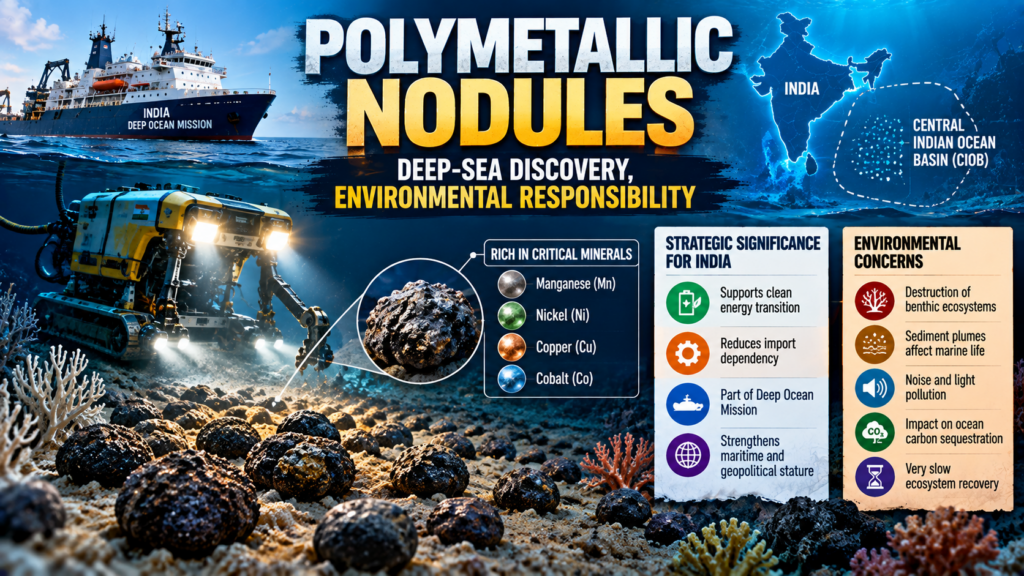
ANSWER: Polymetallic nodules, also known as manganese nodules, are rock-like mineral accretions found scattered across the deep ocean floor, primarily at depths between 4,000 and 6,000 meters. Formed over millions of years through the precipitation of metals from seawater and pore waters around a central nucleus (such as a shell fragment or shark tooth), they are rich sources of valuable critical minerals.
Composition and Critical Minerals
- Manganese: Comprises the largest fraction (~20–30%).
- Iron: Accounts for around 5–10%.
- Nickel, Copper, and Cobalt: Present in smaller percentages (0.5–1.5%), yet economically crucial for modern high-tech and green technologies.
- Trace Metals: Contain trace amounts of molybdenum, titanium, lithium, and rare earth elements (REEs).
Strategic Significance for India
- Energy Transition and Clean Tech: Nickel, cobalt, and copper are essential inputs for electric vehicle (EV) batteries, energy storage systems, and renewable energy infrastructure, directly supporting India’s net-zero transition goals.
- Reducing Import Dependency: India relies heavily on foreign supply chains for key critical minerals (e.g., cobalt and nickel). Deep-sea mining offers long-term resource independence and supply chain resilience.
- Deep Ocean Mission Alignment: Exploration in the Central Indian Ocean Basin (CIOB) forms a cornerstone of India’s flagship Deep Ocean Mission, boosting domestic capabilities in underwater technology, deep-sea mining systems, and submersibles (such as Matsya 6000).
- Geopolitical and Maritime Stature: Being designated a “Pioneer Investor” by the International Seabed Authority (ISA) grants India exclusive rights to explore vast areas in the CIOB, strengthening its maritime presence and leadership in the Indian Ocean region.
Environmental Concerns Associated with Extraction
- Benthic Ecosystem Destruction: Nodules serve as the primary hard substrate for sessile organisms (such as deep-sea sponges and corals). Scraping or vacuuming the seabed permanently destroys these unique abyssal habitats.
- Sediment Plumes: Mining equipment creates large underwater dust plumes that travel vast distances. These suspended sediments smother benthic creatures, clog filtering apparatuses of marine fauna, and disrupt light penetration.
- Noise and Light Pollution: Heavy machinery operating at extreme pressure generates sound and artificial light, disrupting deep-sea organisms that rely on bioluminescence and auditory cues for navigation, mating, and feeding.
- Impact on Ocean Carbon Sequestration: The deep ocean floor acts as a massive carbon sink. Disturbing benthic sediments risks altering microbial communities and disrupting deep-sea biogeochemical cycles critical to global carbon storage.
- Slow Ecosystem Recovery: Abyssal ecosystems operate in near-static conditions with extremely slow metabolic and growth rates. Recovery from physical disruption could take centuries or millennia, if it occurs at all.
Polymetallic nodules present a promising frontier for securing critical minerals vital to global clean energy transitions and national resource security, particularly for India’s strategic deep-sea ambitions. However, the severe and potentially irreversible ecological risks—ranging from benthic habitat destruction to ocean carbon cycle disruption—highlight the urgent need for caution.
|
SOURCE: The Hindu e-paper – Deep-sea discovery, environmental responsibility