
| SYLLABUS: Indian Polity General Studies – : II |
IN NEWS: Courtroom dramas, clipped and shared
QUESTION: “Live-streaming of judicial proceedings represents a shift from a closed courtroom model towards participatory constitutionalism.” Examine
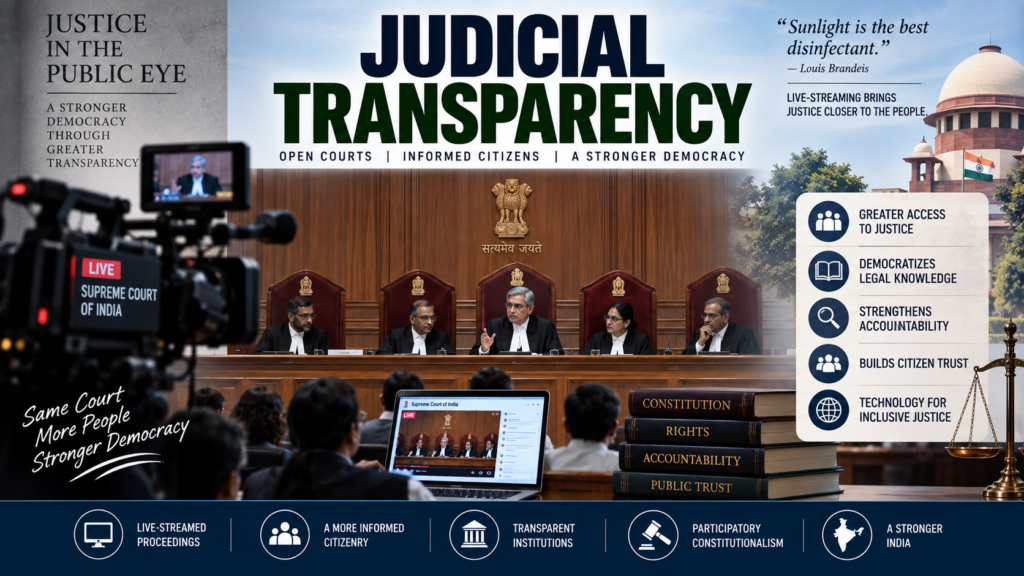
ANSWER: The transition to live-streaming judicial proceedings marks a structural evolution in India’s legal landscape. Historically, the “open court” principle was constrained by physical seating, geographic centralization, and technical legal jargon. By bringing constitutional interpretation into the public domain, live-streaming transforms passive subjects into active civic observers, laying the foundation for participatory constitutionalism.
- Contextual Basis: From Closed Courtrooms to Open Justice
- Judicial Endorsement: In Swapnil Tripathi v. Supreme Court of India (2018), the apex court held that live-streaming is an extension of the “open court” principle and falls under the Right to Access Justice (Article 21) and the Right to Know (Article 19(1)(a)).
- Institutional Adoption: Beginning with High Courts like Gujarat and Karnataka, the Supreme Court institutionalized live-streaming for Constitution Bench matters in 2022, broadcasting crucial discussions on federalism, reservations, and electoral integrity.
- How Live-Streaming Drives Participatory Constitutionalism
- Democratization of Legal Knowledge: Live-streaming strips away institutional opacity, allowing citizens, law students, and researchers direct access to judicial deliberations without relying on secondary media interpretations.
- Fostering Civic Consciousness: Watching constitutional benches deliberate issues like fundamental rights and executive accountability transforms abstract constitutional principles into visible, everyday realities for the electorate.
- Strengthening Institutional Accountability: Direct public scrutiny encourages greater preparation and decorum among advocates while keeping judicial remarks grounded in constitutional norms.
- Realizing “Open Court” in a Digital Age: Physical courtrooms in New Delhi or state capitals present financial and geographical barriers. Digital access decentralizes the courtroom, realizing the true spirit of Article 21 across diverse geographies.
- Structural Risks and Challenges
- Sensationalism and Out-of-Context Clips: Short, uncontextualized video clips tailored for social media algorithms risk turning serious oral observations into clickbait, undermining judicial dignity.
- Risk of Judicial Populism: Public visibility creates a subtle danger where arguments or judicial observations might lean toward public approval rather than strictly adherence to cold legal technicalities.
- Privacy and Protection Concerns: Broadcasting sensitive cases—such as matrimonial disputes, sexual offenses, or national security matters—threatens witness safety and individual privacy rights.
- Digital Divide: Without multi-lingual translation and accessible digital infrastructure in rural areas, participation risks remaining restricted to urban, English-speaking populations.
- Strategic Safeguards & Way Forward
- Strict Adherence to Model Rules: Courts must rigorously implement the Supreme Court’s Model Rules for Live Streaming, incorporating deferred broadcasts (e.g., a 10-minute buffer) to redact sensitive disclosures.
- Clear Exclusion Framework: Matters involving family law, sexual violence, juvenile justice, and national security must remain exempt from live broadcasts to preserve confidentiality.
- Copyright & Misuse Regulation: Establishing strict legal penalties for unauthorized editing, commercialization, or malicious manipulation of official court video feeds.
- Inclusivity Measures: Integrating real-time closed captioning and regional language translations to ensure genuine participatory access for all citizens.
Live-streaming courtroom proceedings bridges the historic gap between citizens and the constitution. When backed by robust privacy safeguards and responsible broadcasting norms, it transforms the judiciary from an elite institution into a transparent, participatory pillar of Indian democracy.
|
SOURCE: The Hindu e-paper – Courtroom dramas, clipped and shared