
|
IN NEWS: The two balance sheets behind every e-waste decision
QUESTION: India’s e-waste challenge is not merely an environmental issue but also a question of economic resilience and national security. Discuss.
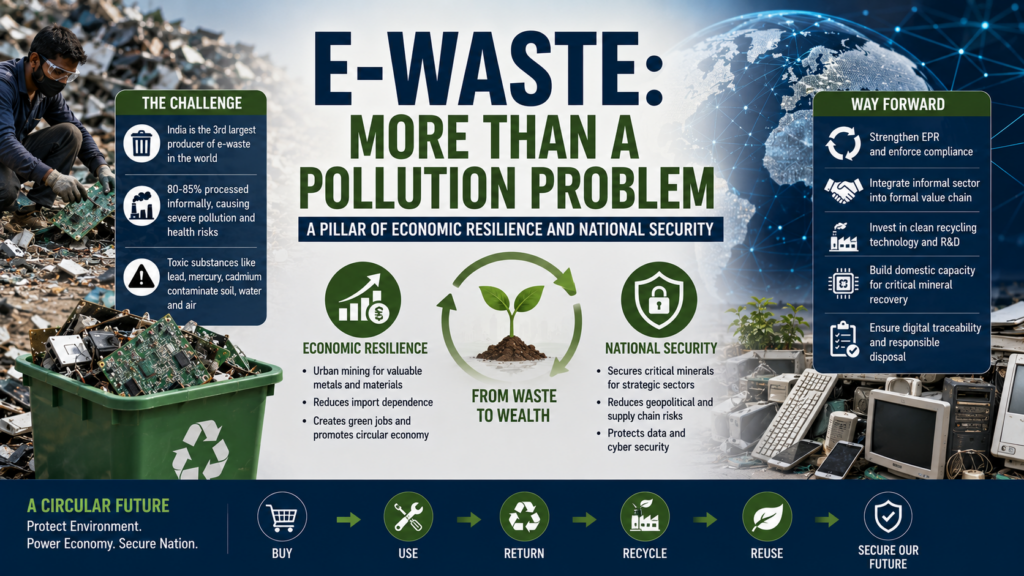
ANSWER: India is currently the third-largest producer of e-waste globally, generating millions of metric tonnes of electronic waste annually. Traditionally viewed as a localized environmental hazard, e-waste has evolved into a strategic nexus involving resource governance, economic resilience, and national security.
1. Environmental Dimension: Beyond the Traditional Lens
- Toxic Pollution & Public Health: Informal recycling releases lead, mercury, cadmium, and polybrominated diphenyl ethers (PBDEs) into topsoil and water bodies (e.g., the Ramganga River near Moradabad), causing severe long-term health risks.
- Informal Dominance: Over 80-85% of India’s e-waste is processed in the informal sector using primitive techniques like acid leaching and open burning, leading to severe eco-toxicity and microplastic contamination.
2. The Economic Resilience Perspective: Urban Mining & Circularity
- Urban Mining & Import Substitution: E-waste contains rich concentrations of precious metals (gold, silver, copper) and key industrial materials. Recovering these reduces reliance on costly raw material imports.
- Unlocking Value & Job Creation: The economic value contained within India’s e-waste stream is estimated in billions of dollars. Formalizing the value chain transitions informal workers into green-collar, organized jobs equipped with safety standards.
- Promoting the Circular Economy: Implementing robust Extended Producer Responsibility (EPR) frameworks forces OEMs to design for repairability, circularity, and long lifecycle operations, driving green manufacturing innovations.
3. The National Security Dimension: Critical Minerals & Supply Chain Defense
- Critical Mineral Security: India is heavily import-reliant on Lithium, Cobalt, Nickel, and Rare Earth Elements (REEs). Printed circuit boards (PCBs) and spent lithium-ion batteries serve as immediate domestic repositories for critical materials needed for clean energy and defense infrastructure.
- Geopolitical De-risking: Single-source dependencies (such as China dominating REE processing or the DRC for raw cobalt) pose severe weaponized supply-chain risks. Domestic recycling creates a secondary supply loop, insulating key strategic sectors from trade embargos or global price volatility.
- Defense & High-Tech Sector Readiness: Defense electronics, radar systems, telecommunications, and electric vehicles require untainted, high-purity strategic metals. Domestic mineral recovery via recycling under initiatives like the National Critical Mineral Mission (NCMM) secures the defense manufacturing base.
- Data & Cyber Security: Improper disposal of military, corporate, or government hardware creates data leaks. Formal e-waste processing mandates verified IT asset disposition (ITAD) and the secure physical destruction of data storage units.
4. Policy & Structural Challenges
- Collection Bottlenecks: The primary barrier is not just extraction technology, but aggregating waste from households and micro-enterprises into formal channels.
- Informal-Formal Asymmetry: Informal aggregators offer immediate cash payments, undercutting formal recyclers burdened by compliance and operational overheads.
- Technology Deficit: India lacks adequate high-end hydrometallurgical and pyrometallurgical facilities required to refine secondary critical minerals to industrial battery/defense-grade purity levels.
Way Forward
- Integrated Policy Synergy: Align the E-Waste Management Rules with the National Critical Mineral Mission (NCMM) so secondary mineral recovery is prioritized alongside primary exploration.
- Formalizing the Informal Sector: Integrate informal collectors (kabadiwalas) into the formal value chain as aggregator links, backed by incentives, protective gear, and digital trade platforms.
- R&D & Infrastructure Subsidies: Support clean extraction capabilities, R&D in urban mining tech (via CSIR/IITs), and deep-tech hydrometallurgical processing plants through targeted production-linked incentives (PLI).
- Enforcing Digital Traceability: Mandate blockchain or QR-code-based inventory tracing across electronic lifecycles to ensure end-of-life devices hit certified recyclers rather than illegal dumpsites.
|
SOURCE: The Hindu e-paper – The two balance sheets behind every e-waste decision