
|
IN NEWS: Can air-cooling handle the heat from a 1-GW data centre?
QUESTION: What are the major cooling technologies available for large data centres? Compare their relative advantages and limitations in terms of energy efficiency, water consumption, scalability and cost.
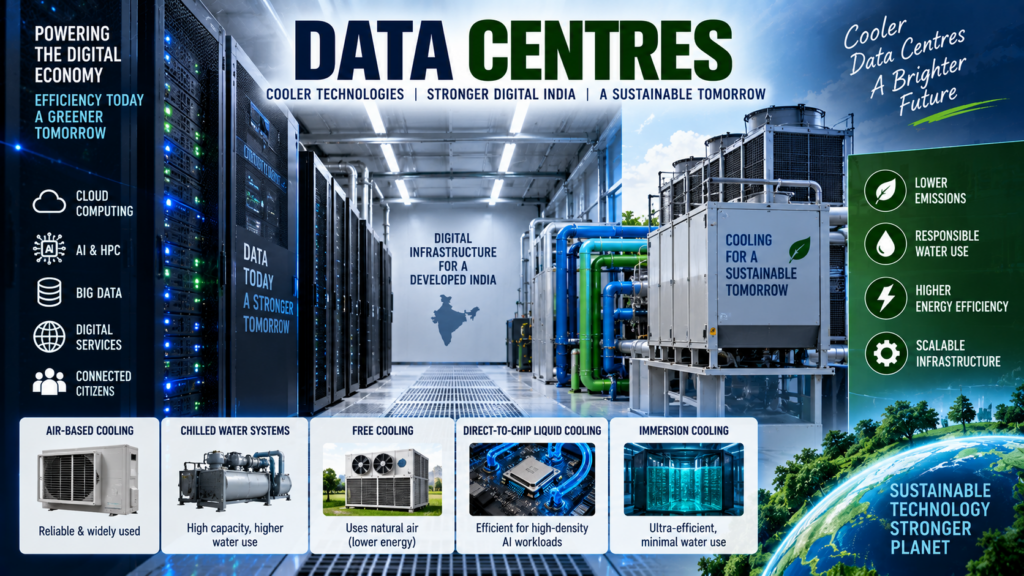
ANSWER: Large data centres rely on a spectrum of cooling solutions to manage thermal loads, ranging from traditional air-based systems to advanced liquid architectures tailored for high-density artificial intelligence (AI) and high-performance computing (HPC) workloads.
Major Cooling Technologies
- Air-Based Cooling (CRAC/CRAH with Containment): Utilizes Computer Room Air Conditioner (CRAC) or Computer Room Air Handler (CRAH) units combined with Hot/Cold Aisle Containment to prevent supply-and-return air mixing.
- Chilled Water & Evaporative Systems: Employs centralized mechanical chillers, cooling towers, and evaporative cooling techniques to reject heat via water circulation and evaporation.
- Free Cooling (Air-Side and Water-Side Economizers): Leverages ambient outdoor air or cold external water sources to cool the facility, bypassing mechanical compressors when weather permits.
- Direct-to-Chip (Cold Plate) Liquid Cooling: Circulates a dielectric or water-based liquid coolant through metal cold plates directly attached to high-heat components (CPUs/GPUs).
- Immersion Cooling (Single-Phase and Two-Phase): Fully submerges entire servers in baths of non-conductive, dielectric fluid, capturing heat directly from all hardware components.
Comparative Evaluation across Key Dimensions
Energy Efficiency (PUE Impact)
- Immersion Cooling: High efficiency; captures heat directly without server fans, enabling Power Usage Effectiveness (PUE) ratings close to 1.02–1.05.
- Direct-to-Chip: High efficiency; targets high-thermal-design-power (TDP) processors, reducing overall fan and compressor power draw.
- Free Cooling: Highly climate-dependent; delivers near-ideal PUE in cold regions by turning off mechanical chillers for long periods.
- Chilled Water & Evaporative: Moderate efficiency; mechanical chillers consume significant energy during peak ambient temperatures.
- Air-Based Systems: Lowest efficiency; struggles with power densities exceeding 15–20 kW per rack, leading to higher fan overhead and lower PUE (1.4–1.6).
Water Consumption (WUE Impact)
- Air-Based & Immersion Cooling: Zero or minimal operational water consumption, operating almost entirely on closed-loop dry circuits.
- Direct-to-Chip & Free Cooling (Air-Side): Low-to-moderate water usage; primarily uses closed-loop secondary fluid networks, though dry-cooler heat rejection requires minimal makeup water.
- Chilled Water & Evaporative Systems: Highest water footprint; relies heavily on evaporative cooling towers, consuming millions of liters daily in large hyperscale facilities.
Scalability and Density Management
- Direct-to-Chip: Highly scalable for modern hybrid facilities; allows targeted retrofitting of high-density AI clusters (60–100+ kW per rack) alongside standard air-cooled racks.
- Air-Based Systems: High scalability for legacy or low-density workloads (under 15 kW per rack), but faces physical thermal limits under extreme AI rack densities.
- Immersion Cooling: Excellent density handling (100+ kW per rack), but difficult to scale incrementally due to specialized tank infrastructure, heavy fluid handling, and strict floor load requirements.
- Free Cooling & Evaporative Systems: Scalability is constrained by regional geography, local climate envelopes, and municipal water availability.
The choice of data centre cooling technology represents a strategic trade-off between thermal capability, operational resource usage, and capital intensity. Traditional air-based and evaporative chilled water systems remain practical for legacy, lower-density workloads, but their high energy overhead and heavy water consumption present mounting sustainability and cost challenges.
|
SOURCE: The Hindu e-paper – Can air-cooling handle the heat from a 1-GW data centre?