
|
IN NEWS: Keeping pace with a succession of climate shock events
QUESTION: Despite facing common climate-induced disasters, South Asian countries exhibit unequal vulnerabilities. Examine the factors responsible and discuss the need for a regional disaster management framework. (15 Marks, 250 Words)
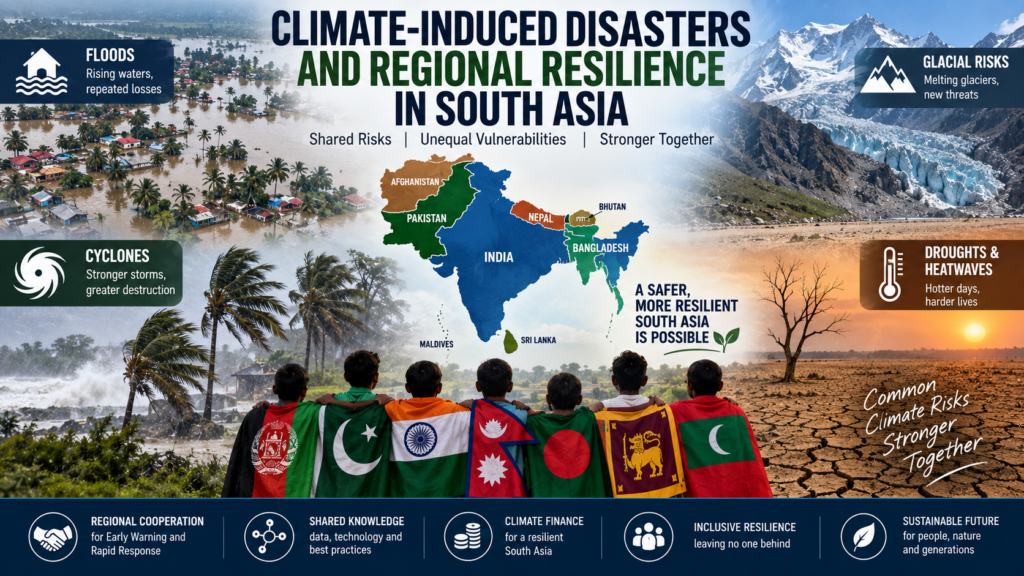
ANSWER: South Asia is one of the world’s most climate-vulnerable regions, facing floods, cyclones, heatwaves, droughts, and glacial lake outburst floods (GLOFs). While these risks are shared, their impacts vary across countries and communities due to unequal vulnerabilities.
Factors Responsible for Differential Vulnerabilities
- Geographical exposure: Bangladesh’s low-lying delta faces cyclones and sea-level rise, while Nepal and Bhutan are vulnerable to Himalayan glacier melt and GLOFs.
- Socio-economic inequalities: Poor households often live in hazard-prone areas and lack resilient housing, insurance, and savings.
- Social exclusion: Women, children, elderly persons, migrants, and marginalized groups have limited access to adaptation measures and disaster information.
- Institutional capacity gaps: India possesses advanced forecasting systems, whereas several neighbouring countries have limited preparedness and response capabilities.
- Urbanisation and infrastructure deficits: Unplanned urban growth increases flood and heatwave risks.
- Climate justice concerns: Communities contributing least to emissions often suffer the greatest impacts, reflecting unequal adaptive capacities.
Need for a Regional Disaster Management Framework
- Transboundary disasters: Floods in the Ganga-Brahmaputra-Meghna basin and cyclones in the Bay of Bengal affect multiple countries simultaneously.
- Regional early warning systems: Real-time sharing of meteorological, glacial, and river-flow data can save lives.
- Coordinated response and relief: Joint stockpiles, search-and-rescue teams, and humanitarian corridors can improve disaster response.
- Knowledge sharing: Bangladesh’s Cyclone Preparedness Programme drastically reduced cyclone deaths, while Ahmedabad’s Heat Action Plan has prevented thousands of heat-related deaths.
- Climate finance and risk pooling: Regional mechanisms can mobilise adaptation finance and disaster insurance.
- Collective resilience-building: Shared river-basin management and ecosystem restoration can reduce future risks.
Existing Institutional Frameworks
- SAARC Disaster Management Centre (SDMC)
- Bay of Bengal Initiative for Multi-Sectoral Technical and Economic Cooperation Disaster Management Exercise (DMEx)
- Coalition for Disaster Resilient Infrastructure (CDRI)
- Sendai Framework for Disaster Risk Reduction (2015–2030)
Measures
- Establish a South Asian Climate Risk Observatory.
- Create a regional disaster response force and humanitarian assistance mechanism.
- Develop integrated Himalayan glacier monitoring and Bay of Bengal cyclone warning systems.
- Strengthen climate-resilient infrastructure through CDRI-led cooperation.
Conclusion
Since climate hazards are increasingly transboundary, disaster resilience in South Asia cannot be pursued in isolation. A cooperative regional framework combining early warning, finance, technology, and coordinated response is essential for transforming shared risks into shared resilience.
|
SOURCE: The Hindu e-paper – Keeping pace with a succession of climate shock events