
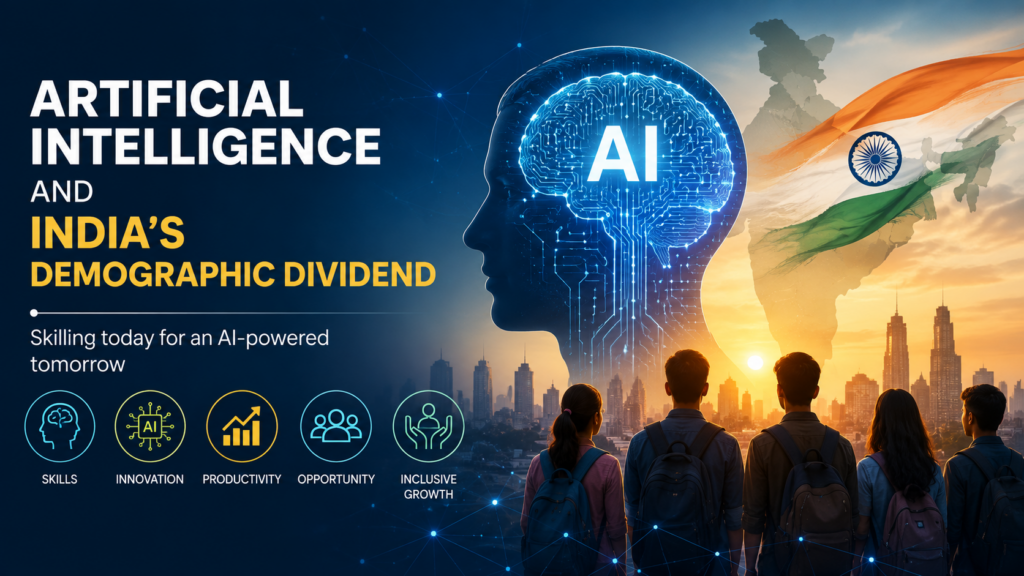
Syllabus: GS Paper II – Governance: Issues relating to development and management of Social Sector/Services relating to Health, Education and Human Resources.
In News
The growing adoption of Artificial Intelligence (AI) is transforming the nature of employment, skill requirements and workplace structures. Rather than simply eliminating jobs, AI is increasingly changing the tasks performed by workers and the skills required to remain employable.
AI and the Changing Nature of Employment
Artificial Intelligence is increasingly automating routine cognitive tasks such as basic coding, data entry and customer support. This is shifting human workers towards non-routine tasks requiring:
- Analytical and critical thinking
- Domain expertise
- Emotional intelligence
- Problem-solving abilities
- AI oversight and data interpretation
The emergence of human-AI collaboration or “augmented work” is also creating demand for skills such as prompt engineering, AI supervision and data analysis.
At the same time, technical literacy alone may not be sufficient. Skills related to cybersecurity, algorithmic auditing and human-centric design are becoming increasingly important.
Implications for India’s Demographic Dividend
India’s young population provides a major opportunity for economic growth. However, rapid AI adoption presents both challenges and opportunities.
Challenges
1. Shrinking Entry-Level Employment
AI can automate several junior-level roles in sectors such as IT-BPO, entry-level coding and back-office administration. This could narrow the traditional entry-level pathway for fresh graduates.
2. Employability Gap
A significant gap between academic education and industry-ready skills could result in underemployment if workers are unable to adapt to AI-driven workplaces.
3. Vulnerability of the Informal Sector
A large informal workforce with limited digital literacy may face increasing vulnerability as AI-enabled automation expands across logistics, retail and manufacturing.
4. Gender and Urban-Rural Divide
Women employed in routine administrative roles and young people in rural areas with limited access to digital infrastructure may face greater risks of technological exclusion.
Opportunities
Global Digital Talent Hub:
With appropriate upskilling, India’s large youth workforce can meet global demand for AI development, data annotation and machine-learning operations.
Leapfrogging Development:
AI can improve productivity in sectors such as:
- Agriculture: Precision farming
- Healthcare: AI-assisted diagnostics
- Education: Hyper-personalized learning
Way Forward
1. Curriculum Overhaul:
Higher education should be aligned with Industry 4.0, with greater emphasis on critical thinking and computational logic under the framework of NEP 2020.
2. Institutionalised Upskilling:
Initiatives such as FutureSkills PRIME and Mission Karmayogi can be scaled up to reskill workers in AI-related domains.
3. Promote Labour-Augmenting AI:
Policy should focus on AI as a complement to labour rather than merely as a replacement for labour, particularly in labour-intensive sectors.
UPSC Perspective
The central challenge for India is not simply whether AI will replace jobs, but whether the Indian workforce can transition from routine tasks to higher-value, AI-complementary roles.
Key Takeaway:
AI can either strengthen India’s demographic dividend or turn it into a demographic challenge. The outcome will depend largely on the country’s ability to invest in education, digital infrastructure, reskilling and human-AI collaboration.