
|
IN NEWS: Can an accused be denied a copy of the FIR?
QUESTION: Examine the legal position regarding an accused person’s right to obtain a copy of the FIR during investigation. How have judicial pronouncements supplemented the statutory framework?(250 words, 150 marks)
ANSWER: The right of an accused person to obtain a copy of the First Information Report (FIR) during an ongoing investigation touches upon the fundamental balance between fair procedure under Article 21 of the Constitution and the state’s legitimate interest in conducting an unhindered criminal investigation.
Statutory Framework Governing Access to the FIR
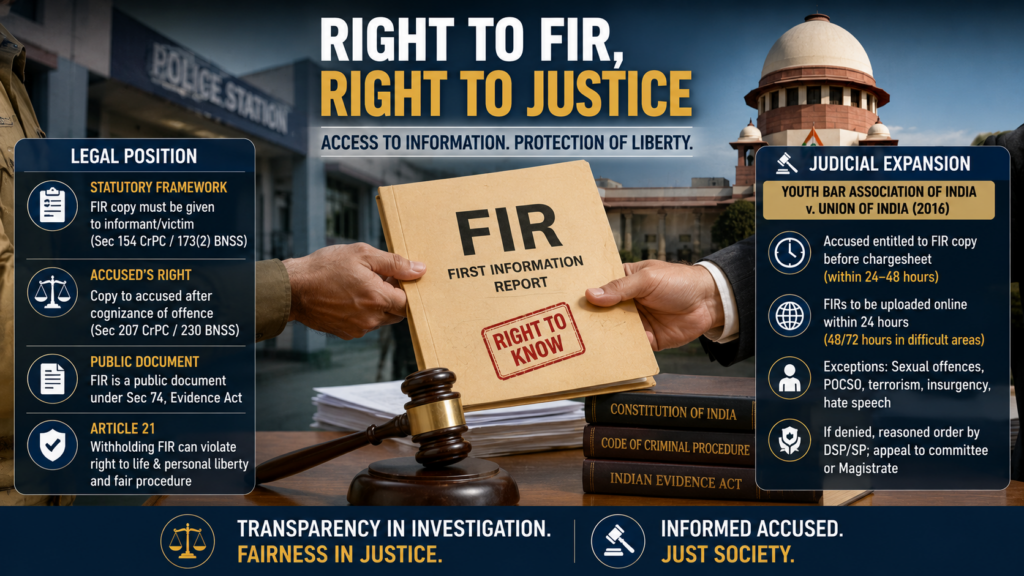
Under the statutory scheme of the Code of Criminal Procedure, 1973 (CrPC) — as mirrored in the Bharatiya Nagarik Suraksha Sanhita, 2023 (BNSS) — the provision of an FIR copy to an accused is explicitly delayed until the investigation culminates.
- Free Copy to the Informant/Victim: Section 154(2) CrPC (Section 173(2) BNSS) mandates that a copy of the FIR be provided immediately and free of cost to the informant or victim upon registration. The statutory scheme does not contain an equivalent express obligation for the police to supply a copy to the accused at the time of FIR registration.
- Supply of Documents upon Cognizance: The explicit statutory right of the accused to receive a copy of the FIR arises only after the investigation is completed and the magistrate takes cognizance under Section 207 CrPC (Section 230 BNSS). Under this section, the magistrate must supply the police report, the FIR, witness statements, and other reliance documents to the accused free of cost.
- Public Document Status: Section 74 of the Indian Evidence Act, 1872 (Section 74 of the Bharatiya Sakshya Adhiniyam, 2023) classifies an FIR as a “public document” recorded by a public officer. While Section 76 of the Evidence Act entitles any person having an interest in a public document to inspect or apply for a certified copy, police authorities historically resisted pre-chargesheet disclosures to prevent tampering or absconding.
Judicial Interventions and Expansion of Rights
Recognizing that delayed access to the FIR prejudiced the accused’s right to seek pre-arrest relief (anticipatory bail under Section 438 CrPC / Section 482 BNSS) or challenge illegal detention, the higher judiciary systematically expanded pre-chargesheet access to the FIR.
- Classification as a Public Document: In early landmark cases, including State of Uttar Pradesh v. Raj Narain (1975) and various High Court decisions, courts established that an FIR is a public document. Consequently, an accused, being a person affected by the allegations, possesses a legal right to inspect and obtain a certified copy before the trial commences.
- Protection of Personal Liberty (Article 21): High Courts consistently ruled that withholding the FIR from an accused while threatening or effecting arrest violates the fundamental right to life and personal liberty guaranteed under Article 21. An accused cannot effectively exercise the right to legal counsel under Article 22(1) or approach a court for anticipatory bail without knowing the precise allegations recorded in the FIR.
Landmark Mandate: Youth Bar Association of India v. Union of India (2016)
The Supreme Court of India formalized and standardized the accused’s right to obtain a copy of the FIR during the investigative stage through its landmark judgment in Youth Bar Association of India v. Union of India (2016). The Court issued comprehensive directives binding on all States and Union Territories:
- Pre-Chargesheet Right to Obtain Copies: The Court ruled that an accused is entitled to obtain a copy of the FIR at an earlier stage than prescribed under Section 207 CrPC. Upon an application by the accused or their representative, along with the prescribed fee, police authorities or the competent magistrate must supply a certified copy within 24 to 48 hours.
- Mandatory Online Uploading of FIRs: The Supreme Court directed that copies of all registered FIRs must be uploaded on the official police or state government websites within 24 hours of registration. In regions with difficult geographical terrain or connectivity constraints, this timeframe can be extended up to 48 or 72 hours.
- Exceptions for Sensitive Offences: To protect victims and preserve sensitive investigations, the directive exempts certain categories of FIRs from public uploading. These include cases involving sexual offences, offences under the Protection of Children from Sexual Offences (POCSO) Act, terrorism, insurgency, and hate speech.
- Procedure for Denial and Redressal: If the police decide not to upload or provide an FIR copy owing to the sensitive nature of the case, such a decision cannot be taken by an investigating officer arbitrarily; it requires a reasoned decision from an officer not below the rank of Deputy Superintendent of Police (DSP) or Superintendent of Police (SP). An aggrieved person denied a copy can approach a dedicated committee of senior police officers or file an application before the jurisdictional Magistrate, who must adjudicate the request expeditiously.
Constitutional Impact and Practical Realignment
Judicial pronouncements transformed the statutory framework from a delayed-disclosure model into a regime of proactive transparency.
By unlinking access to the FIR from the filing of the chargesheet, the judiciary established that access to basic criminal allegations is a prerequisite for a fair procedure. This judicial evolution ensures that an accused can exercise constitutional remedies—such as seeking quashing of the FIR under Section 482 CrPC (Section 528 BNSS) or applying for interim protection—without waiting for the completion of the police investigation.
|
SOURCE: The Hindu e-paper – Can an accused be denied a copy of the FIR?