
|
IN NEWS: Many layers
QUESTION: How can India strengthen its agricultural supply-chain infrastructure to simultaneously protect farmers from price crashes and consumers from excessive food inflation?
ANSWER: The paradox of Indian agriculture lies in the recurring dual crisis of farm-gate price crashes during harvest gluts and sharp retail food inflation during lean seasons. This phenomenon—most visible in perishable commodities like Tomato, Onion, and Potato (TOP)—is primarily driven by structural bottlenecks in supply-chain infrastructure, severe post-harvest losses, asymmetric market information, and excessive reliance on intermediaries.
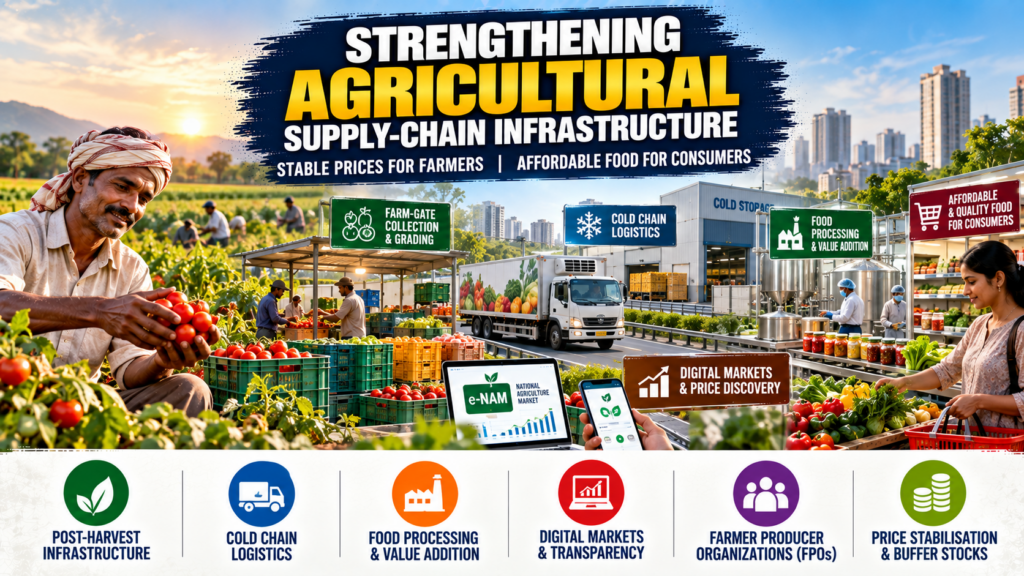
Strengthening India’s agricultural supply-chain infrastructure requires transitioning from a production-centric model to a market-driven value-chain approach, balancing producer realization with consumer affordability.
Key Interventions to Strengthen Supply-Chain Infrastructure
- Decentralized Farm-Gate Post-Harvest Infrastructure
- Primary Processing at Source: Establish integrated primary processing centers (sorting, grading, washing, and packaging) at the village/block level through Farmer Producer Organizations (FPOs) and Village Level Entrepreneurs.
- Distributed Cold-Chain Networks: Shift from large, centralized cold storages concentrated in select regions to a hub-and-spoke model of micro-cold storages, pre-cooling units, and solar-powered cold rooms near farm gates. This reduces the 15–30% post-harvest loss in perishables and prevents immediate post-harvest distress sales.
- Modernizing Logistics and Multimodal Transit
- Cold-Chain Logistics Gap: Expand reefer (refrigerated) transport and integrated cold-chain corridors to connect production clusters directly to major urban consumption centers.
- Scale Up Targeted Transport Initiatives: Expand dedicated freight services like Kisan Rail and Krishi Udaan for rapid, low-cost long-distance transit of perishable produce from surplus regions (e.g., North-East or Central India) to deficit urban hubs.
- Enhancing Processing and Value-Addition Capacity
- Primary and Secondary Processing: Expand processing capabilities under initiatives like the PM Kisan SAMPADA Yojana and PM Formalisation of Micro Food Processing Enterprises (PMFME). Transforming raw seasonal surpluses into shelf-stable goods (e.g., tomato paste, dehydrated onions, milk powder) creates a structural floor for farm-gate prices and absorbs seasonal gluts.
- Market Integration, Transparency, and Digital Infra
- Pan-India Digital Marketplaces: Strengthen National Agriculture Market (e-NAM) integration with physical mandis to enable national-level transparent price discovery and dismantle localized cartelization.
- Negotiable Warehouse Receipts (NWRs): Expand scientific warehousing accredited by the Warehousing Development and Regulatory Authority (WDRA). Electronic NWRs allow farmers to pledge stored produce to access formal credit, enabling them to hold stock during post-harvest price crashes and sell when market conditions improve.
- Strengthening Institutional and Aggregation Models
- FPOs and Cooperatives as Supply-Chain Anchors: Empower FPOs to aggregate smallholder produce, negotiate directly with bulk buyers, retailers, and food processors, and eliminate unnecessary intermediary layers that drive up retail prices while depressing farm-gate realization.
- Direct Farmer-to-Consumer Connectivity: Promote alternative marketing channels, direct-to-consumer (D2C) agri-tech platforms, and specialized farmers’ markets to shorten the supply chain.
- Dynamic Price Stabilization and Infrastructure Governance
- Targeted Buffer Stock Infrastructure: Leverage the Price Stabilization Fund (PSF) to build strategic reserves of key perishables (pulses, onions, potatoes) directly from farm gates during peak production and release them during lean periods to curb retail spikes.
- Real-Time Supply Intelligence: Deploy digital supply-chain tracking, satellite crop mapping, and predictive AI analytics to anticipate localized production shortfalls or gluts early, enabling timely market intervention.
Way Forward
- Capitalize Agriculture Infrastructure Fund (AIF): Accelerate credit flow from the ₹1 lakh crore AIF toward community farm assets, FPO-led packhouses, and last-mile cold-chain links.
- Promote Public-Private Partnerships (PPP): Encourage private investment in modern agri-logistics, specialized reefer fleets, and smart warehousing through long-term concession models and viability gap funding.
- Harmonize Agri-Marketing Policies: Encourage states to reform local APMC Acts to facilitate direct buying, contract farming, and seamless interstate movement of agricultural commodities without discretionary stock-limit disruptions.
- Energy-Resilient Cold Chains: Integrate decentralized solar powered cold-storage solutions across rural feeder lines to drastically lower operational costs and keep cold storage affordable for smallholders.
|
SOURCE: The Hindu e-paper – Many layers