
|
IN NEWS: Coming of age
QUESTION: Distinguish between cryptocurrencies and stablecoins. What regulatory challenges arise from their differing risk profiles?(250 words)
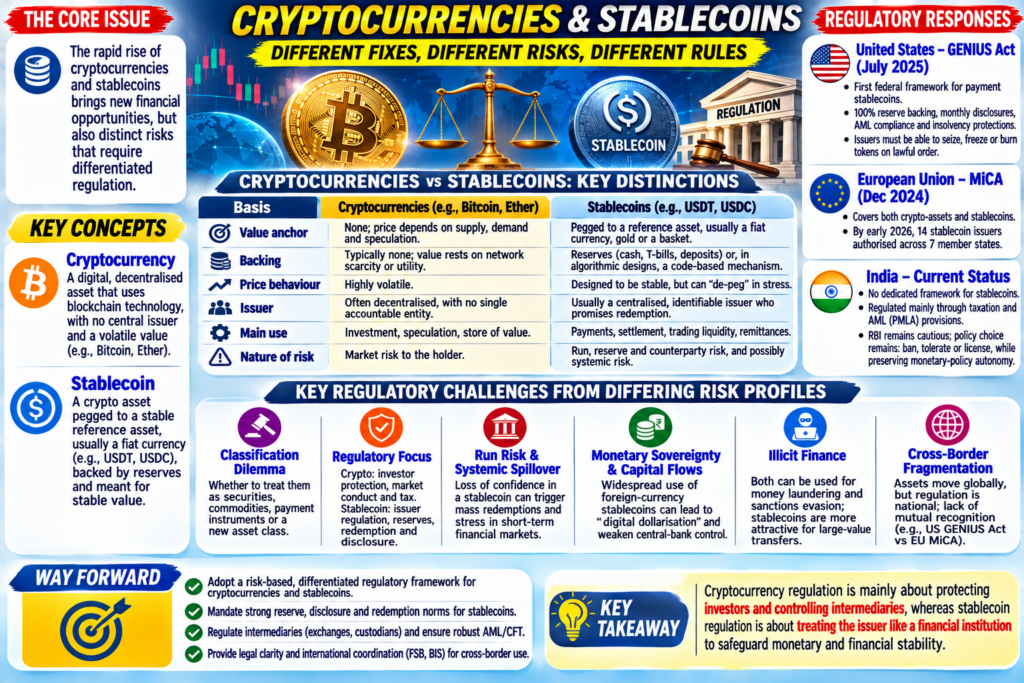
ANSWER: Cryptocurrencies are built on the scarcity of a decentralised asset and carry market risk. Stablecoins are built on a promise of redemption and carry the run risk of a money-like claim. That difference sets the regulatory problem for each.
| Basis | Cryptocurrencies (e.g., Bitcoin, Ether) | Stablecoins (e.g., USDT, USDC) |
| Value anchor | None; price comes from supply, demand and speculation | Pegged to a reference asset, usually a fiat currency, gold or a basket |
| Backing | Typically none; value rests on network scarcity or utility | Reserves (cash, T-bills, deposits) or, in algorithmic designs, a code-based mechanism |
| Price behaviour | Highly volatile | Designed to be stable, but they can “de-peg” |
| Issuer | Often decentralised, with no one to hold accountable | Usually a centralised, identifiable issuer who promises redemption |
| Main use | Investment, speculation, store of value | Payments, settlement, trading liquidity, remittances |
| Nature of risk | Market risk to the holder | Run, reserve and counterparty risk, and possibly systemic risk |
Regulatory challenges from the differing risk profiles
- Classification. The first problem is which legal category each asset falls into. A volatile token with no issuer sits awkwardly among securities, commodities and currencies. A stablecoin looks like a payment instrument, a money-market fund or a bank deposit, depending on its reserves and its redemption promise. Regulators in different countries have chosen different answers, which leads to overlapping or conflicting jurisdiction.
- Different regulatory targets. For cryptocurrencies the focus is investor protection, market manipulation, exchange conduct and tax. Because there is often no issuer, regulators must regulate intermediaries such as exchanges and custodians, not the asset itself. For stablecoins, regulators can regulate the issuer and focus on reserve quality, redemption rights, disclosure and insolvency treatment.
- Run risk and systemic spillover. A stablecoin that loses confidence can trigger a rush to redeem. If the issuer has to sell reserve assets such as government securities quickly, the stress can spread to short-term funding markets. Cryptocurrency price crashes mostly hurt investors, though large leveraged exposures can spread losses.
- Monetary sovereignty and capital flows. Widely used stablecoins linked to a foreign currency can substitute for the domestic currency, a form of “digital dollarisation”. They can weaken central-bank control over money supply and make capital controls harder to enforce. This worry is sharper for emerging economies such as India, and it is part of the case for central bank digital currencies like the e-rupee.
- Illicit finance. Both asset classes can be used for money laundering and sanctions evasion. Stablecoins are more attractive for large-value transfers because they hold their value. Their issuers can, however, freeze or block tokens, which creates a point of control that purely decentralised cryptocurrencies lack.
- Cross-border fragmentation. These assets move across borders instantly, while regulation is national. There is no mutual-recognition or equivalence agreement between the US GENIUS Act and the EU’s MiCA, so a stablecoin authorised in one has no standing in the other. That leaves issuers facing parallel compliance regimes.
How regimes are responding
- United States: The GENIUS Act, signed in July 2025, is the first major federal framework for payment stablecoins. It applies only to payment stablecoins and does not regulate unbacked cryptocurrencies. It mandates 100% reserve backing, monthly disclosures, AML compliance and insolvency protections for holders. Issuers must also be able to seize, freeze or burn tokens on lawful order.
- European Union: MiCA entered into force on 30 December 2024 and covers both crypto-assets and stablecoins. By early 2026, 14 stablecoin issuers held MiCA authorisation across 7 member states.
- Common features: Both frameworks restrict issuers from paying interest directly to holders, but exchanges may still offer rewards or promotions tied to stablecoin holdings. This gap shows how hard it is to keep an instrument from becoming a de facto savings product.
- India: India has no dedicated framework for stablecoins. Existing laws such as the Prevention of Money Laundering Act address only parts of the risk spectrum, and crypto-assets are currently handled mainly through taxation and AML rules. The RBI has traditionally been sceptical, and the policy question is whether to ban, tolerate or license stablecoins while preserving monetary-policy autonomy.
Cryptocurrency regulation is mainly about protecting investors and controlling intermediaries. Stablecoin regulation is mainly about treating the issuer like a financial institution, with reserves, redemption and supervision, and about protecting monetary and financial stability. An effective approach would be proportionate and risk-based, with international coordination (the FSB and BIS are active here), and with clear treatment of foreign issuers.
|
SOURCE: The Hindu epaper – Coming of age