
|
IN NEWS: How AI training models could compromise privacy
QUESTION: “The emergence of AI-driven profiling and the extraction of personal information from anonymised datasets pose new challenges to the constitutional Right to Privacy.” Discuss.(250 words)
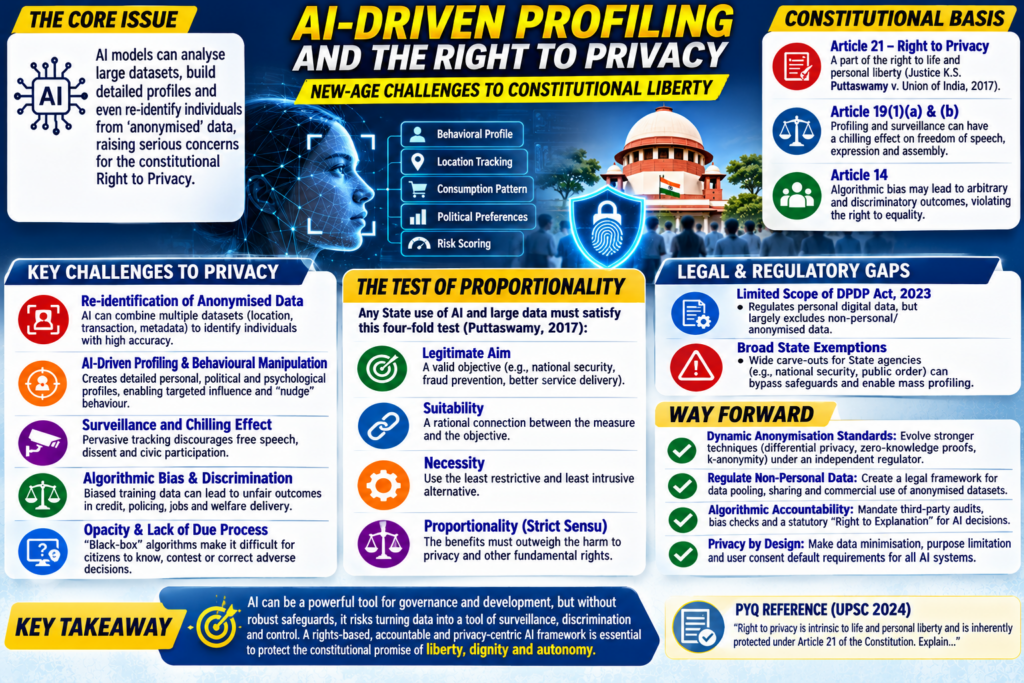
ANSWER: In Justice K.S. Puttaswamy v. Union of India (2017), the Supreme Court declared the Right to Privacy an intrinsic part of Life and Personal Liberty under Article 21. However, the advent of Artificial Intelligence (AI) and advanced big-data analytics has fundamentally challenged traditional privacy paradigms, shifting the threat from simple raw data collection to algorithmic profiling and re-identification of anonymised datasets.
Key Challenges to the Constitutional Right to Privacy
1. Fallacy of Anonymisation & Threat to Informational Autonomy
- Re-identification Attacks: Modern AI models can cross-reference multiple non-personal or anonymised datasets (e.g., aggregate financial transactions, metadata, location logs) to re-identify individuals with high statistical certainty.
- Erosion of Purpose Limitation: Data collected for benevolent public utilities (e.g., urban planning, health metrics) can be reverse-engineered by AI algorithms, violating the core constitutional mandate of “informational self-determination.”
2. AI-Driven Profiling & Behavioural Manipulation
- Surveillance State and Commercial Profiling: AI algorithms process consumer habits, political opinions, and digital footprints to create deep psychological profiles. This leads to targeted nudge economics and political micro-targeting, infringing on individual choice and autonomy.
- Chilling Effect on Fundamental Freedoms: Omnipresent automated tracking creates a “chilling effect” on citizens’ Right to Freedom of Speech and Expression (Article 19(1)(a)) and Assembly (Article 19(1)(b)) due to the fear of continuous background surveillance.
3. Algorithmic Bias and Violation of Equality (Article 14)
- Discriminatory Outcomes: Profiling based on historical, non-sanitised training data can automate societal biases against specific communities in credit scoring, predictive policing, job recruitment, and welfare delivery.
- Opacity and Lack of Due Process: The “black box” nature of proprietary AI algorithms makes it nearly impossible for affected citizens to challenge automated decisions, undermining administrative fairness and due process under Article 21.
Constitutional & Statutory Assessment: Test of Proportionality
- Legitimate State Aim: Promoting national security, preventing fraud, or efficient welfare delivery using big data.
- Suitability: The technological measure must have a rational connection to the stated goal without indiscriminate data extraction.
- Necessity: The least restrictive tool must be deployed; non-personal datasets should not be processed if identical outcomes can be achieved without granular profiling.
- Proportionality Strict Sensu: Preventing systemic harm (e.g., mass automated surveillance) must outweigh the administrative utility derived.
Structural Gaps in Existing Legal Frameworks
- Exclusion of Non-Personal Data: Frameworks like the Digital Personal Data Protection (DPDP) Act primarily regulate personal digital data, leaving a legal void around commercial exploitation and re-identification of anonymised/non-personal datasets.
- Broad State Exemptions: Sweeping exceptions for state agencies under national security clauses risk bypassing statutory oversight for AI-led mass profiling tools.
Way Forward
- Dynamic Anonymisation Standards: Establish evolving technical benchmarks (such as differential privacy, zero-knowledge proofs, and k-anonymity) governed by an independent regulatory body to make dataset re-identification mathematically infeasible.
- Regulation of Non-Personal Data: Enact robust legal safeguards governing non-personal and anonymised data governance to control raw data pooling and algorithmic exploitation.
- Algorithmic Accountability & Right to Explanation: Mandate third-party algorithmic audits for high-risk AI deployments to eliminate bias and ensure citizens have a statutory “Right to Explanation” when profiling impacts their rights.
- Privacy by Design: Enforce structural obligations on tech developers and data fiduciaries to build technical architecture where privacy protection and data minimization are default settings.
|
SOURCE: The Hindu epaper – How AI training models could compromise privacy