
SYLLABUS: Indian Economy General Studies – : III Indian Economy and issues relating to planning, mobilization of resources, growth, development and employment.
IN NEWS: Why have Central banks around the world began hiking rates?
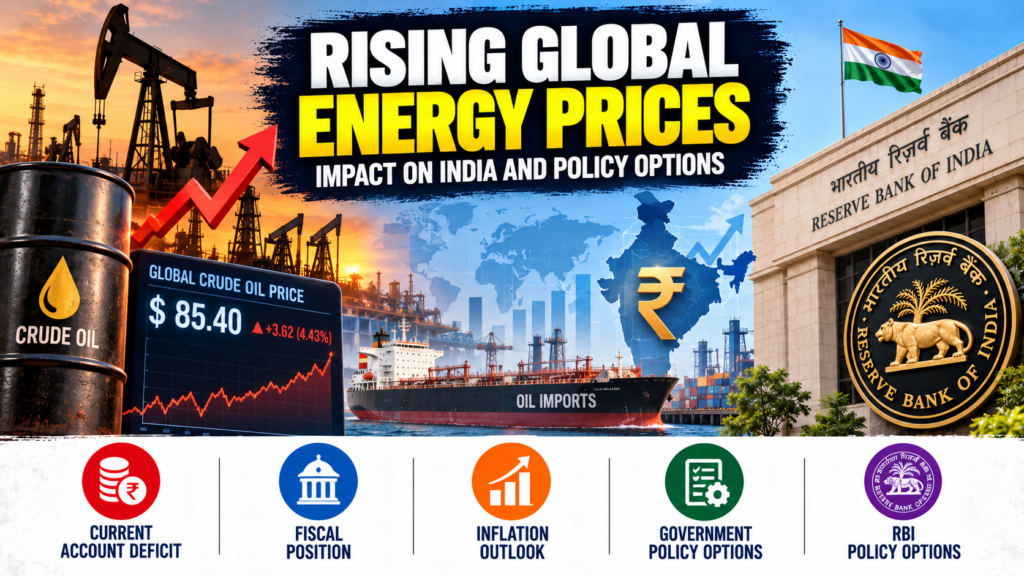
QUESTION: How can sustained increases in global energy prices affect India’s current account deficit, fiscal position and inflation outlook? Discuss the policy options available to the government and the RBI. (250 words)
ANSWER: As India imports roughly 85% of its crude oil requirements and depends significantly on imported natural gas and coal, sustained shocks in global energy prices act as a major macroeconomic disturbance.
1. Impact on Macroeconomic Indicators
- Current Account Deficit (CAD)
- Trade Deficit Expansion: Oil and natural gas constitute the largest share of India’s import bill. Rule-of-thumb estimates indicate that every $10 per barrel sustained increase in global crude oil prices widens India’s CAD by approximately 0.35% to 0.5% of GDP.
- Terms of Trade Deterioration: India must export a larger volume of domestic goods and services to pay for the same volume of energy imports, resulting in a net loss of national real income.
- Currency Depreciation Pressure: Higher dollar demand from public state oil marketing companies (OMCs) weakens the INR against the USD. Rupee depreciation creates a feedback loop that further raises the local currency cost of imported commodities.
B. Fiscal Position
- Elevated Subsidy Burden: Elevated energy costs raise government expenditure on key farm inputs, especially fertilizer subsidies (as natural gas is the primary feedstock for urea manufacturing) and LPG subsidies targeted at vulnerable households.
- Excise Tax Revenue Sacrifices: To cushion domestic consumers and prevent inflation, the central and state governments often cut excise duties and Value Added Tax (VAT) on petrol and diesel. This directly reduces capital allocation for infrastructure projects and risks revenue deficit slippage.
- Under-Recoveries by State Energy Entities: If state-owned Oil Marketing Companies (OMCs) or state power utilities absorb rising crude or coal prices without passing them on to end consumers, their financial health deteriorates, potentially requiring fiscal support or equity injections from the government.
C. Inflation Outlook
- Direct Cost-Push Channel: Higher prices for petrol, diesel, CNG, and electricity directly increase the fuel and light component of the Consumer Price Index (CPI).
- Indirect Freight & Input Channel: Freight transport costs rise across manufacturing and agriculture, driving up food, industrial product, and services pricing. Studies suggest that a 10% sustained increase in crude prices raises headline CPI inflation by roughly 20–30 basis points.
- De-anchoring Inflation Expectations: Second-round effects occur as persistent energy price hikes force businesses and workers to build higher expected costs into wage demands and service contracts, making core inflation sticky.
2. Policy Options Available to the Government
- Fiscal Policy Calibration (Duty Adjustments):
- Execute targeted cuts in excise duties and state-level VAT on transport fuels to absorb price spikes and protect vulnerable income groups, while balancing revenue targets.
- Temporarily adjust duty structures on strategic industrial energy imports to limit price spikes in manufacturing supply chains.
- Diversification of Import Basket & Hedging:
- Diversify energy import geography through long-term bilateral contracts and preferential price agreements.
- Facilitate trade settlement mechanisms using local currencies (e.g., INR-Dirham trade) to reduce foreign exchange pressures and insulate domestic foreign exchange reserves.
- Strategic Petroleum Reserves (SPR) Utilization:
- Release crude oil from Strategic Petroleum Reserves to smooth out short-term market volatility and alleviate supply bottlenecks.
- Accelerated Structural Transition:
- Deepen structural investments in renewable energy, green hydrogen, and electric mobility to reduce long-run structural energy dependency on foreign imports.
- Increase mandatory biofuel blending targets (e.g., E20 ethanol blending) to curb physical crude oil import requirements.
3. Policy Options Available to the Reserve Bank of India (RBI)
- Monetary Policy Adjustments:
- Raise the policy Repo Rate or shift monetary stance toward tightening if high energy costs spill over into core inflation and unanchor inflation expectations.
- Utilize Liquidity Adjustment Facility (LAF) tools to absorb excess system liquidity, dampening demand-pull inflation.
- Foreign Exchange Market Intervention:
- Intervene in the spot and forward foreign exchange markets via dollar sales from forex reserves to prevent disorderly, speculative depreciation of the Rupee.
- Targeted Capital Inflow Initiatives:
- Relax Foreign Portfolio Investment (FPI) limits in government securities and corporate bonds, raise limits on External Commercial Borrowings (ECBs), or adjust Non-Resident Indian (NRI) deposit rate ceilings to attract non-debt capital flows and finance the widening CAD.
- Special Forex Swap Windows:
- Open dedicated, concessional foreign exchange swap windows directly for public-sector Oil Marketing Companies (OMCs) to meet their dollar demand off-market, preventing sudden spikes in interbank foreign exchange market volatility.
|
SOURCE: The Hindu epaper – Why have Central banks around the world began hiking rates?