
SYLLABUS: Ethics General Studies – : IV Emotional intelligence-concepts, and their utilities and application in administration and governance.
IN NEWS: A 10-minute boat ride that cost 13 young lives
QUESTION: Public officials often face a choice between enforcing safety regulations and responding to the immediate mobility needs of disadvantaged communities. Discuss the ethical dimensions of this dilemma and suggest a humane, accountable approach. (10 marks, 150 words)
ANSWER: Public officials regularly navigate the complex junction between procedural regulatory compliance and distributive social justice. The dilemma between enforcing safety regulations (e.g., removing unauthorized informal transit options, clearing street vendors, or enforcing strict vehicle norms) and accommodating the immediate mobility needs of socio-economically disadvantaged communities exposes the fundamental tension between the rule of law and empathetic governance.
When safe and regulated options are unaffordable or geographically absent, informal or unregulated mobility becomes a lifeline for livelihoods, education, and basic healthcare.
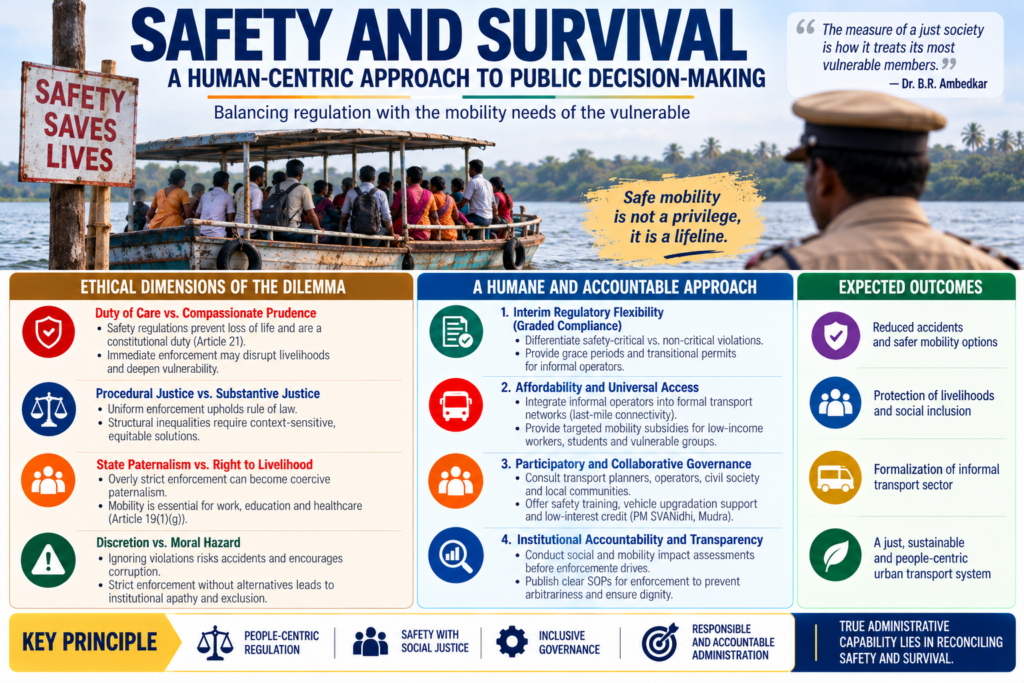
Ethical Dimensions of the Dilemma
1. Duty of Care vs. Compassionate Prudence
- Deontological Imperative (Duty of Care): Safety regulations exist to prevent harm, safeguard life (Article 21), and prevent public disasters (e.g., overcrowded, unregulated mini-buses or informal e-rickshaws leading to fatal accidents). Neglecting safety rules constitutes a breach of administrative duty.
- Utilitarian / Compassionate Prudence: Immediate enforcement without viable alternatives strips low-income workers of mobility, causing job loss, poverty, and systemic exclusion. The immediate harm caused by enforcement often outweighs the prospective risk of accidents.
2. Procedural Justice vs. Substantive Justice
- Procedural Justice: Demands uniform application of rules across all citizens without bias or exception.
- Substantive / Distributive Justice: Recognizes structural inequalities (Rawls’ Difference Principle). Equal application of strict norms on unequally positioned groups deepens social inequity, as disadvantaged groups cannot afford compliant formal transport.
3. State Paternalism vs. Right to Livelihood
- Strict enforcement can turn into coercive paternalism when the state deprives vulnerable citizens of their self-reliant, low-cost transport options without offering a public alternative, undermining their fundamental right to earn a livelihood (Article 19(1)(g)).
4. Discretion vs. Moral Hazard
- Turning a blind eye to violations creates a moral hazard, compromising legal integrity and risking official extortion or systemic bribery. Conversely, strict enforcement leads to institutional apathy.
A Humane and Accountable Approach
To resolve this conflict without sacrificing safety or human dignity, administrators should adopt a “Safe-Transition & Inclusive Mobility” Framework:
1. Interim Regulatory Flexibility (Graded Compliance)
- Safety-Critical vs. Non-Critical Segregation: Differentiate strictly between immediate life-threatening violations (e.g., lack of brakes, severe overloading) and administrative non-compliance (e.g., pending registration, route permits).
- Grace Periods & Transitional Permits: Issue temporary operational permits for informal operators, coupled with a clear, step-by-step roadmap for compliance.
2. Affordability and Universal Access Integration
- Subsidized Last-Mile Feeder Networks: Integrate informal operators (e.g., e-rickshaws, shared auto-rickshaws) into formal city transport plans as last-mile connectivity providers rather than treating them as illegal encroachments.
- Targeted Mobility Subsidies: Provide direct public transport subsidies or concessions for low-income workers, students, and informal sector workers to make regulated modes accessible.
3. Participatory and Collaborative Governance
- Multi-Stakeholder Consultations: Establish forums bringing together urban transport planners, traffic police, informal transport worker unions, and civil society organizations to design realistic, context-specific routes and rules.
- Capacity Building & Upgradation: Offer public-funded vehicle retrofitting, safety training, and low-interest institutional credit (e.g., under PM SVANidhi or Mudra schemes) to help informal operators upgrade to safe, compliant vehicles.
4. Institutional Accountability & Transparency
- Impact Assessment Studies: Before undertaking anti-encroachment or vehicular ban drives, conduct mandatory “Social and Mobility Impact Assessments” to evaluate the effect on vulnerable populations.
- Clear Administrative SOPs: Publish transparent Standard Operating Procedures (SOPs) for traffic enforcement officers to prevent arbitrary impounding and corruption, ensuring dignity in enforcement.
True administrative capability lies not in choosing between safety and survival, but in reconciling them through creative, human-centric policy design. As emphasized by Dr. B.R. Ambedkar, constitutional morality requires that state power be used to elevate the marginalized. By shifting from punitive enforcement to empowering regulatory inclusion, public officials can protect public safety while fulfilling their constitutional obligation toward social justice.
|
SOURCE: The Hindu e-paper – A 10-minute boat ride that cost 13 young lives