
|
IN NEWS: Metrics to minds — restoring purpose to universities
QUESTION: “The quality of higher education depends not merely on standardised assessment but also on the academic autonomy and accountability of institutions.” Discuss. (15 marks, 250 words)
ANSWER: Standardised assessment mechanisms set essential minimum benchmarks, true educational excellence cannot be achieved through rigid compliance alone. Quality higher education demands an ecosystem where academic autonomy unleashes institutional innovation, and robust accountability ensures public trust, equity, and outcome-oriented performance.
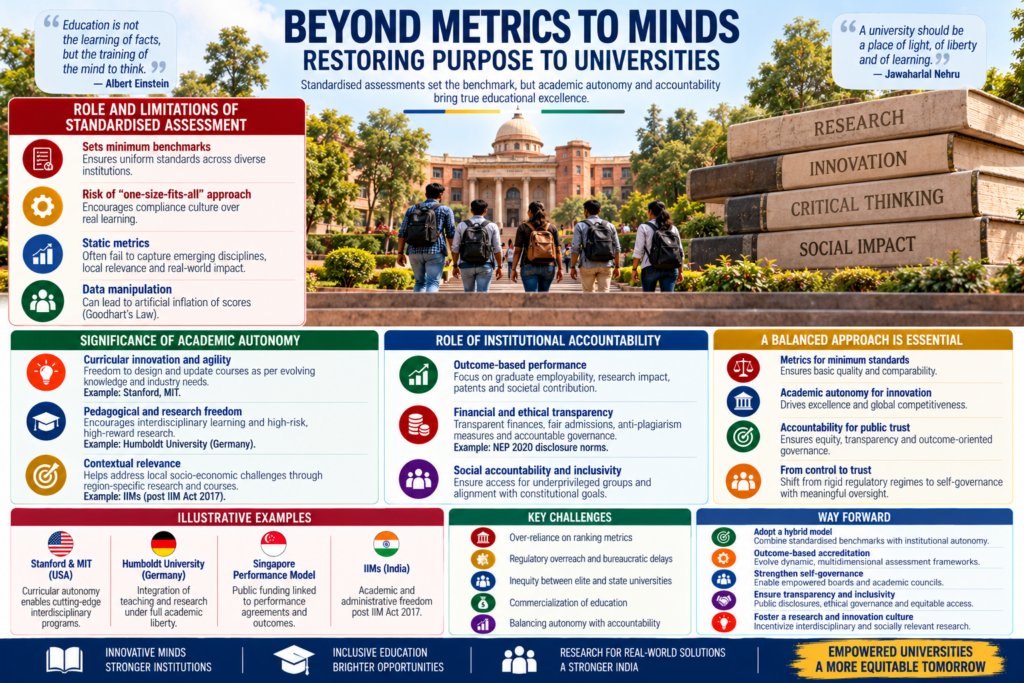
Role and Limitations of Standardised Assessment
- Minimum Benchmarking vs. Pursuit of Excellence: Standardised metrics establish uniform baselines across diverse institutions. However, they risk promoting a “one-size-fits-all” compliance culture, where universities focus on administrative box-ticking rather than deep pedagogical reform.
- Static Metrics in a Dynamic World: Rigid accreditation criteria often fail to capture real-time industry demands, emerging multidisciplinary fields (e.g., AI, Climate Tech), or localized research impact.
- Data Manipulation and Goodhart’s Law: When a measure becomes a target, it ceases to be a good measure. Over-reliance on numerical scores can lead to artificial inflation of research metrics (e.g., predatory journal citations) without improving real-world teaching or social impact.
Significance of Academic Autonomy in Driving Quality
- Curricular Innovation and Agility: Autonomous universities can rapidly revise syllabi without waiting for tedious centralized approvals.
- Global Example: Stanford University and MIT in the USA leverage total curricular autonomy to continuously launch cutting-edge interdisciplinary programs in emerging fields like neuro-technology and sustainable energy systems.
- Indian Example: Indian Institutes of Management (IIMs), through the IIM Act 2017, gained administrative and academic freedom to design courses, update admissions, and expand offshore footprints.
- Pedagogical and Research Freedom: Academic freedom encourages faculty to adopt experiential learning methodologies and pursue long-term, high-risk, high-reward research rather than playing safe to meet fixed publication quotas.
- Global Example: Humboldt University of Berlin (Germany) pioneer-modeled the integration of teaching and research under full academic liberty, laying the foundation for modern research universities.
- Contextual Relevance and Problem-Solving: Autonomous regional universities can direct research toward solving local socio-economic issues (e.g., agrarian distress, local water management) rather than adhering to rigid central priorities.
Role of Institutional Accountability in Sustaining Quality
- Outcome-Based Performance Standards: Accountability must shift from input-based oversight (e.g., land size, classroom count) to output-based governance (e.g., graduate employability, citation impact, patent filings, and societal contribution).
- Global Example: Singapore’s University Governance Model provides public funding tied directly to Performance Agreements (PAs), where universities are evaluated on graduate employment rates, research commercialization, and international partnerships.
- Financial and Ethical Transparency: Autonomous public and private institutions must maintain financial probity, transparent student admissions, fair fee structures, and strict anti-plagiarism protocols.
- Indian Example: National Education Policy (NEP) 2020 mandates transparent, public disclosures of finances, faculty profiles, and student outcomes as a pillar of the self-regulatory framework.
- Social Accountability and Inclusivity: Institutions must remain accountable to broader national goals, ensuring social equity, access for underprivileged groups, and constitutional alignment.
Standardised assessment acts as a necessary foundation, but academic autonomy forms the engine of innovation, and accountability serves as the steering wheel ensuring alignment with national development goals. Achieving world-class higher education requires shifting from “command-and-control” regulatory regimes to a system based on trust, self-governance, and outcome-oriented evaluation.
|
SOURCE: The Hindu e-paper – Metrics to minds — restoring purpose to universities