
SYLLABUS: Indian Polity General Studies – : II Parliament and State legislatures—structure, functioning, conduct of business, powers & privileges and issues arising out of these.
IN NEWS: Satyagraha for Constitution-as-commons
QUESTION: How do peaceful protests and civil resistance contribute to the deepening of constitutional democracy in India? Discuss with reference to the principles of satyagraha and constitutional morality. (15 marks, 250 words)
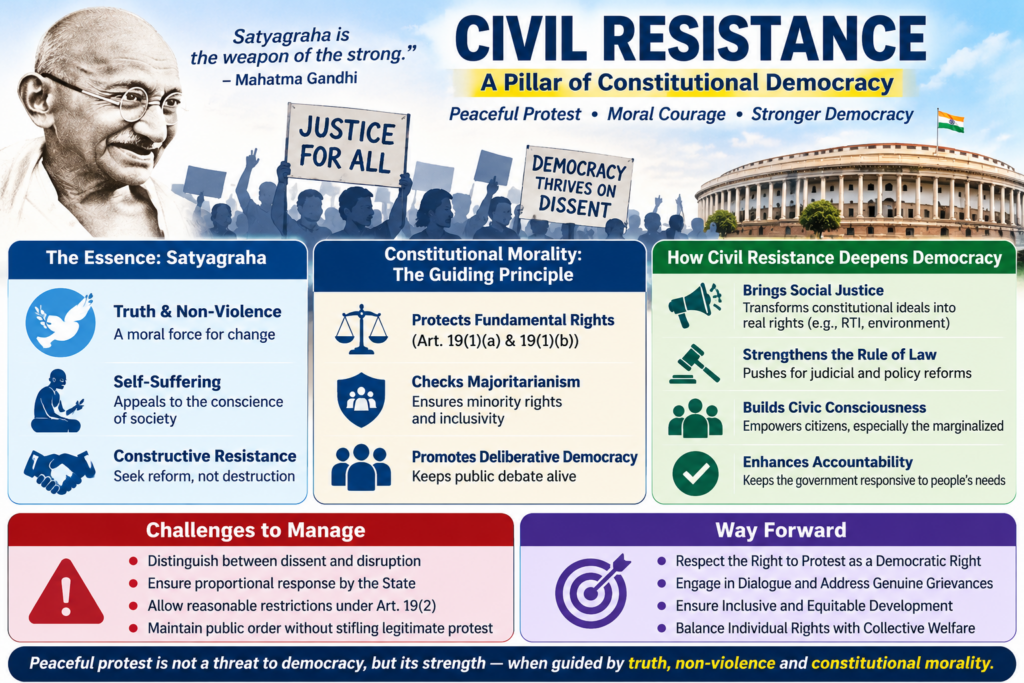
ANSWER: In a constitutional democracy, the constitutional framework provides the legal and institutional architecture, while civil engagement acts as its living pulse. Peaceful protest and civil resistance in India are not merely extra-parliamentary mechanisms of dissent; they are fundamental to the deepening of democratic culture. Rooted historically in the philosophy of Satyagraha and guided normatively by Constitutional Morality, non-violent resistance bridges the gap between formal legal democracy and substantive socio-political justice.
1. The Intersection of Satyagraha and Civil Resistance
- Truth and Non-Violence as Moral Force: Satyagraha asserts that resistance must be anchored in Satya (truth) and executed through Ahimsa (non-violence). By rejecting physical force, civil resistance forces the state to engage on moral grounds rather than through coercion.
- Self-Suffering and Conscience: The willing acceptance of self-suffering by protesters highlights systemic injustices, appealing to the collective conscience of the nation and holding public institutions accountable.
- Constructive Action over Destruction: Satyagraha views protest not as an end in itself, but as a persuasive mechanism to convert the opponent and reform unjust policy, thereby strengthening political dialogue.
2. Constitutional Morality as the Normative Compass
- Checking Majoritarian Tendencies: While representative elections reflect popular majorities, constitutional morality demands that fundamental rights remain protected against temporary majoritarian overreach. Peaceful protest acts as a counterweight, ensuring that marginalized voices retain a platform.
- Upholding Fundamental Rights: Civil resistance directly exercises constitutional freedoms guaranteed under Article 19(1)(a) (freedom of speech and expression) and Article 19(1)(b) (freedom to assemble peaceably and without arms), giving practical vitality to fundamental rights.
- Promoting Deliberative Democracy: Constitutional morality requires ongoing deliberation between the state and its citizens. Civil resistance prevents democratic decay by keeping public debate alive between electoral cycles.
3. Mechanisms of Democratic Deepening
Expanding the Horizons of Socio-Economic Rights
Historically, peaceful movements have translated abstract constitutional aspirations into tangible rights. Movements such as the Narmada Bachao Andolan, the Right to Information movement, and various agrarian and labor movements brought environmental rights, public transparency, and economic security into the fold of Article 21 (Right to Life and Personal Liberty).
Judicial Interpretation and Rule of Law
Civil resistance often pushes statutory and policy deadlocks into the judicial domain. Supreme Court jurisprudence—notably through Public Interest Litigation (PIL)—has frequently responded to peaceful popular movements, refining the interpretation of constitutional rights and reinforcing the rule of law over executive discretion.
Fostering Civic Consciousness and Inclusion
Grassroots protests demystify the Constitution for ordinary citizens. By using constitutional language to assert claims against the state, movements foster civic literacy, empower historically disadvantaged communities, and build a participatory political culture.
4. Challenges and Essential Safeguards
For peaceful civil resistance to continuously strengthen constitutional democracy, it must navigate critical constitutional boundaries:
- Distinction Between Dissent and Disruption: As Dr. Ambedkar noted in his final speech to the Constituent Assembly, reliance on extra-constitutional methods when constitutional remedies are open must be approached with caution. To maintain constitutional legitimacy, protests must remain non-violent and proportionate.
- State Proportionality: The state’s response to civil resistance tests its own commitment to constitutional morality. Over-regulation through arbitrary restrictions under Section 144 of the BNSS (formerly CrPC) or blanket internet shutdowns erodes the constitutional space for dissent.
- Maintenance of Public Order: Balancing individual rights under Article 19 with reasonable restrictions under Article 19(2) ensures that civil resistance deepens democracy without undermining public order or national security.
Peaceful protest and civil resistance are vital to Indian constitutionalism. By synthesizing the ethical rigor of Satyagraha with the normative boundaries of Constitutional Morality, non-violent resistance ensures that Indian democracy remains dynamic, inclusive, and self-correcting. Rather than posing a threat to state authority, reasoned civil resistance fulfills the constitutional vision of a sovereign republic governed by truth, justice, liberty, and fraternity.
|
SOURCE: The Hindu epaper – Satyagraha for Constitution-as-commons