
|
IN NEWS: India-U.S. ties and the hurdle of American unilateralism
QUESTION: Examine the major sources of friction in India–U.S. relations. How can both countries reconcile their strategic interests while preserving mutual trust and respect?(250 words)
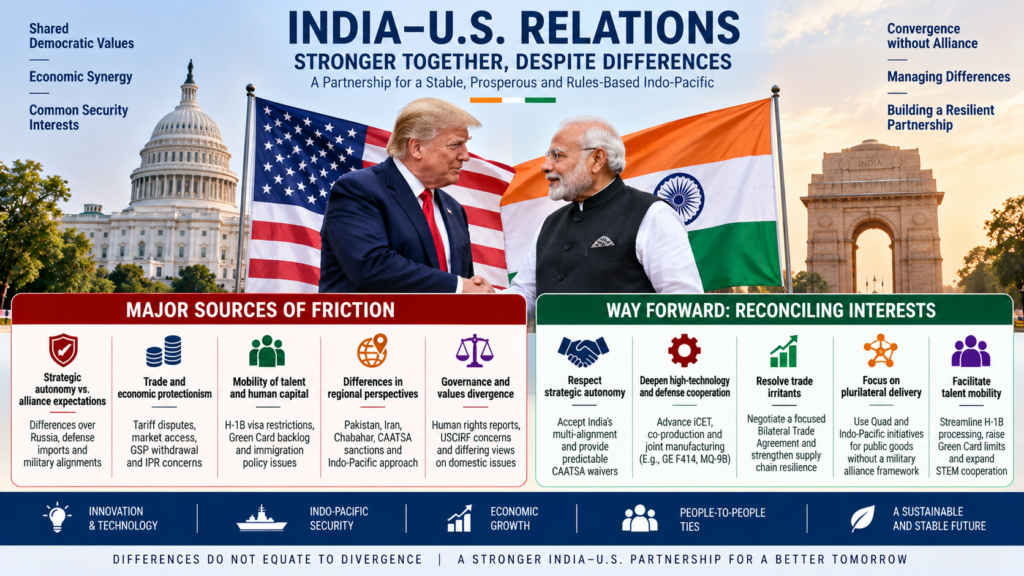
ANSWER: The India–U.S. partnership, often described as the “defining partnership of the 21st century,” is built on a strong foundation of shared democratic values, economic synergy, and common security concerns in the Indo-Pacific. However, the relationship operates under a “convergence without alliance” paradigm. As both nations navigate an increasingly complex multipolar world, significant sources of friction regularly emerge across strategic, economic, and geopolitical domains.
1. Major Sources of Friction in India–U.S. Relations
A. Strategic Autonomy vs. Alliance Expectations
- Divergent Worldviews: Washington traditionally views international security through formal military alliances (e.g., NATO). In contrast, India’s foreign policy is anchored in strategic autonomy and multi-alignment (e.g., active membership in BRICS and SCO), rejecting participation in military blocs.
- The Russia Factor: India relies on Russia for nearly $40\%–50\%$ of its defense imports and became a top importer of discounted Russian crude oil (reaching over 1.5to1.8millionbarrels/day). This directly counters U.S. efforts under G7 price caps to isolate Moscow economically.
B. Trade and Economic Protectionism
- Tariff Disputes and Market Access: Bilateral trade reached $\$128\text{ billion}$ in FY24, but tensions persist over India’s tariffs on ICT goods, agricultural products (e.g., GMOs, dairy), and medical devices. Friction remains over the U.S. 2019 withdrawal of India’s Generalized System of Preferences (GSP) status.
- Intellectual Property Rights (IPR): India remains on the U.S. Trade Representative’s (USTR) Special 301 Priority Watch List. Key clashes stem from Section 3(d) of the Indian Patents Act (prohibiting evergreening) and compulsory licensing provisions under TRIPS.
C. Mobility of Talent and Human Capital
- Immigration Restrictions: Indian nationals receive over $70\%$ of all issued H-1B visas. Strict caps (65,000 general limit plus 20,000 advanced degree exemption), wage-tier changes, and per-country caps on Employment-Based Green Cards create decades-long backlogs.
- Impact on Diaspora: As Indian IT service providers generate billions in bilateral trade, protectionist visa policies and processing delays directly disrupt human capital mobility and economic synergies.
D. Differences in Regional Perspectives
- Neighborhood and Iran: U.S. military aid packages for Pakistan’s F-16 fleet and sanction waivers for India’s operations at Iran’s Chabahar Port create policy friction. India views Chabahar as a crucial gateway to Afghanistan and the INSTC corridor.
- Extraterritorial Sanctions: The threat of secondary sanctions under CAATSA (Countering America’s Adversaries Through Sanctions Act)—triggered by India’s $\$5.43\text{ billion}$ procurement of Russian S-400 Triumf missile systems—encroaches upon India’s sovereign defense choices.
E. Governance and Internal Values Divergence
- Value-Based Rhetoric: Critical assessments by the USCIRF (U.S. Commission on International Religious Freedom) recommending “Country of Particular Concern” (CPC) designation, alongside U.S. State Department human rights reports, are rejected by New Delhi as biased interference in internal affairs.
2. Reconciling Strategic Interests While Preserving Mutual Trust
A. Operationalize “Strategic Equivalence”
- Respect Red Lines: Washington must accept that an autonomous India serves as a stronger balancing power in the Indo-Pacific than a treaty ally.
- Institutionalize CAATSA Waivers: Grant formal, predictable statutory waivers for legacy defense acquisitions from non-U.S. vendors.
B. Strengthen High-Technology and Defense Co-Production
- Deepen iCET Collaboration: Execute projects under the Initiative on Critical and Emerging Technologies (iCET) spanning AI, semiconductors, quantum computing, and commercial space ventures.
- Defense Industrial Co-Development: Advance joint manufacturing agreements, such as the GE F414 jet engine transfer of technology for India’s LCA Tejas Mk2 and the procurement/co-production of Stryker armored vehicles and MQ-9B SeaGuardian drones.
C. Institutionalize Economic and Trade Reconciliation
- Targeted Trade Frameworks: Resolve outstanding WTO disputes through bilateral settlements (building on the 7 disputes mutually resolved in 2023) and negotiate a focused Bilateral Trade Agreement.
- Supply Chain Resiliency: Leverage the Indo-Pacific Economic Framework for Prosperity (IPEF) and “friend-shoring” initiatives to de-risk critical tech supply chains away from single-source dependencies.
D. Plurilateral Alignment in the Indo-Pacific
- Focus on Quad Delivery: Utilize the Quad (India, U.S., Japan, Australia) to deliver public goods—including the Indo-Pacific Partnership for Maritime Domain Awareness (IPMDA), cable connectivity, and climate resilience—without converting it into a formal military alliance.
E. Smooth Human Capital Transitions
- Streamline High-Skilled Migration: Establish dedicated fast-track processing for STEM scholars, raise per-country Green Card limits, and expand domestic H-1B visa re-stamping pilots to protect the innovation corridor linking Silicon Valley and Indian tech hubs.
The India–U.S. relationship does not require total policy convergence to be effective. By recognizing that differences do not equate to divergence, both nations can manage tactical frictions through mature, institutionalized dialogue. Reconciling U.S. power with India’s strategic ambitions through economic integration, technology transfers, and mutual respect for strategic sovereignty will ensure a resilient, stable partnership for the Indo-Pacific and beyond.
|
SOURCE: The Hindu epaper – India-U.S. ties and the hurdle of American unilateralism