
|
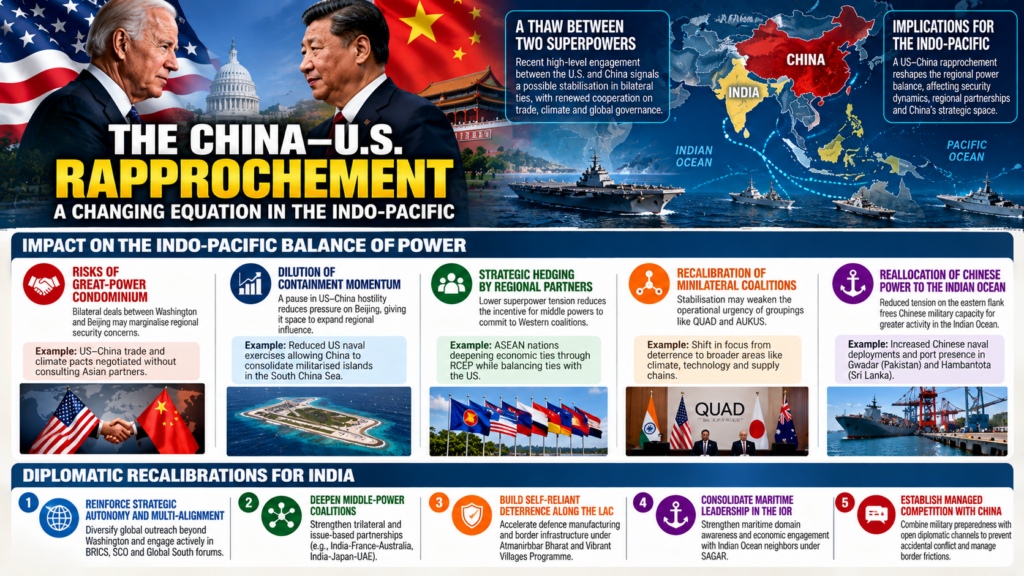
IN NEWS: The China-U.S. rapprochement
QUESTION: How does a US-China strategic thaw impact the Indo-Pacific balance of power, and what diplomatic recalibrations must India undertake to safeguard its national interests?(250 words)
ANSWER:
Introduction
The high-level bilateralism between the US and China effectively signals a “G2” global order, a condominium where Washington and Beijing manage global security and economic frameworks directly between themselves. This superpower accommodation reshapes the Indo-Pacific power matrix, directly challenging the strategic assumptions of middle powers like India.
Impact on the Indo-Pacific Balance of Power
- Risks of Great-Power Condominium: Bilateral deals negotiated directly between Washington and Beijing risk marginalizing regional security concerns.
- Example: High-level US-China trade and climate pacts negotiated without consulting Asian partners.
- Dilution of Containment Momentum: A pause in US-China hostility lowers Washington’s pressure on Beijing, giving China space to expand its regional influence.
- Example: Reduced US naval freedom-of-navigation exercises allowing China to consolidate militarized islands in the South China Sea.
- Strategic Hedging by Regional Partners: Lower superpower tension reduces the incentive for middle powers to commit to Western anti-China coalitions.
- Example: ASEAN nations balancing ties by joining Chinese-led economic frameworks like RCEP while maintaining cautious ties with the US.
- Recalibration of Minilateral Coalitions: High-level bilateral stabilization risks weakening the operational urgency and deterrence focus of minilateral groupings.
- Example: Shifts in QUAD and AUKUS priorities from hard military deterrence toward softer public goods like climate tech and supply chains.
- Reallocation of Chinese Power to the Indian Ocean: Reduced tension on China’s eastern flank frees military capacity for expansion into southern waters.
- Example: Increased Chinese dual-use naval deployments and submarine docking across port bases in Gwadar (Pakistan) and Hambantota (Sri Lanka).
Diplomatic Recalibrations Required for India
- Reinforcing Strategic Autonomy and Multi-Alignment: India must diversify its global outreach beyond Washington to preserve independent decision-making.
- Example: Active engagement across non-Western forums like BRICS and the SCO while leading initiatives for the Global South.
- Deepening Middle-Power Coalitions: India should build issue-based partnerships with key middle powers to maintain a multipolar Indo-Pacific.
- Example: Strengthening trilateral dialogues (e.g., India-France-Australia or India-Japan-UAE) for maritime security and supply chain resilience.
- Building Self-Reliant Deterrence along the LAC: India cannot depend on external counterweights for border defense and must bolster its independent military capabilities.
- Example: Accelerating Atmanirbhar Bharat in defense manufacturing and upgrading all-weather infrastructure under Vibrant Villages Programme along the northern border.
- Consolidating Maritime Leadership in the IOR: India must reinforce its position as the primary security provider across South Asia and Indian Ocean littorals to block Chinese encirclement.
- Example: Deploying maritime domain awareness tools under SAGAR and offering economic bailouts to neighbors like Sri Lanka and Maldives.
- Establishing Managed Competition with China: India should adopt a dual-track approach by combining military readiness with open diplomatic channels to prevent accidental conflict.
- Example: Maintaining firm troop deployments along the LAC while utilizing Corps Commander dialogues and WMCC meetings to manage border frictions
Conclusion
To navigate this shifting landscape, India must lead in institutionalizing middle-power networks , such as formal defense consultations with Japan, France, and Australia to shield regional security from superpower fluctuations.Ultimately, a self-reliant, multi-aligned India remains the indispensable anchor for a free, open, and multipolar Indo-Pacific.
|