
SYLLABUS: Ethics General Studies – : IV Ethics and Human Interface: Essence, determinants and consequences of Ethics in-human actions; dimensions of ethics; ethics – in private and public relationships. Human Values – lessons from the lives and teachings of great leaders, reformers and administrators; role of family society and educational institutions in inculcating values.
IN NEWS: Gandhiji’s many ways of understanding ‘genius’
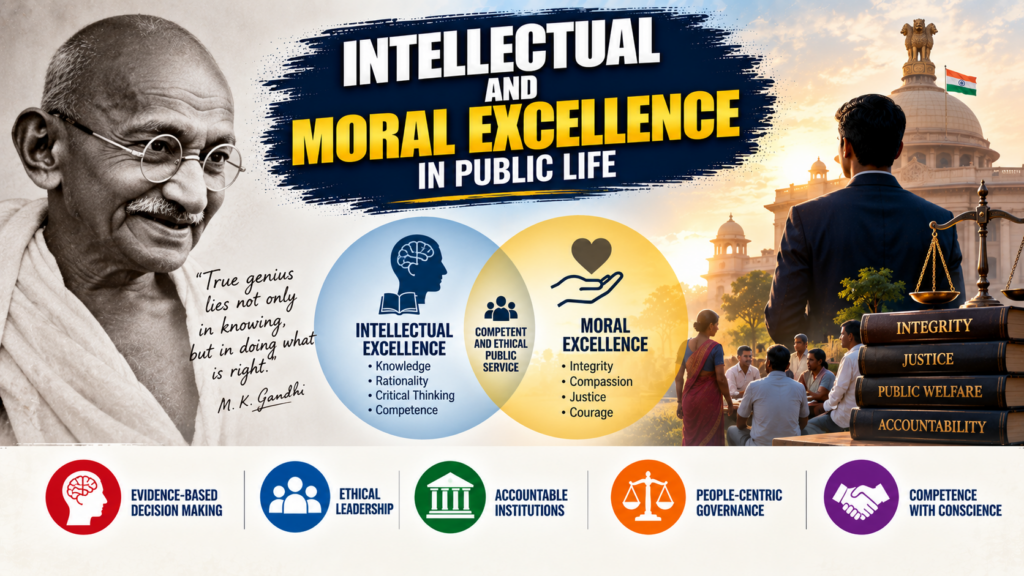
QUESTION: Distinguish between intellectual excellence and moral excellence. How can public institutions ensure that both complement each other in the exercise of authority? (150 words)
ANSWER: Intellectual excellence is the capacity to reason, analyse and solve problems effectively, while moral excellence is the ability to act with integrity, justice, empathy and courage. In public administration, the former provides competence, while the latter provides ethical direction.
Distinction
- Intellectual excellence: knowledge, rationality, critical thinking and sound judgment.
- Moral excellence: integrity, justice, compassion, courage and sense of duty.
- Core question: “What can be done effectively?” versus “What ought to be done?”
- Risk in isolation: Intelligence without morality can produce efficient wrongdoing; morality without competence can produce good intentions without effective outcomes.
Aristotle’s virtue ethics provides the bridge: excellence requires both practical wisdom (phronesis) and virtuous character.
How can public institutions integrate both?
- Combine competence with virtue
Recruitment and training should develop expertise alongside integrity and ethical reasoning. UPSC assessment of judgment, integrity and suitability reflects this approach. - Apply ethical theories to decision-making
- Kantian ethics: Treat citizens as ends, never merely as means; hence, administrative efficiency cannot justify violating dignity or rights.
- Utilitarianism: Policies should seek maximum overall welfare, useful in resource allocation during disasters or pandemics.
- Rawls’ theory of justice: Decisions should protect the least advantaged, preventing efficiency from overriding distributive justice.
- Aristotle: Cultivate virtues such as prudence, courage and justice so that officials can exercise discretion wisely.
- Combine evidence with empathy
During COVID-19, administrators required scientific and logistical expertise while addressing the hardships of migrants and vulnerable groups. This reflects a balance between utilitarian welfare and a Kantian concern for dignity. - Build accountability into authority
RTI, CAG audits, social audits, vigilance mechanisms and judicial review ensure that intellectual capability does not become arbitrary power. MGNREGA social audits, for example, combine administrative systems with citizen oversight. - Encourage ethical leadership and moral courage
T.N. Seshan’s tenure as CEC illustrates the importance of combining institutional knowledge with courage and commitment to electoral integrity. - Judge both ends and means
An administrator may achieve rapid results through coercion, but Kantian ethics would question the means, while virtue ethics would examine the character reflected in the decision. Thus, public institutions should evaluate both outcomes and the ethical process.
Public institutions achieve legitimate authority when Aristotle’s practical wisdom, Kant’s duty, utilitarian concern for welfare and Rawlsian justice inform administrative competence. Ultimately, good governance requires “competence with conscience.”
|
SOURCE: The Hindu epaper – Gandhiji’s many ways of understanding ‘genius’