
|
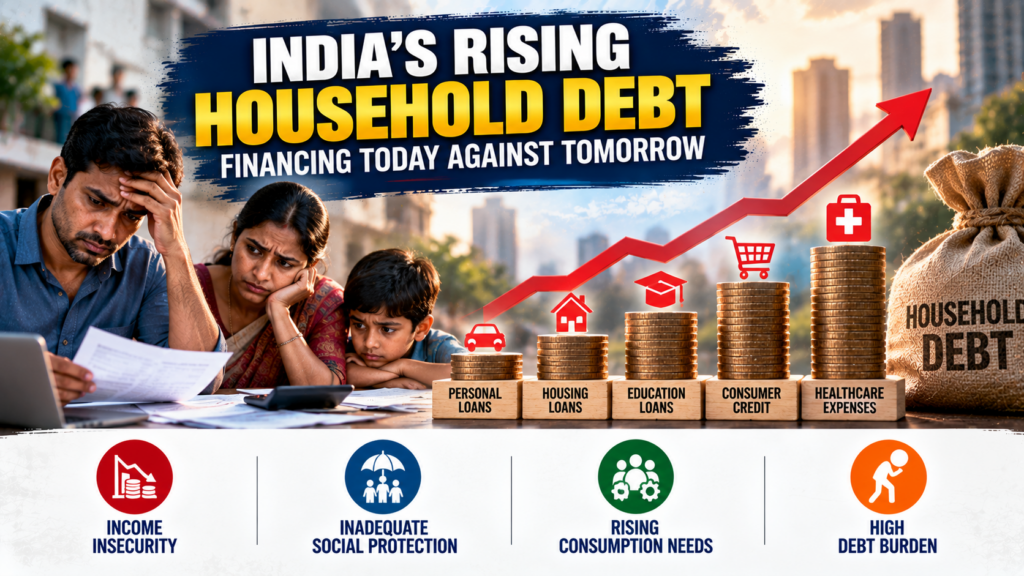
IN NEWS: Household debt, financing today against tomorrow
QUESTION: “India’s rising household debt is not merely a financial phenomenon but also a reflection of income insecurity and inadequate social protection.” Discuss.(250 words)
ANSWER: The rising trajectory of household debt in India—which reached a high of around 40% of GDP in recent years—represents a fundamental structural shift in the Indian economy. Rather than indicating financial deepening or economic prosperity driven by asset creation, a critical examination reveals that this debt growth is heavily tied to underlying income volatility and gaps in the social safety net.
Understanding the Dual Nature of Debt Growth
- Asset-Building vs. Consumption Borrowing: Healthy household debt typically finances long-term, wealth-generating assets like real estate, education, or capital equipment. In India, however, a substantial portion of recent borrowing consists of unsecured personal loans, credit card balances, and microfinance commitments used to meet daily operational shortfalls.
- Formalization vs. Vulnerability: While increased access to formal credit and digital lending networks has reduced dependence on predatory informal moneylenders, it has also lowered the threshold for households to leverage themselves beyond their repayment capacity.
Household Debt as a Reflection of Income Insecurity
- Stagnant Real Wages: Real wage growth across rural and informal urban sectors has remained suppressed relative to inflation in essential commodities. When earnings fail to keep pace with living expenses, debt becomes a secondary income source to maintain consumption levels.
- Informalization of the Workforce: With over 80% of India’s workforce operating in the informal economy without long-term contracts or predictable earnings, income shocks—such as seasonal unemployment, crop failures, or contract cancellations—frequently force families to borrow for baseline subsistence.
- K-Shaped Recovery Trends: Disproportionate income growth at the top end of the economic spectrum contrasts sharply with wage stagnation among low- and middle-income groups. High debt-to-income ratios are concentrated among families trying to preserve their standard of living amidst uneven economic expansion.
Deficiencies in Social Protection Amplifying Indebtedness
- Out-of-Pocket Healthcare Expenses: Medical emergencies remain a leading catalyst for distress borrowing in India. Despite coverage initiatives like Ayushman Bharat, out-of-pocket health expenditure remains high, compelling households to take high-interest unsecured loans during catastrophic health events.
- Absence of Comprehensive Unemployment Insurance: Unlike developed economies with formal unemployment benefits, Indian workers facing job loss rely on personal savings or borrowing to manage household expenses during employment gaps.
- Inadequate Old-Age and Pension Support: A vast majority of the informal workforce lacks social security or pension coverage upon retirement. Aged populations and their supporting families frequently turn to debt to manage basic living costs and late-life care.
Key Implications for the Broader Economy
- Suppressed Future Consumption: High debt-service burdens reduce disposable income, weakening aggregate demand and dampening long-term economic growth.
- Financial Sector Risks: Widespread defaults among lower-income borrowers pose structural risks to Non-Banking Financial Companies (NBFCs), Microfinance Institutions (MFIs), and retail lending portfolios of commercial banks.
- Socio-Economic Stress: Debt stress directly correlates with mental health issues, distress asset sales, and intergenerational poverty traps, reversing gains made in poverty reduction.
Wayforward
- Strengthen Public Social Safety Nets: Broaden the operational coverage of health insurance, introduce structured informal sector pension schemes, and strengthen urban employment guarantees.
- Focus on Real Wage and Job Growth: Prioritize labor-intensive manufacturing and formal sector employment creation to enhance baseline earnings and reduce reliance on credit for consumption.
- Strengthen Macroprudential Guardrails: Expand regulatory overwatch on digital lending platforms, enforce strict risk-weighting on unsecured consumer retail loans, and mandate robust credit counseling frameworks.
|
SOURCE: The Hindu, e – paper – Household debt, financing today against tomorrow