
SYLLABUS: Agriculture General Studies – : III Food processing and related industries in India- scope and significance, location, upstream and downstream requirements, supply chain management.
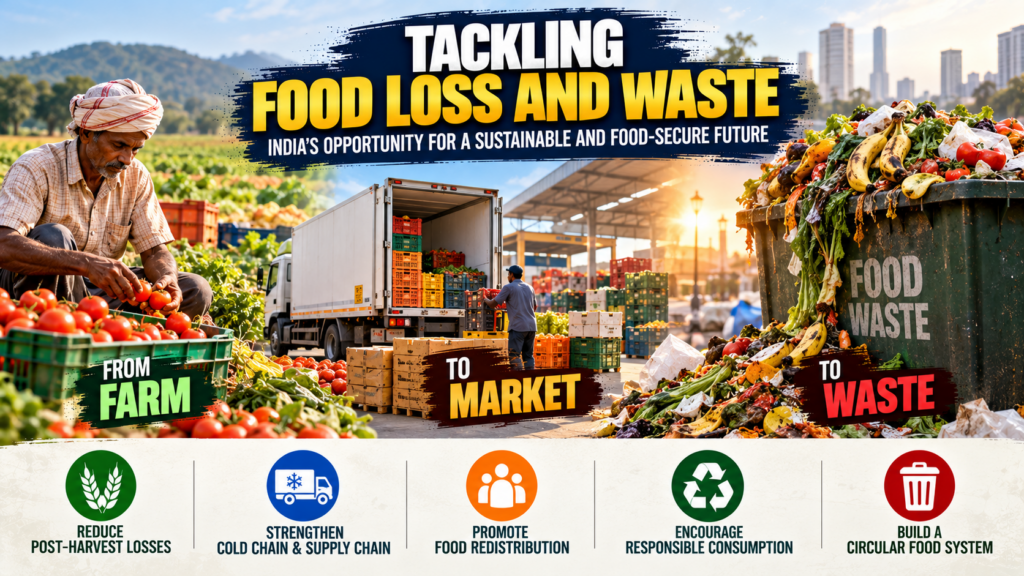
IN NEWS: Tackling food loss and waste — India’s opportunity
QUESTION: “India needs to shift from fragmented interventions to an integrated national strategy for tackling food loss and waste.” Discuss
ANSWER: India presents a stark paradox: while remaining a leading agricultural producer globally, it struggles with persistent nutritional insecurity and immense post-harvest losses. The UN Environment Programme Food Waste Index Report estimates household food waste alone in India at around 55 kg per capita annually, translating to tens of millions of metric tonnes wasted each year across supply chains and consumer touchpoints.
The Problem of Fragmented Interventions
- Ministry Disconnects: Cold-chain infrastructure falls under the Ministry of Agriculture and Farmers Welfare and Ministry of Food Processing Industries, municipal solid waste management falls under the Ministry of Housing and Urban Affairs, and consumer safety or standards rest with the Ministry of Consumer Affairs, Food and Public Distribution (FSSAI).
- Infrastructure Shortfalls: Despite schemes like PM Kisan SAMPADA Yojana, cold-chain logistics cover less than 10 to 12 percent of perishable agricultural produce. Losses remain heaviest in horticulture, dairy, and fisheries due to fragmented rural storage networks.
- Decentralized Voluntary Initiatives: Programs like FSSAI’s Save Food Share Food or private surplus food redistribution networks operate localized, voluntary models that lack national scale, legal backstops, or standardized quality benchmarks.
- Lack of Unified Data: India lacks a standard baseline tracking system to continuously measure loss percentages across distinct regional agro-ecological zones and supply chain links.
The Case for an Integrated National Strategy
- Governance and Legal Framework
- National FLW Mission: Establishing a single coordinating body or task force under NITI Aayog to oversee Target 12.3 of the UN Sustainable Development Goals (halving food waste and reducing food losses by 2030).
- Good Samaritan Protections: Standardizing legal protections and liability safety nets for food donors, restaurants, and retail chains that donate unsold, wholesome food to food banks and charities.
- Fiscal Incentives: Providing corporate tax credits, GST concessions, and green financing for businesses investing in loss-mitigation logistics, redistribution networks, and upcycled food processing.
- Supply Chain and Technical Integration
- Farm-to-Fork Cold Chain Infrastructure: Integrating solar-powered micro-cold stores at farm-gates, refrigerated transport (reefer vans), and digital supply chain tracking to reduce post-harvest decay before produce reaches central markets.
- AI and Smart Marketplaces: Leveraging AgriTech platforms to match localized surplus produce directly with processing units, dark stores, or institutional buyers, significantly reducing holding times at traditional mandis.
- Consumer Behavior and Circular Economy
- Standardized Date Labeling: Clarifying regulatory distinctions between “Use By” and “Best Before” dates to curb premature household disposal.
- Urban Redistribution and Waste Recovery: Institutionalizing city-level food recovery networks while mandating organic waste segregation to divert non-edible food waste into bio-gas generation and industrial composting.
Way Forward
- Phase 1 — Baseline and Framework (Months 0–12): Establish the National Food Loss and Waste Mission, build a standardized digital baseline tracking framework across state supply nodes, and draft national Good Samaritan legislation.
- Phase 2 — Supply Chain Upgrade (Years 1–3): Rapidly expand solar-powered farm-gate micro-cooling units, offer tax incentives for AgriTech platforms trading surplus produce, and revise date labeling regulations.
- Phase 3 — Circular Scale and Enforcement (Years 3–5): Enforce mandatory organic waste segregation in Tier-1 and Tier-2 cities, scale industrial composting or bio-gas energy recovery, and measure target progress toward SDG 12.3 goals.
Tackling food loss and waste in India is not merely an agricultural or logistical challenge; it is a critical lever for environmental sustainability, climate resilience, and food security. Moving from piecemeal schemes to an integrated national mission will optimize food availability, improve farmer incomes, and significantly lower greenhouse gas emissions associated with decaying organic waste.
PYQ REFERENCE “What are the main constraints in transport and marketing of agricultural produce in India? Suggest measures to overcome them.”
SOURCE: The Hindu e-paper – Tackling food loss and waste — India’s opportunity