
|
IN NEWS: Revisiting India’s nuclear doctrine without revising it
QUESTION: Discuss how India can strengthen the credibility of its nuclear deterrence while retaining the core principles of its existing doctrine.
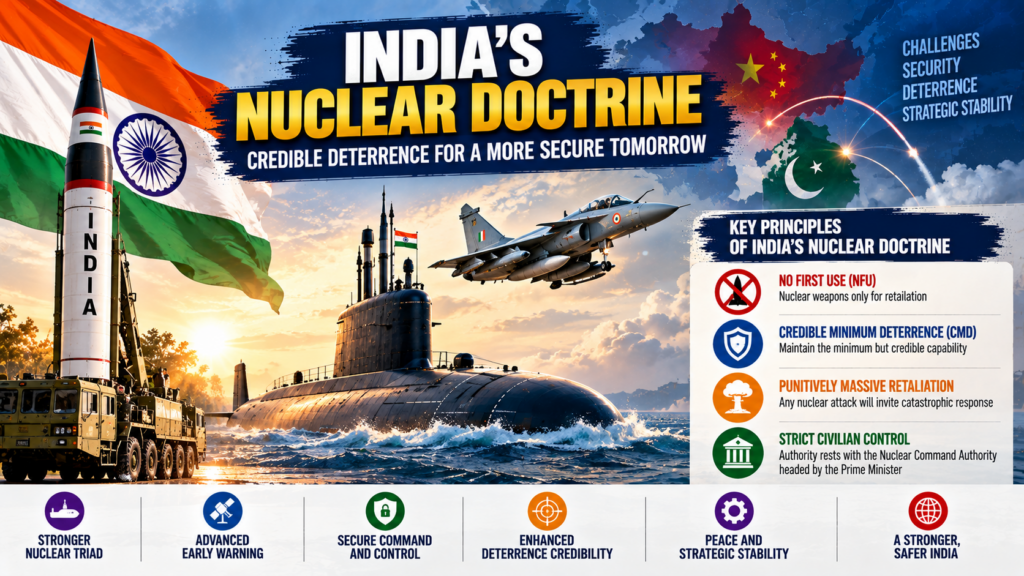
ANSWER: India’s nuclear doctrine, officially adopted in 2003, is grounded in two fundamental tenets: No First Use (NFU) and Credible Minimum Deterrence (CMD). It commits non-use against non-nuclear-armed states, massive retaliation in the event of a nuclear attack on Indian territory or forces, and strict civilian control through the Nuclear Command Authority (NCA).
However, regional dynamics—such as China’s rapid nuclear expansion, hypersonic developments, and Pakistan’s deployment of Tactical Nuclear Weapons (TNWs)—have raised questions about the operational credibility of India’s deterrence. Strengthening deterrence without diluting core principles requires reinforcing capabilities, readiness, and strategic signaling rather than altering the core defensive posture.
Core Principles of India’s Existing Doctrine
- No First Use (NFU): Nuclear weapons are strictly for retaliation against a first strike involving nuclear weapons (or chemical/biological attacks) on India or its forces.
- Credible Minimum Deterrence (CMD): Maintaining the minimum size of forces necessary to inflict unacceptable damage on an adversary.
- Punitively Massive Retaliation: Ensuring that any retaliatory strike causes catastrophic, unacceptable damage.
- Strict Civilian Control: Absolute authority rests with the Political Council of the Nuclear Command Authority (NCA), headed by the Prime Minister.
Challenges to Deterrence Credibility
- Asymmetric Threats and Tactical Weapons: Pakistan’s development of short-range battlefield nukes (e.g., Nasr) aims to exploit the gap between India’s conventional responses and its doctrine of “massive retaliation”.
- Two-Front Nuclear Collusion: China’s rapid warhead buildup, silo fields, and hypersonic capability present a sophisticated qualitative threat alongside Pakistan.
- Vulnerability of Second-Strike Assets: Satellites, high-resolution surveillance, and anti-submarine warfare (ASW) technologies make fixed land assets and surface vessels increasingly detectable.
- Technological Disruptions: Emerging threats in cyberwarfare, counter-space weapons, and artificial intelligence risk blinding early-warning systems or compromising command-and-control networks.
Measures to Strengthen Credibility While Retaining Core Principles
1. Hardening and Expanding the Nuclear Triad (Bolstering CMD)
- Enhancing SSBN Capabilities: True second-strike capability under NFU relies on sea-based assets. Accelerating the deployment of Arihant-class ballistic missile submarines armed with long-range Submarine Launched Ballistic Missiles (SLBMs like the K-4 and K-5) ensures survivability against a surprise first strike.
- Induction of MIRV Technology: Successfully integrating Multiple Independently Targetable Reentry Vehicle (MIRV) technology (as demonstrated in Agni-V) penetrates adversary Ballistic Missile Defence (BMD) systems without increasing the total missile inventory, thereby upholding “minimum” deterrence while boosting “credibility”.
2. Maintaining Strategic Ambiguity within NFU Frameworks
- Operationalizing Flexible Response Options: Without changing the text of the doctrine, India can communicate that “massive retaliation” includes a full spectrum of counter-force and counter-value targeting options. This deters adversaries from assuming India would hesitate to respond to lower-yield tactical strikes.
- Revisiting Thresholds: Clearly reiterating that the use of tactical nuclear weapons on Indian forces—even inside adversary territory—constitutes a nuclear strike triggering full-spectrum retaliation.
3. Strengthening Command, Control, and Communications (C3I)
- Cyber and Space Hardening: Protecting early-warning systems, satellite networks, and the Strategic Forces Command (SFC) against high-end cyberattacks and electronic warfare.
- Redundant Command Structures: Establishing alternate, subterranean, and air-mobile command centers to guarantee surviving political authority and continuous control following an enemy first strike.
4. Enhancing Intelligence, Surveillance, and Reconnaissance (ISR)
- Early Warning Satellites: Deploying dedicated space-based infrared sensors and long-range early warning radars to detect adversary launches in real time, increasing reaction time for political authorization.
- Real-time Target Acquisition: Integrating real-time intelligence for rapid target selection during retaliatory execution.
5. Strengthening Conventional Capabilities to Raise the Nuclear Threshold
- Integrated Battle Groups (IBGs): Robust conventional superiority deters limited military adventurism, preventing conflicts from reaching a nuclear threshold where TNWs could be invoked.
- Missile Defense Shield: Strengthening multi-layered Ballistic Missile Defence (BMD) networks (e.g., Phase-I and Phase-II BMD, S-400 systems) to protect high-value decision-making nodes, ensuring political continuity after a first strike.
India does not need to abandon its No First Use policy or embark on an arms race to ensure security. The credibility of a defensive doctrine rests entirely on the guaranteed survivability of second-strike assets and the unmistakable political resolve to retaliate. By modernizing the nuclear triad, hardening C3I systems, and maintaining strategic ambiguity on retaliatory execution, India can effectively deter both conventional and sub-conventional nuclear coercion while remaining a responsible nuclear power.
|
SOURCE: The Hindu e-paper – Revisiting India’s nuclear doctrine without revising it