
SYLLABUS: Social Justice General Studies:- II Issues Relating to Development and Management of Social Sector/Services relating to Health, Education, Human Resources.
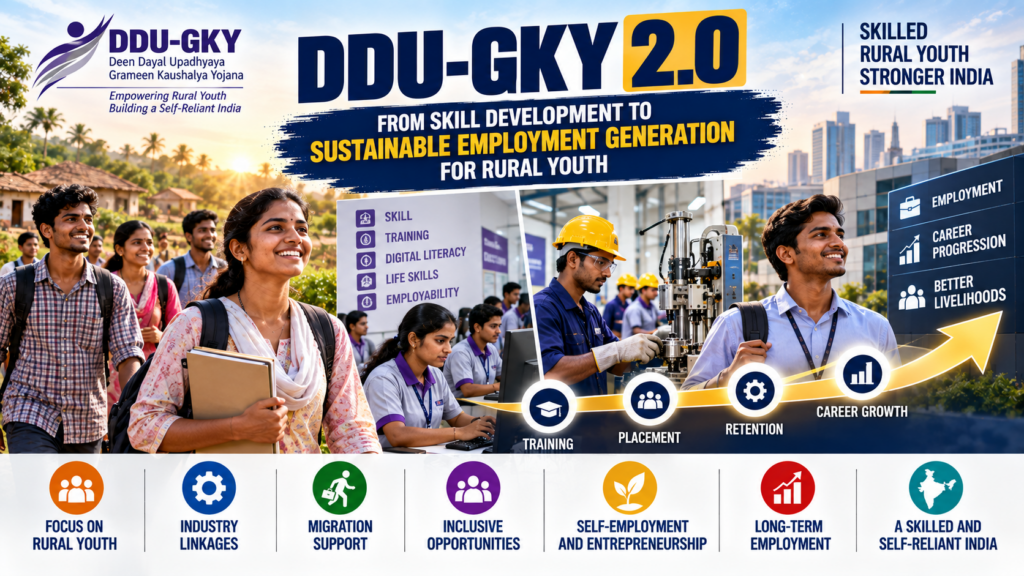
IN NEWS: Deen Dayal Upadhyaya Grameen Kaushalya Yojana 2.0 : Building a Skilled and Self-Reliant Workforce
QUESTION: DDU-GKY 2.0 represents a shift from skill development to sustainable employment generation for rural youth. Discuss. (15 marks, 250 words)
ANSWER: The Deen Dayal Upadhyaya Grameen Kaushalya Yojana (DDU-GKY), launched in 2014 under the National Rural Livelihoods Mission, was conceived as a placement-linked skilling programme for rural youth from poor households. The upgraded DDU-GKY 2.0 Guidelines, notified in May 2025, broaden this approach by focusing not merely on securing a placement but on employment retention, career progression and sustainable livelihoods.
DDU-GKY 2.0 : Focus on sustainable employment :
Retention
- DDU-GKY 2.0 increases the minimum placement duration from 3 months to 6 months and provides 12-month post-placement tracking, indicating a shift from securing employment to sustaining it.
- Retention-linked financial support further encourages candidates to remain in employment for longer periods.
- This makes employment continuity an explicit programme outcome rather than treating placement as the endpoint.
Employability
- The revised framework combines occupational training with digital literacy, English communication, employability and life skills and entrepreneurship.
- This helps bridge the gap between formal skill certification and actual workplace readiness.
- Training linked to emerging areas such as green jobs, healthcare, logistics and EV-related occupations can also help rural youth adapt to changing labour-market demand.
Progression
- DDU-GKY 2.0 provides opportunities for reskilling and upskilling, recognising that employability needs to evolve with technological and occupational changes.
- Thus, the objective moves from helping a rural youth obtain a first job towards enabling continued employability and career advancement.
- Sustainable employment requires not merely entry into the labour market but the ability to remain relevant and progress within it.
Mobility
- Migration Support Centres provide rural youth migrating for employment with assistance such as counselling, employment information, placement support and accommodation-related assistance.
- By providing support at the migration stage, the scheme recognises that difficulties after leaving the home region can affect employment continuity.
- This makes labour mobility a more supported pathway to livelihood improvement rather than treating migration as an issue outside the skilling programme.
Linkages
- Job Melas, employer tie-ups and industry participation strengthen the connection between training and actual employment opportunities.
- Under the Captive Employment/Recruit-Train-Deploy model, employers participate in training candidates according to their manpower requirements and subsequently employ them.
- This creates a direct training, employer demand , employment pathway and can reduce the persistent skill job mismatch .
Inclusion
DDU-GKY incorporates special interventions for regions and groups facing distinctive barriers to employment.
- Roshni provides residential skill training for rural youth in Left-Wing Extremism-affected districts and has been extended to Aspirational Districts. Its focus on women and local livelihood opportunities demonstrates the importance of context-specific skills for vulnerable regions.
- Himayat is a special DDU-GKY initiative for youth in Jammu & Kashmir and Ladakh, providing employment-oriented training with pathways to wage employment, self-employment and emerging forms of work. It demonstrates how skilling can be adapted to region-specific employment needs.
- Special provisions for the North-Eastern States and hard-to-reach areas recognise that geographical isolation, connectivity constraints and higher delivery costs can restrict access to skilling. Additional support for difficult areas helps make training provision viable in such locations.
Livelihoods
- DDU-GKY 2.0 recognises wage employment, self-employment and gig employment, thereby broadening the concept of sustainable livelihood beyond conventional salaried jobs.
- Rural Self Employment Training Institutes (RSETIs) complement wage-employment pathways by providing rural youth with entrepreneurship training and handholding support to establish self-employment ventures.
- RSETIs therefore illustrate an alternative pathway of training to enterprise creation to self-employment, where rural youth can become employment creators rather than only employment seekers.
Significance of the Scheme:
- Employment quality: The emphasis on retention and post-placement tracking shifts attention from the number of placements to the durability of employment.
- Skill alignment: Industry participation and demand-linked training can improve the correspondence between skills possessed by rural youth and skills required by employers.
- Rural diversification: Access to non-farm employment, entrepreneurship and emerging occupations can provide rural households with additional livelihood options beyond agriculture and casual labour.
- Income stability: Longer employment duration, retention support and career progression can help rural youth move towards more predictable and sustainable income streams.
- Labour mobility: Migration support can enable rural workers to access opportunities outside their home regions while reducing some of the practical difficulties associated with migration.
- Regional equity: Initiatives such as Roshni, Himayat and special provisions for the North-East and difficult areas acknowledge that uniform skilling interventions may not adequately address geographically and socially differentiated barriers.
- Women’s participation: Greater access to employment-oriented training, including the focus on women under initiatives such as Roshni, can strengthen women’s participation in paid employment, provided barriers to retention are also addressed.
Challenges of the Scheme:
- Placement does not necessarily mean sustainable employment since wages, working conditions, job security and opportunities for advancement also determine livelihood outcomes.
- Six months of employment cannot by itself establish a long-term career, making continued reskilling and progression important.
- Rapid technological changes can create new skill gaps, requiring regular curriculum revision and stronger industry participation.
- Gig and informal employment can provide opportunities without adequate social protection, highlighting the need for portable welfare and social-security mechanisms.
- Women may face mobility, care responsibilities and workplace-related constraints, which can affect their ability to retain employment.
- Regional differences in labour demand can limit the returns from skilling, particularly where suitable employment opportunities remain limited.
Way Forward
- Outcome-based monitoring should assess employment duration, wages, retention and career progression alongside the number trained and placed.
- Labour-market mapping should guide the selection of trades and regular revision of training curricula.
- Greater convergence among DDU-GKY, DAY-NRLM, RSETIs, MSMEs and industry can create an integrated rural livelihood ecosystem.
- Portable social-security benefits should accompany labour mobility, particularly for migrant and gig workers.
- Continuous reskilling and upskilling should become part of the employment lifecycle rather than being treated as a one-time intervention.
DDU-GKY 2.0 broadens the meaning of successful skilling from obtaining a job to sustaining employment and progressing towards a secure livelihood. Its emphasis on retention, industry linkages, migration support and context-specific initiatives reflects a shift towards a more durable and inclusive rural employment generation.
|
SOURCE: The Press Information Bureau