
|
IN NEWS: India and the plausible multilateralism of BRICS
QUESTION: ”The growing internal divergences within BRICS pose challenges to its effectiveness as a multilateral grouping.” In this context, examine the role of India in making BRICS a meaningful platform for global cooperation. (10 marks, 150 words)
ANSWER: BRICS has evolved from an economic grouping into a significant platform for Global South cooperation and reform of the international order. Its expansion has increased its representativeness but also brought together countries with competing strategic interests. However, as the article highlights, “internal contradictions” and “external convergence” can coexist, making BRICS particularly relevant to India’s strategic autonomy.
Internal divergences within BRICS
- India – China strategic rivalry: Unresolved border issues and competition in the Indo-Pacific constrain political convergence.
- Conflicting geopolitical interests: Differences over the Ukraine war, West Asian conflicts and relations with the U.S. create divergent priorities.
- Iran – UAE/West Asian tensions: BRICS brings countries with competing regional interests onto a common platform, creating space for dialogue.
- Russia–West confrontation: Russia’s increasingly adversarial relationship with the West does not correspond with the interests of members such as India and the UAE.
- Heterogeneous membership: Different political systems, economic structures and foreign-policy orientations make consensus more difficult.
- Risk of bloc politics: If BRICS becomes explicitly anti-Western, it could constrain members such as India that maintain extensive relations with the U.S. and Europe.
Yet, areas of external convergence exist,
Despite these differences, members broadly share interests in:
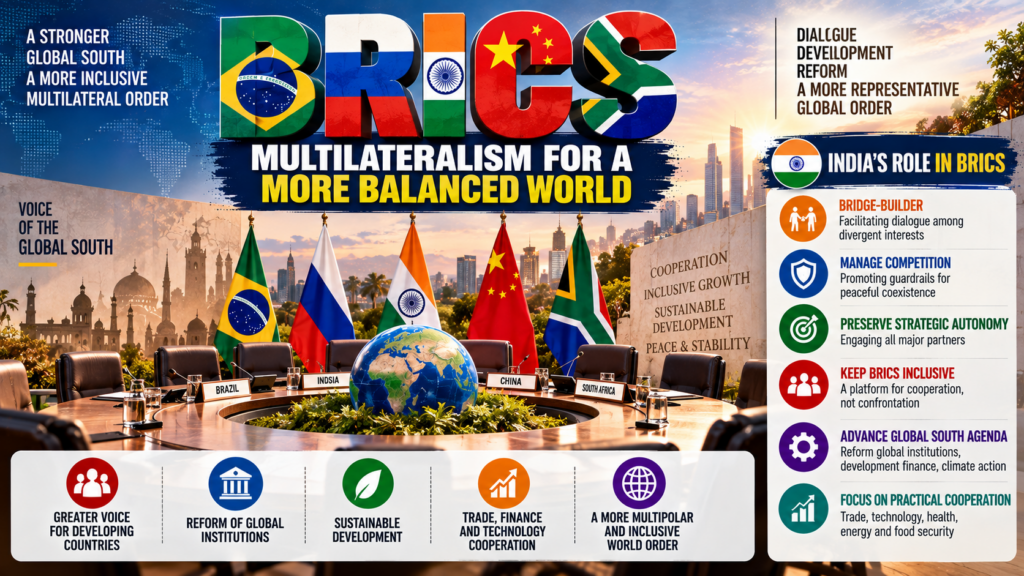
- A more representative and multipolar global order
- Reform of global governance institutions
- Greater voice for the Global South
- Cooperation on trade, finance, climate change, health and technology
- Opposition to unilateral approaches that undermine multilateral institutions
Thus, BRICS does not require complete geopolitical convergence to produce meaningful cooperation.
India’s role in BRICS:
- Bridge-builder and dialogue facilitator
India can use BRICS to keep communication open among competing powers. The grouping provides a platform where India can engage China despite bilateral tensions and interact with countries having divergent positions on global conflicts.
- Promote “guardrails” for competitive coexistence
Rather than attempting to eliminate India–China competition, India can use multilateral platforms such as BRICS to manage differences and prevent competition from escalating into confrontation.
- Preserve strategic autonomy
The article cautions against India becoming a frontline in the U.S.–China strategic competition. BRICS allows India to maintain engagement with China and Russia while simultaneously deepening its partnerships with the U.S., Europe, Japan and other partners.
- Prevent BRICS from becoming an anti-Western bloc
India can ensure that BRICS remains a platform for multilateral cooperation rather than ideological confrontation with the West. This complements India’s multi-aligned foreign policy.
- Strengthen the Global South agenda
India can use BRICS to advance:
- Reform of the UN and international financial institutions
- Greater representation for developing countries
- Development finance
- Climate and energy cooperation
- Food and health security
- Focus on functional cooperation
Where geopolitical consensus is difficult, India can promote cooperation in areas of shared interest such as AI governance, digital technologies, resilient supply chains, development finance, climate action and public health.
- Strengthen BRICS institutions
India can contribute to making mechanisms such as the New Development Bank more effective in financing infrastructure and sustainable development in developing countries.
The significance of BRICS for India lies not in the absence of contradictions but in its ability to manage them. Its structure gives India diplomatic space to engage competing powers while avoiding exclusive alignment with any one bloc. Therefore, India should pursue “functional convergence amid strategic divergence” using BRICS to promote dialogue, strategic autonomy, Global South interests and a more representative multilateral order.
|
SOURCE: The Hindu e-paper – India and the plausible multilateralism of BRICS