
|
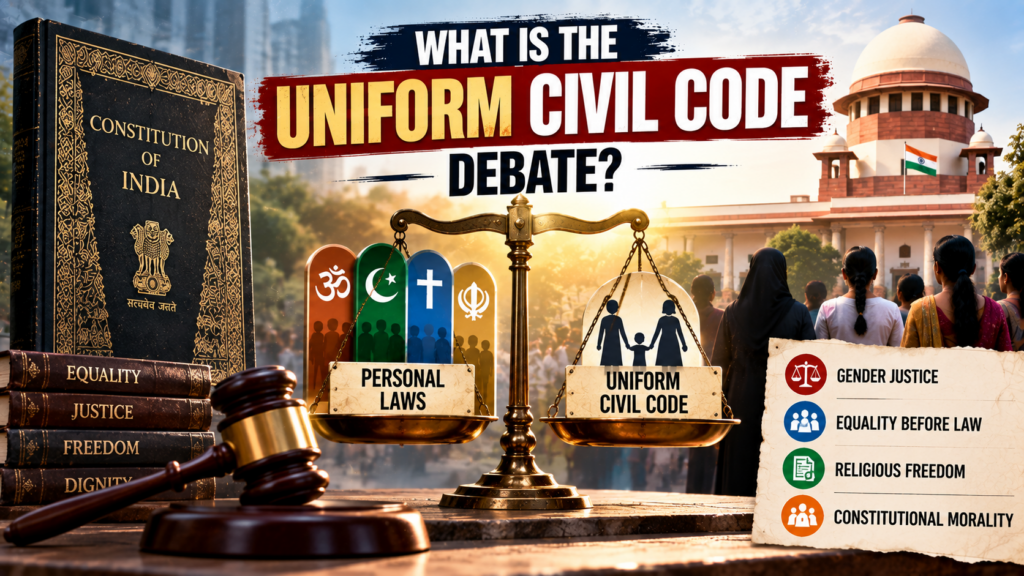
IN NEWS: What is the Uniform Civil Code debate?
QUESTION: To what extent can constitutional morality be invoked to reform personal laws that are alleged to discriminate against women? Discuss.
ANSWER: Constitutional morality refers to the adherence to the fundamental principles, values, and ideals embedded within a Constitution—such as liberty, equality, non-discrimination, human dignity, and justice. In the Indian context, it serves as a crucial judicial tool for evaluating laws against the moral framework established by the Constitution, rather than relying on societal or majoritarian morality.
Constitutional Morality as a Tool for Personal Law Reform
- Supremacy of Fundamental Rights over Customary Laws: Under Article 13(1), any law in force before the commencement of the Constitution that violates Fundamental Rights is void. Judicial interpretation increasingly holds that faith-based personal practices cannot claim immunity if they violate Articles 14 (Equality), 15 (Prohibition of discrimination), and 21 (Right to Life and Personal Dignity).
- Affirmation of Gender Equality and Individual Dignity: In the landmark Sabarimala case (Indian Young Lawyers Association v. State of Kerala, 2018) and Shayara Bano v. Union of India (2017), the Supreme Court emphasized that constitutional morality prioritizes individual rights and dignity over institutional or religious practices that enforce gender-based exclusion.
- Overcoming Majoritarian and Societal Morality: Judicial reliance on constitutional morality prevents courts from bowing to entrenched societal prejudices or patriarchal traditions, ensuring that vulnerable or marginalized groups—particularly women—receive constitutional protection.
Key Challenges and Limitations in Invoking Constitutional Morality
- Tension with Religious Freedom (Articles 25 and 26): Faith communities often argue that personal laws form an essential part of their freedom of religion. Striking a balance between individual gender rights (Article 14) and collective freedom of conscience (Article 25) remains a contentious constitutional challenge.
- Judicial Overreach and Subjectivity: Critics argue that “constitutional morality” lacks a rigid statutory definition, giving broad discretion to judges. Applying it too aggressively to religious domains without legislative action risks allegations of judicial overreach and statutory instability.
- Social Resistance and Backlash: Top-down judicial reform driven purely by constitutional interpretation can provoke community resistance if not accompanied by organic social awareness or legislative consensus, potentially undermining compliance on the ground.
Constitutional morality acts as a vital transformative standard to ensure that personal laws do not become instruments of gender-based oppression. While judicial interventions based on constitutional values are essential to strike down discriminatory practices, long-term gender justice is best achieved when constitutional morality guides legislative action toward comprehensive reform and social sensitization.
|
SOURCE: The Hindu e-paper – What is the Uniform Civil Code debate?