
|
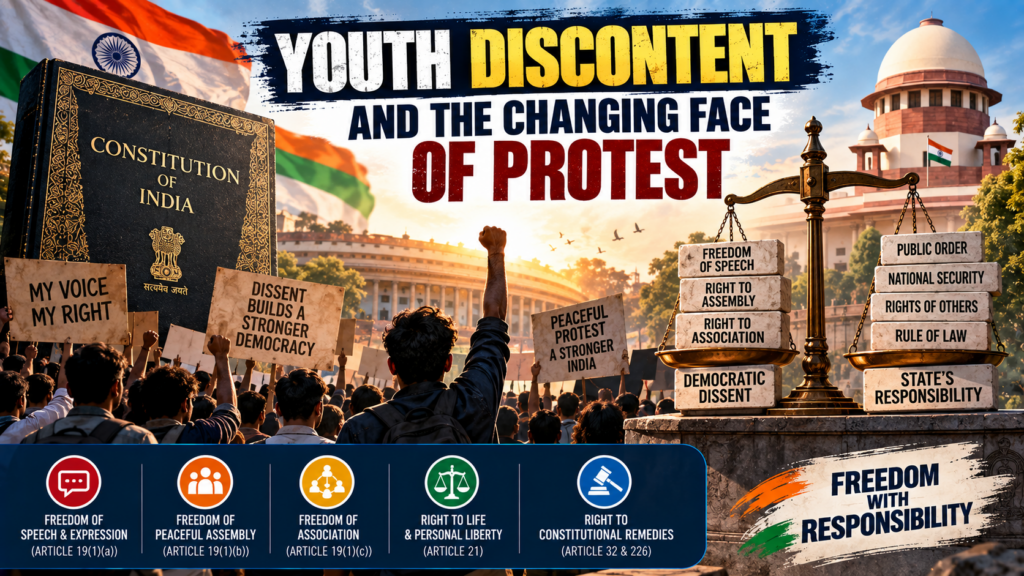
IN NEWS: Youth discontent and the changing face of protest
QUESTION: What are the constitutional safeguards available to citizens for peaceful protest and dissent? How can the State balance these freedoms with public order?
ANSWER: In democratic constitutions (such as the Constitution of India), the right to peaceful protest and dissent is anchored in fundamental fundamental rights, balanced against the state’s responsibility to maintain public order.
Constitutional Safeguards for Peaceful Protest and Dissent
- Freedom of Speech and Expression: Citizens have the right to express their opinions, dissent, and critique state policies through words, writing, publications, or symbolic acts. Dissent is recognized as an essential component of a vibrant democracy.
- Freedom of Peaceful Assembly: Citizens possess the right to gather peacefully without arms. This forms the bedrock of rallies, marches, and peaceful demonstrations.
- Freedom to Form Associations and Unions: The right to unite into groups, trade unions, or civic organizations allows citizens to collectively voice grievances and organize sustained movements.
- Right to Life and Personal Liberty: The state cannot arbitrarily arrest, detain, or use excessive force against peaceful demonstrators. Any restriction on liberty during a protest must be procedurally fair, just, and reasonable.
- Right to Constitutional Remedies: Citizens can directly approach higher courts (such as the High Courts or Supreme Court via writ petitions) to enforce their fundamental rights if a protest is unlawfully banned or if protestors are arbitrarily detained.
How the State Balances Fundamental Freedoms with Public Order
- Principle of Reasonable Restrictions: Fundamental rights to protest and assemble are not absolute. The state may impose reasonable restrictions on grounds such as public order, sovereignty and integrity of the nation, decency, morality, or security of the state.
- Doctrine of Proportionality: Any restraint imposed by administrative authorities (such as curfew orders, internet shutdowns, or preventive detentions) must be proportional to the threat. Force or prohibition used by law enforcement must be the minimum necessary to achieve the objective.
- Clear Legal Procedures and Prior Approvals: The state regulates the venue, time, and scale of demonstrations using regulatory frameworks (such as designated protest sites or police permissions) to ensure daily public movement and emergency services are not completely paralyzed.
- Judicial Review and Oversight: Constitutional courts act as a check on executive action. The judiciary ensures that section orders, unlawful assembly declarations, or police actions do not become tools to suppress legitimate political dissent under the guise of maintaining order.
- Duty of Citizens: Citizens are bound by constitutional duties to perform peaceful protests without resorting to destruction of public property, violence, or hatred, ensuring their dissent does not violate the fundamental rights of non-protesting citizens to move freely and carry on their livelihoods.
The constitutional right to peaceful protest and dissent serves as a vital safety valve for democracy, ensuring that public grievances can be voiced and addressed within the framework of law. While the state possesses legitimate authority to impose reasonable restrictions to preserve public order, such power must always satisfy the tests of proportionality, fairness, and necessity.
|
SOURCE: The Hindu e-paper – Youth discontent and the changing face of protest