
|
IN NEWS: Perilous retreat
QUESTION: Examine the significance of the Forest Rights Act, 2006 in correcting the historical injustices faced by forest-dwelling tribal communities. What challenges continue to undermine its effective implementation?
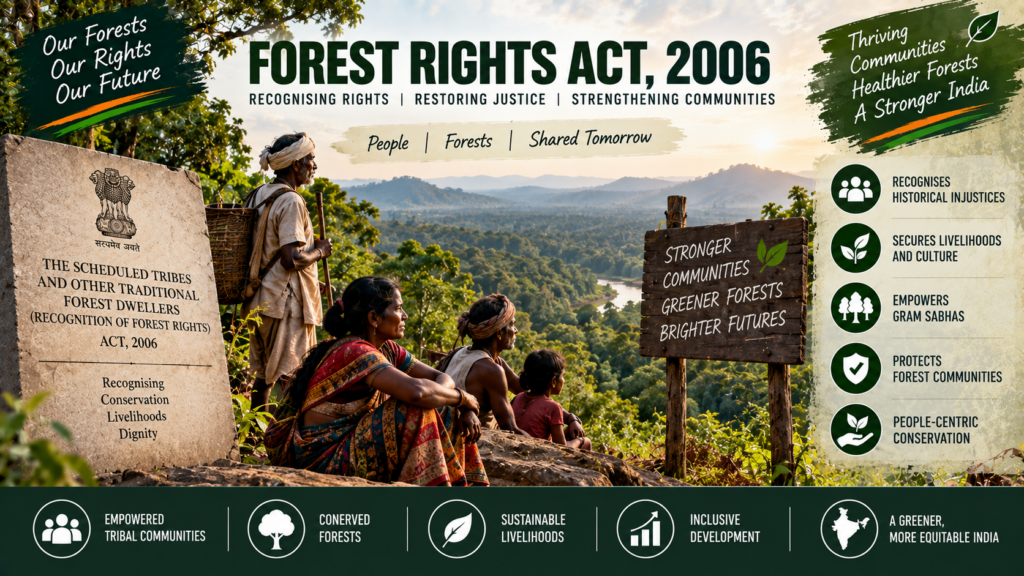
ANSWER: The Scheduled Tribes and Other Traditional Forest Dwellers (Recognition of Forest Rights) Act, 2006—commonly known as the Forest Rights Act (FRA)—marks a landmark departure from India’s colonial-era forest administration. By shifting the statutory focus from state-centric resource exploitation to democratic forest governance, the legislation seeks to undo generations of structural displacement and disenfranchisement.
Significance in Correcting Historical Injustices
- Transition from “Encroachers” to Rights-Holders: Under colonial regulations like the Indian Forest Act of 1927 and post-independence consolidation measures, forest dwellers were historically categorized as illegal occupants on state lands. The FRA formally recognizes their long-standing symbiotic relationship with forests, granting legal tenure over lands continuously occupied prior to December 13, 2005.
- Recognition of Community Forest Rights (CFR): Beyond individual agricultural holdings, the Act vests rights to collect, use, and dispose of Minor Forest Produce (MFP), access grazing areas and water bodies, and manage traditional forest resources. This restores traditional livelihoods and common property regimes previously nationalized by the state.
- Democratic Decentralization via the Gram Sabha: The Act shifts decision-making authority away from bureaucratic monopolies to local assemblies. The Gram Sabha is empowered as the primary statutory authority to initiate rights-determination processes and manage conserved forest domains.
- Protection against Arbitrary Eviction: The FRA prohibits the displacement of forest-dwelling communities from protected areas or development sites without completing the legal recognition of their rights and obtaining informed consent.
- Specific Redressal for Vulnerable Groups: It mandates the conversion of un-surveyed habitations and forest villages into regular revenue villages, recognizes habitat rights for Particularly Vulnerable Tribal Groups (PVTGs), and ensures joint land titles for women.
Challenges Undermining Implementation
- Bureaucratic Resistance and Institutional Inertia: Forest departments often hesitate to relinquish territorial control over timber and mineral-rich lands. State agencies frequently override or bypass Gram Sabhas in favor of Joint Forest Management Committees (JFMCs) or state-controlled forestry programs.
- High Claim Rejection Rates and Procedural Hurdles: Substantial numbers of Individual Forest Rights (IFR) and Community Forest Rights (CFR) claims are rejected summarily without providing written justifications or fair opportunities for appeal as required by the law.
- Stringent Evidentiary Requirements: Proving occupancy prior to the cutoff date poses a severe challenge for marginalized communities lacking formal documentation. For Other Traditional Forest Dwellers (OTFDs), satisfying the requirement of proving three generations (75 years) of residence remains a persistent bottleneck.
- Neglect of Community Forest Rights: Implementation has predominantly prioritized individual land titles (IFR) over broader community forest rights (CFR). Limiting CFR recognition deprives local bodies of legal management rights over critical forest ecosystems.
- Legislative and Policy Overlaps: Divergent objectives between the FRA, the Wildlife Protection Act (1972), the Forest Conservation Act (1980), and recent environmental amendments create operational friction. Commercial clearance for mining, infrastructure, and compensatory afforestation projects is frequently granted without securing prior Gram Sabha consent.
- Capacity Constraints at Local Levels: Many Gram Sabhas suffer from a lack of technical support, limited awareness of spatial mapping tools (such as GPS-based boundary demarcation), and inadequate funding, hindering their ability to process complex land claims effectively.
While the Forest Rights Act, 2006 offers a radical framework for tribal empowerment and decentralized conservation, bridging the gap between its legal mandate and ground-level execution requires political willpower, capacity-building for Gram Sabhas, and institutional alignment across government departments.
|