
|
IN NEWS: U.S. tariffs are not what is holding back Indian research
QUESTION: India’s weak research intensity in manufacturing predates recent trade tensions and reflects deeper structural deficiencies in its innovation ecosystem. Examine.
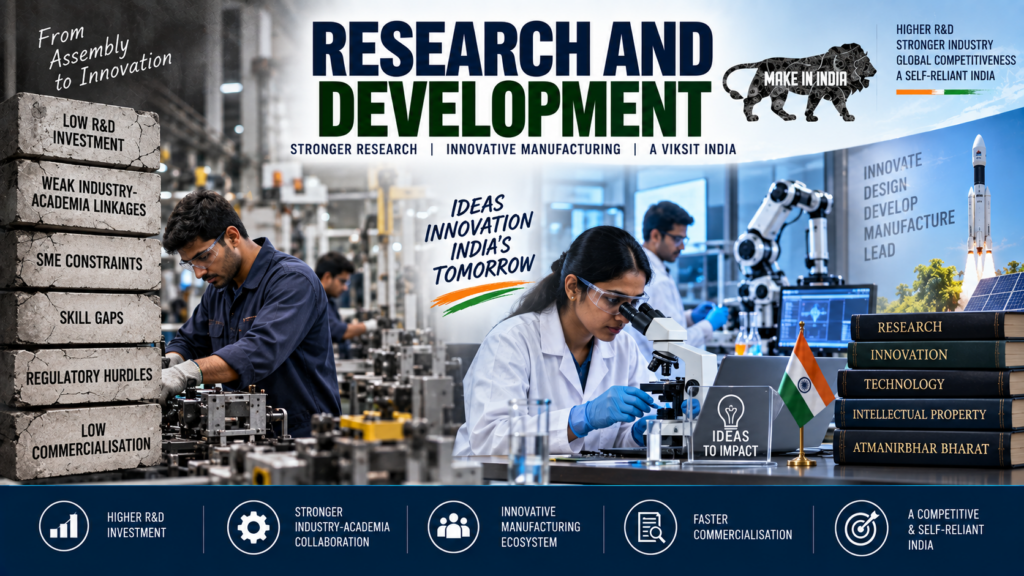
ANSWER: India’s low research intensity in manufacturing is an endemic structural issue that existed long before recent supply chain realignments and trade tensions. Historically, Indian manufacturing has optimized for low labor costs, reverse engineering, and low-value assembly. Moving toward innovation-based manufacturing requires addressing several foundational deficiencies across investment, institutional design, market structure, and human capital.
Low Expenditure and Skewed Capital Allocation
- Depressed Gross Expenditure on R&D (GERD): India’s national R&D spend has hovered around 0.6% to 0.8% of GDP for decades, far behind global innovation benchmarks such as South Korea (~4.8%), the US (~3.5%), and China (~2.4%).
- Disproportionate Public Sector Burden: Unlike advanced economies where private industry drives over 70% of R&D, India’s public sector historically bore nearly two-thirds of the R&D burden—primarily directed toward defense, space, and atomic energy rather than commercial manufacturing technologies.
- Siloed Fiscal Priorities: Manufacturing capital in India has primarily favored physical capacity expansion, real estate, and basic plant infrastructure over intangible assets, software integration, and patent creation.
Market Dynamics and Enterprise Fragility
- Predominance of Low-Scale MSMEs: Over 90% of Indian manufacturing enterprises are micro-units with limited balance-sheet room to absorb the risk or gestation period of long-term R&D.
- Missing Middle in Advanced Technology: India possesses a dualistic structure comprising large conglomerates and tiny informal units, with an absence of mid-sized, technology-intensive original equipment manufacturers (OEMs) akin to Germany’s Mittelstand.
- Risk Aversion and Short Horizons: Domestic firms have traditionally relied on technology imports, process reverse engineering, or royalty licensing from abroad rather than funding domestic lab-to-market commercialization.
Broken Academia-Industry Integration
- Institutional Separation: Higher education and research institutions operate in siloes, isolated from the operational mandates of manufacturing industries. Academic evaluations prioritize journal publication metrics over patents, technology transfers, or industrial utility.
- Absence of Intermediate Prototyping Facilities: The “valley of death” between proof-of-concept in university labs and full-scale commercial manufacturing remains wide due to a shortage of shared testing centers, pilot lines, and industrial incubators.
Regulatory Complexity and Weak Intellectual Property Delivery
- Inflexible IP Ecosystem: While patent filings have risen, the processing and grant lifecycles remain slow. Weak or unpredictable enforcement mechanisms disincentivize private firms from committing capital to high-risk, home-grown IP.
- Stringent Compliance Burden: Complex labor rules, land acquisition hurdles, and regulatory red tape divert management bandwidth away from technology strategy toward routine compliance management.
Skill Mismatch and Deep-Tech Talent Deficits
- Low Density of Applied Researchers: India has roughly 255 researchers per million people—drastically below global standards—with a severe shortage of specialized domain experts in advanced material science, precision tooling, power electronics, and industrial robotics.
- Rote-Learning and Curricular Stagnation: The higher engineering system historically prioritized volume output for service desk jobs over practical industrial research, resulting in widespread skill mismatches for advanced manufacturing tasks.
Addressing India’s structural deficiencies in manufacturing research intensity requires moving past short-term fiscal fixes toward systemic ecosystem reform. The convergence of global trade realignments and domestic industrial ambitions creates a clear mandate: India cannot rely on cost arbitrage alone to sustain long-term economic growth.
|
SOURCE: The Hindu e-paper – U.S. tariffs are not what is holding back Indian research