
|
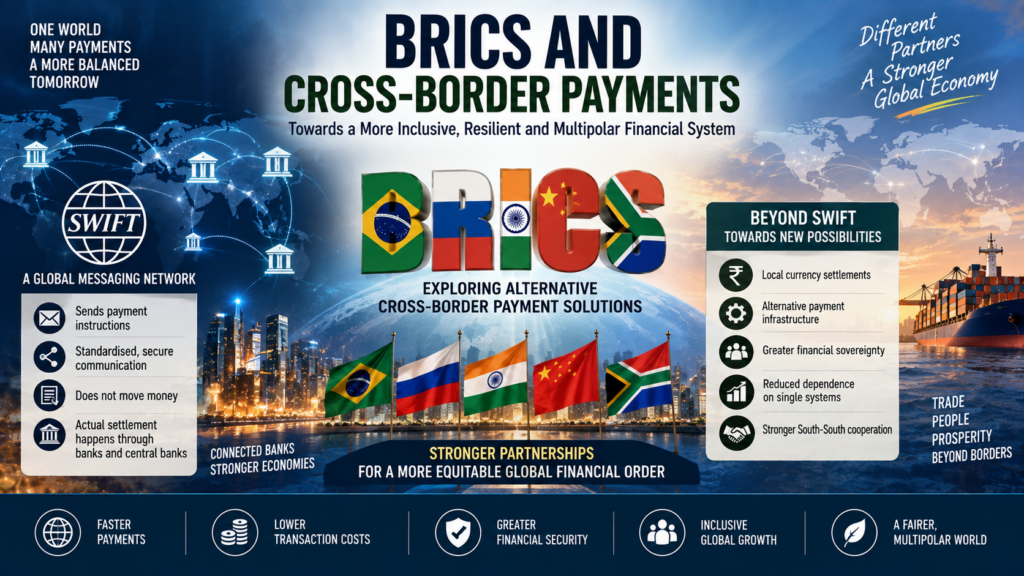
IN NEWS: Why is BRICS exploring cross-border payments?
QUESTION: SWIFT facilitates communication of payment instructions rather than the actual movement of money. Explain how this distinction helps understand the architecture of international payments.
ANSWER: The distinction between messaging (instruction) and settlement (value movement) is the core structural division in global banking. SWIFT acts as the secure messaging layer (the communication backbone), while central banks and commercial correspondent accounts handle the underlying settlement layer (the financial movement).
The Communication Layer (SWIFT)
- Message Standardization: SWIFT provides a standardized financial messaging format (historically MT messages, transitioning to ISO 20022/MX). This ensures that a bank in Tokyo and a bank in New York interpret payment parameters—such as beneficiary account numbers, intermediary routing codes, and foreign exchange instructions—identically.
- Instruction Transfer Without Balance Verification: SWIFT transmits encrypted instructions telling a receiver to debit one account and credit another. However, transmitting a SWIFT message does not alter any actual account balance or transfer real liquidity on its own.
- Security and Non-Repudiation: The protocol ensures that the instruction cannot be altered in transit and verifies that the sender is authenticated, establishing legal certainty before any monetary settlement occurs.
The Settlement Layer (Nostro/Vostro Accounts)
- Correspondent Banking Network: Actual money moves via adjustments across pre-funded accounts held between commercial banks, known as Nostro (“our money at your bank”) and Vostro (“your money at our bank”) accounts.
- Central Bank Real-Time Gross Settlement (RTGS): Final, risk-free settlement of fiat currencies happens on domestic central bank networks (e.g., Fedwire in the US, CHAPS in the UK, TARGET2 in the Eurozone). Money only “moves” when commercial bank reserves at a central bank shift, or when balance ledger entries update between correspondent partners.
Architectural Implications of the Separation
- Decoupled Architecture: Separating message transmission from monetary clearing allows SWIFT to connect over 11,000 institutions across more than 200 countries without requiring every bank to hold a direct credit link or central account with every other bank.
- Asynchronous Execution: Messaging occurs almost instantaneously, but settlement can take hours or days depending on local clearing hours, time-zone alignment, and compliance checks (AML/Sanctions screening).
- Credit and Liquidity Exposure: Because an instruction can arrive before funds settle, recipient banks face settlement risk. They must manage credit exposure to sending banks to decide whether to advance funds to the ultimate beneficiary before final settlement clears.
- Modularity and Innovation: Modern instant payment platforms, central bank digital currencies (CBDCs), and blockchain protocols aim to bridge this gap by marrying immediate messaging directly with real-time atomic settlement.
Modern payment innovations—including instant cross-border settlement rails and blockchain protocols—are aimed at closing this gap by merging secure messaging and real-time settlement into a unified transaction stream.
|
SOURCE: The Hindu e-paper – Why is BRICS exploring cross-border payments?