
|
IN NEWS: Warning on warming
QUESTION: Why does India’s per capita emission level remain important in international climate negotiations? Does it, by itself, justify India’s present mitigation trajectory?
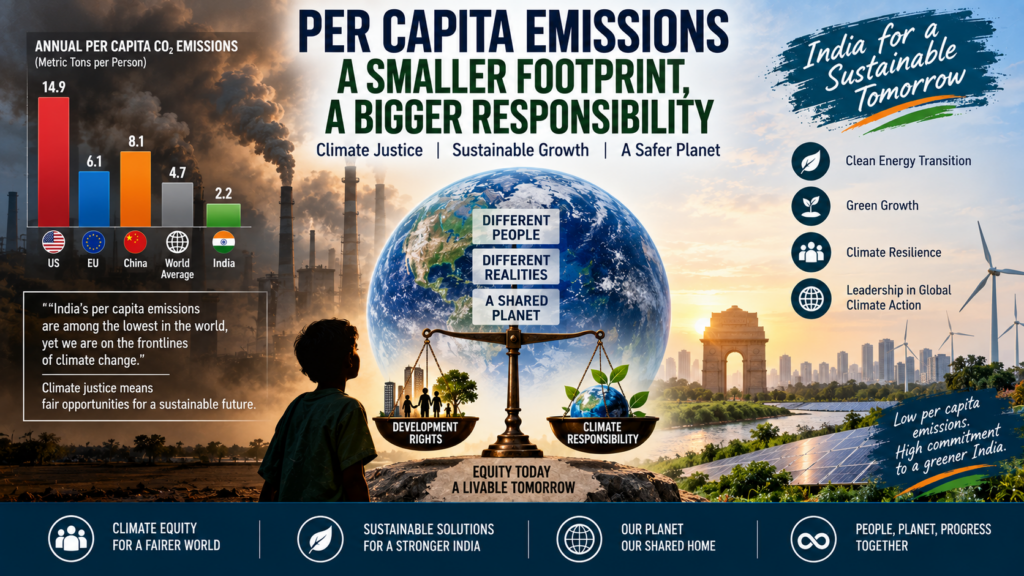
ANSWER: India’s per capita emission level— standing at roughly 2.2 metric tons of $\text{CO}_2$ per year, which is well below the global average of ~4.7 metric tons and less than half of major economies like the US, EU, or China—remains a cornerstone metric in international climate diplomacy.
Importance of Per Capita Emissions in International Negotiations
- Core Metric of Climate Equity & Individual Rights: The per capita framework grounds climate action in human rights. It posits that every individual on Earth has an equal right to the global carbon budget and atmospheric space, rather than treating countries as monolithic carbon emitters.
- Operationalizing CBDR-RC: It reinforces the UN principle of Common But Differentiated Responsibilities and Respective Capabilities (CBDR-RC). By decoupling aggregate national emissions from individual resource consumption, it highlights the historical carbon debt owed by industrialized nations whose citizens consume carbon at drastically higher rates.
- Protecting Development & Poverty Alleviation Space: Highlighting per capita emissions protects India’s policy room to industrialize, expand infrastructure, bring basic energy access to hundreds of millions, and lift its population out of poverty without being unfairly penalized by aggregate figures.
- Reflecting Consumption Patterns: Aggregate emissions hide stark domestic realities. India’s low per capita output reflects low baseline energy consumption per person compared to the luxury emissions prevalent in high-income economies.
Does Per Capita Emission Alone Justify India’s Mitigation Trajectory?
While low per capita emissions provide a strong moral and ethical defense, they do not, by themselves, fully justify India’s current or future mitigation trajectory. Relying exclusively on this single metric creates notable strategic, economic, and planetary limitations:
- The Reality of Aggregate Global Impact: Climate change is driven by the total volume of greenhouse gases in the atmosphere, not per-capita averages. As the world’s third-largest annual emitter (~3.2 billion tonnes of carbon dioxide), India’s aggregate growth directly shapes global temperature trajectories.
- Severe Vulnerability to Climate Risks: India is among the most climate-vulnerable nations, facing extreme heatwaves, glacier retreat, erratic monsoons, and sea-level rise. Delaying mitigation under the banner of low per-capita emissions directly hurts India’s long-term domestic economic and human security.
- Economic Opportunity & Industrial Competitiveness: Transitioning to clean energy is no longer just a burden; it is an economic driver. Early adoption of solar, green hydrogen, and electric mobility shields India from fossil fuel import volatility, lowers health costs, and positions the nation as a market leader in green manufacturing.
- A Dual-Track Justification Framework: Consequently, India justifies its mitigation trajectory through a combination of low per capita emissions (establishing the moral right to development) and proactive climate leadership. India demonstrates this by achieving its non-fossil capacity targets early, targeting net-zero by 2070, and establishing global institutions like the International Solar Alliance (ISA) and Coalition for Disaster Resilient Infrastructure (CDRI).
Per capita emissions remain indispensable as an ethical baseline for climate justice and burden-sharing in global negotiations. However, India’s actual mitigation trajectory is governed by a pragmatic blend of this equity principle, domestic economic self-interest, climate risk management, and global clean tech leadership.
|