
|
IN NEWS: New Delhi to quantify ocean wealth, climate risks in new accounting push
QUESTION: What is the significance of assigning a monetary value to marine fish resources? Discuss its role in promoting sustainable fisheries and the blue economy in India. (10 Marks, 150 Words)
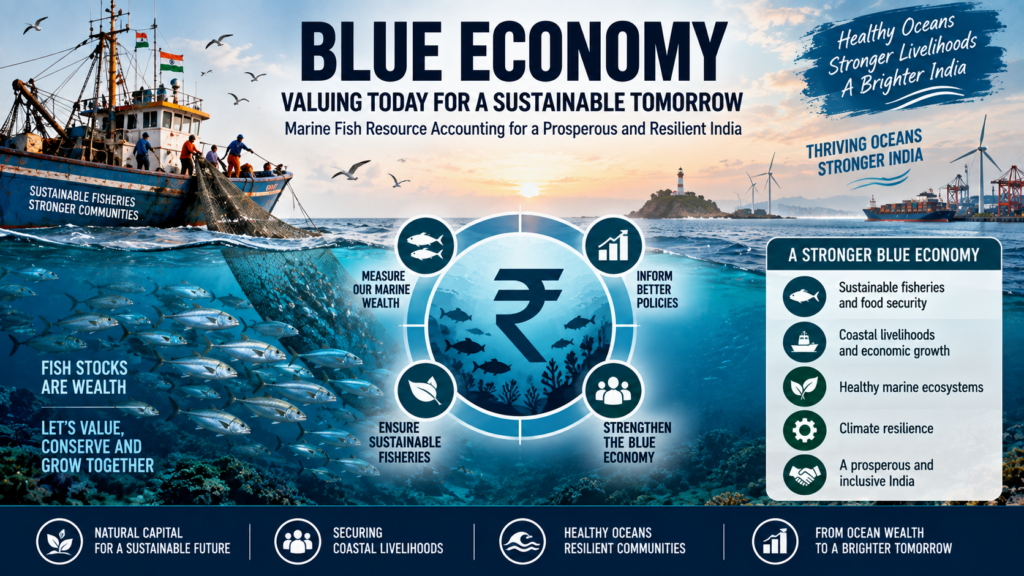
ANSWER: India has initiated Marine Fish Resource Accounting under the UN System of Environmental-Economic Accounting (SEEA) framework, treating marine fish stocks as natural capital assets and assigning them a monetary value. This marks a shift from measuring annual fish production to assessing the long-term wealth and sustainability of marine resources.
Significance of Assigning Monetary Value to Marine Fish Resources
- Recognises fish stocks as natural capital: Moves beyond catch statistics to assess whether marine resources are being depleted, maintained, or regenerated.
- Supports evidence-based policymaking: Enables scientific determination of catch limits and sustainable harvesting levels.
- Captures environmental costs: Quantifies losses arising from overfishing, habitat degradation, pollution, and climate change.
- Strengthens national accounting: Integrates marine wealth into environmental-economic accounts alongside forests, minerals, and water resources.
- Improves inter-generational equity: Ensures present exploitation does not compromise future livelihoods.
Role in Promoting Sustainable Fisheries
- Helps identify vulnerable fish stocks and regions requiring conservation.
- Supports ecosystem-based fisheries management and stock restoration programmes.
- Facilitates monitoring of climate-induced changes in marine ecosystems.
- Encourages responsible fishing practices and reduces overexploitation of resources.
- Supports India’s commitments under SDG 14 (Life Below Water).
Example: NITI Aayog estimates India’s EEZ resource potential at around 7.16 million metric tonnes, while warning against overexploitation of deep-sea resources.
Role in Strengthening the Blue Economy
- Supports India’s ambition of developing a $100-billion Blue Economy by 2030.
- Assists in balancing competing uses of ocean space—fisheries, ports, tourism, offshore energy, and coastal infrastructure.
- Enhances investor confidence through better valuation of marine assets.
- Promotes sustainable exports and coastal livelihood security.
Government Initiatives
- Pradhan Mantri Matsya Sampada Yojana (PMMSY)
- Fisheries and Aquaculture Infrastructure Development Fund (FIDF)
- Sagarmala Programme
- Deep Ocean Mission
- Blue Economy Policy Framework of India
Challenges
- Limited species-wise biomass data and stock assessments.
- Difficulty in valuing migratory and regenerative marine resources.
- Climate change and ocean warming create uncertainty in future stock values.
Conclusion
Marine fish resource accounting represents a transition from “measuring production” to “measuring sustainability.” By integrating ecology with economics, it can improve fisheries governance, protect marine biodiversity, strengthen coastal livelihoods, and ensure that India’s blue economy grows within ecological limits.
|
SOURCE: The Hindu e-paper – New Delhi to quantify ocean wealth, climate risks in new accounting push