
|
IN NEWS: All animals need equal consideration
QUESTION: Should Indian animal welfare jurisprudence move from a cruelty-prevention approach to a broader animal-dignity and welfare approach? Critically examine.
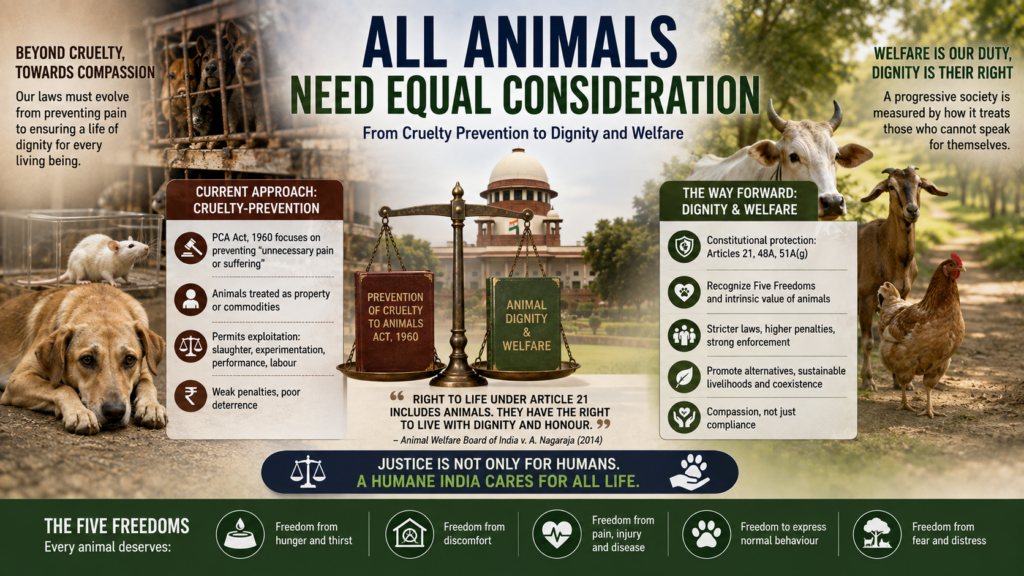
ANSWER: India’s animal welfare jurisprudence stands at a critical crossroads between anthropocentric regulation and ecocentric rights. Traditionally anchored in the Prevention of Cruelty to Animals (PCA) Act, 1960, Indian law has primarily focused on a negative duty—preventing “unnecessary pain and suffering”—while permitting the economic exploitation of non-human entities. However, landmark judicial interpretations, notably in Animal Welfare Board of India v. A. Nagaraja (2014), have sought to expand Article 21 (Right to Life) to include animal dignity and the internationally recognized Five Freedoms.
1. The Current Paradigm: Cruelty-Prevention Approach
India’s primary statutory framework, the Prevention of Cruelty to Animals (PCA) Act, 1960, is anchored in a welfare model aimed at preventing “unnecessary pain or suffering.”
- Statutory Limitations: The PCA Act does not prohibit the exploitation of animals; it merely regulates it. It permits activities like scientific experimentation, slaughter for food, and agricultural labor, provided “unnecessary” pain is avoided.
- Anthropocentric Bias: Animals are treated as property or commodities rather than right-holders. The legal focus is on regulating human behavior rather than establishing animal autonomy.
- Inadequate Penalties: Penalties under the 1960 Act (e.g., fines as low as ₹50 for first-time offenders) fail to act as a meaningful deterrent against systemic abuse.
2. Arguments for Transitioning to an Animal-Dignity & Rights Approach
- Expansion of Constitutional Protections (Article 21):
- In Animal Welfare Board of India v. A. Nagaraja (2014), the Supreme Court held that the right to life under Article 21 is not confined to humans alone, affirming that animals have an intrinsic right to live with dignity and honor.
- It formally recognized the Five Freedoms for animals (freedom from hunger, thirst, discomfort, pain/disease, and freedom to express natural behavior).
- Constitutional Realization of Duties: Articles 48A (Directive Principle for the State to protect wildlife) and 51A(g) (Fundamental Duty of citizens to show “compassion for living creatures”) gain substantive legal force when read alongside animal dignity.
- Ecocentric Alignment: Modern global environmental jurisprudence increasingly favors ecocentrism. Recognizing animal dignity aligns with the One Health approach, connecting ecosystem integrity directly to human health and survival.
- Deterrence Against Systemic Exploitation: A dignity-based standard restricts intensive industrial exploitation—such as battery cages in factory farming, unregulated commercial breeding, and harsh animal testing—where systemic suffering is normalized.
3. Challenges and Critical Concerns
- Socio-Economic Realities and Livelihoods: Millions of marginalized rural households rely on livestock, dairy, agrarian animal labor, and fisheries. Treating animals as right-holders with inviolable dignity could criminalize traditional livelihoods and threaten food security.
- Cultural and Religious Traditions: Customs involving animals (e.g., Jallikattu, Kambala, or traditional sacrifices) highlight conflicts between cultural rights (Article 29) and animal rights. The Supreme Court’s 2023 Constitution Bench judgment upholding state amendments on Jallikattu demonstrated that Parliament and state legislatures can regulate traditional practices through welfare safeguards without recognizing absolute animal dignity.
- Legal and Conceptual Ambiguity: Granting constitutional “dignity” or legal personhood to non-human entities creates enforcement dilemmas. For example, it blurs the legal boundary between human rights and animal interests, leading to complex conflicts in policy and law.
- Implementation and Institutional Gaps: State Animal Welfare Boards often lack adequate resources, personnel, and infrastructure. Shifting to a rights-based framework without strengthening enforcement mechanisms risks creating high legal standards on paper with little practical impact.
Way Forward
- Legislative Overhaul: Update the PCA Act, 1960, by incorporating species-specific welfare standards, stricter penalties, and formalizing the Five Freedoms within statutory law.
- Harmonizing Rights with Pragmatism: Adopt a qualified dignity approach that prohibits cruel practices (e.g., forced performance, abandonments, extreme confinement) while permitting regulated human use under strict, modern standards of care.
- Institutional Strengthening: Fund and empower the Animal Welfare Board of India (AWBI) and local SPCAs to ensure effective enforcement and monitoring.
- Gradual Transition to Alternatives: Support non-animal testing alternatives in research, promote sustainable alternative livelihoods for working-animal handlers, and incentivize modern, humane agricultural practices.
|
SOURCE: The Hindu e-paper – All animals need equal consideration