
|
IN NEWS: The broken promise of right to work
QUESTION: Distinguish between a welfare scheme and a rights-based welfare framework. Why does this distinction matter for employment guarantee programmes in India?
(150 words)
ANSWER: The evolution of public interventions in India reflects a fundamental paradigm shift from administrative discretion to constitutional accountability. Understanding the conceptual divide between a discretionary welfare scheme and a rights-based welfare framework is vital to evaluating India’s social safety net, particularly public employment programmes like MGNREGA.
Distinguishing Between a Welfare Scheme and a Rights-Based Welfare Framework
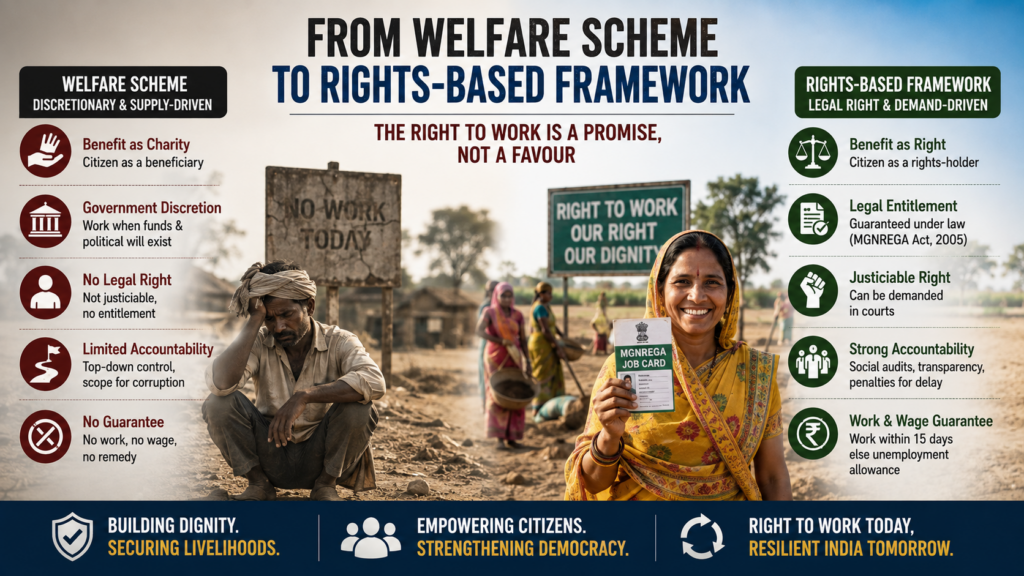
A welfare scheme is an executive-driven social assistance initiative implemented as a matter of policy discretion. In contrast, a rights-based welfare framework is a legally mandated system rooted in fundamental human and constitutional rights, creating enforceable claims against the state.
1. Conceptual Basis and Legal Status
- Welfare Scheme: Operates on executive orders, policy guidelines, or budgetary notifications. It is non-justiciable; citizens cannot approach the courts to demand its implementation if the government halts it.
- Rights-Based Framework: Backed by statutory legislation (e.g., MGNREGA 2005, NFSA 2013) anchored in constitutional principles (such as Article 21’s Right to Life and Article 41’s Right to Work). Benefits are legally enforceable entitlements.
2. Position of the Citizen
- Welfare Scheme: Treats the individual as a passive “beneficiary” or recipient of state patronage or charity.
- Rights-Based Framework: Frames the citizen as an active “rights-holder” empowered to demand services from the state as a matter of dignity.
3. State Obligation and Funding
- Welfare Scheme: State obligation is “supply-driven” and subject to fiscal availability. If funds run out, benefits can be reduced, paused, or terminated at administrative discretion.
- Rights-Based Framework: State obligation is “demand-driven” and mandatory. The government is legally bound to allocate necessary funds to meet citizen demand.
4. Accountability and Grievance Redressal
- Welfare Scheme: Rely on internal administrative chains of command. Redressal is informal and often discretionary.
- Rights-Based Framework: Establishes statutory grievance redressal mechanisms, legal penalties for non-compliance, social audits, and mandatory compensation (e.g., unemployment allowances or delay compensation).
Why the Distinction Matters for Employment Guarantee Programmes in India
Historically, India relied on discretionary work programmes such as the Jawahar Rozgar Yojana (JRY) or National Food for Work Programme (NFFWP). The shift to a rights-based model under the Mahatma Gandhi National Rural Employment Guarantee Act (MGNREGA) in 2005 transformed the political economy of rural labor in several key ways:
1. Shift from Supply-Driven to Demand-Driven Work
Under earlier employment schemes, work was opened only when local bureaucrats decided to start a project (supply-driven). In a rights-based framework, employment is triggered when workers demand it. If the state fails to provide work within 15 days of application, it is legally mandated to pay a statutory unemployment allowance, shifting the cost of administrative delay onto the state.
2. Structural Reduction of Patronage and Corruption
Discretionary schemes often fostered local clientelism, where job allocation was controlled by Sarpanches or contractors. A rights-based framework replaces discretionary selection with statutory guarantees, social audits, self-targeting mechanism (unskilled manual work), and direct wage transfers, empowering marginalized social groups (SC, ST, and women) to claim work without seeking political favors.
3. Protection Against Fiscal Arbitrariness
In discretionary schemes, central or state governments can easily cap budgets during fiscal austerity, halting employment during distress periods. Under an employment guarantee, budget allocations must adapt to demand surges (e.g., during agricultural lean seasons, droughts, or economic shocks like the COVID-19 pandemic).
4. Floor Price for Rural Labor and Bargaining Power
Because the right to work is legally backed with statutory minimum wages, it sets a reservation wage floor in the rural economy. Informal labourers are no longer forced into distress migration or exploitative private agricultural wages, significantly boosting their overall bargaining power in the local labor market.
5. Institutionalized Transparency and Participatory Governance
A rights-based framework incorporates mandatory democratic tools—such as Gram Sabha-led project planning, social audits by independent bodies, and public display of job cards and muster rolls. This shifts monitoring from top-down bureaucratic inspection to bottom-up civic oversight.
The distinction between a welfare scheme and a rights-based framework is not merely legalistic; it fundamentally redefines the relationship between the citizen and the state. By converting social assistance into a statutory right, employment guarantee schemes empower vulnerable households, institutionalize state accountability, and anchor economic security within democratic citizenship
|
SOURCE: The Hindu e-paper – The broken promise of right to work