
|
IN NEWS: A shared disaster, beyond borders and geopolitics
QUESTION: How do the fragile geology and steep topography of the Himalayas amplify the impact of glacial lake outbursts, landslides and flash floods? Discuss with suitable examples. (250 words, 15 marks)
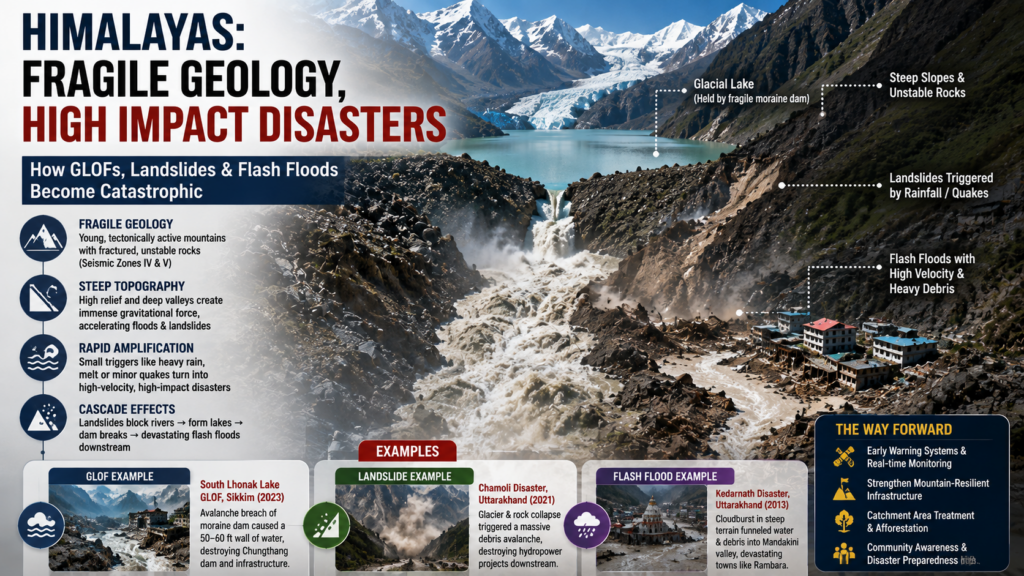
ANSWER: The young, tectonically active nature of the Himalayas—characterized by fragile, heavily fractured rock structures and high seismic sensitivity (Zones IV and V)—coupled with extreme topographical relief, acts as a powerful amplifier for natural hazards. When heavy precipitation, glacier melt, or minor earthquakes occur, the steep mountain terrain converts these triggers into high-velocity, catastrophic disasters.
Amplification of Glacial Lake Outburst Floods (GLOFs)
- Unconsolidated Moraine Dams: High-altitude Himalayan glacial lakes are typically impounded by terminal and lateral moraines—unconsolidated mixtures of loose boulders, gravel, and fine silt—rather than solid rock, making them structurally weak.
- Gravitational Momentum: The steep gradient of Himalayan valleys provides immense gravitational potential energy. When a moraine breaches, the escaping water accelerates rapidly, entraining massive amounts of sediment and transforming into a devastating debris flow.
- Example: The October 2023 South Lhonak Lake GLOF in Sikkim occurred when an avalanche or slope failure breached the fragile moraine dam at an altitude of 17,000 feet. The steep descent down the Teesta River basin propelled a colossal wall of water that surged 50–60 feet high, completely destroying the Chungthang dam and downstream infrastructure.
Amplification of Landslides and Mass Wasting
- Fractured Bedrock and Permafrost Thaw: Continuous tectonic convergence between the Indian and Eurasian plates leaves Himalayan rock faces heavily sheared. Elevation-dependent warming thaws permafrost, removing the “ice-cement” holding steep rock faces together.
- Shear Stress on Steep Slopes: The precipitous angle of Himalayan slopes means that minor triggers—such as heavy monsoon spells or small tremors—drastically increase down-slope shear stress, leading to massive rockfalls and slope failures.
- Cascade Effects (LLOFs): Landslides frequently collapse into narrow river channels, creating temporary “landslide lakes.” When these unstable natural dams overflow or collapse, they unleash secondary catastrophic flash floods downstream.
- Example: The 2021 Chamoli disaster in Uttarakhand was triggered when a steep hanging glacier and rock face collapsed into the narrow Rishi Ganga gorge. The falling mass instantly fluidized, generating a massive debris avalanche that scoured the valley floor and destroyed multiple hydropower units.
Amplification of Flash Floods and Cloudbursts
- Topographic Funneling: Steep, V-shaped Himalayan gorges act as natural funnels. When localized cloudbursts dump heavy rainfall over a short duration, the water cannot spread out; instead, it is violently channeled into narrow stream beds.
- High Kinetic Energy and Debris Loaddings: As high-velocity water rushes down steep slopes, it scours riverbeds and picks up accumulated construction muck, loose soil, and boulders. This transforms ordinary rainfall into high-density mudflows possessing exponential destructive force.
- Example: The 2013 Kedarnath disaster was heavily intensified by a cloudburst over the steep terrain surrounding the Chorabari basin. The precipitous topography funneled massive volumes of water and glacial debris directly into the Mandakini valley, where high flow velocities and heavy sediment loading obliterated towns like Rambara.
The inherent fragility of Himalayan geology and the high-relief topography ensure that environmental triggers do not remain localized incidents. Instead, they cascade rapidly through river basins, turning localized climatic events into large-scale humanitarian and ecological crises.
|