
|
IN NEWS: Danger from above
QUESTION: Examine the conflict between ecological fragility and infrastructure-led development in the Himalayas. What principles should guide development in high-risk mountain regions?
ANSWER: The Himalayan mountain range is young, tectonically active, and ecologically fragile. Rapid infrastructure-led development—such as wide highways, mega-hydroelectric projects, and intensive urbanization—frequently conflicts with the natural carrying capacity of the region, accelerating disasters like land subsidence, flash floods, and massive slope failures.
Conflict Between Ecological Fragility and Infrastructure Development
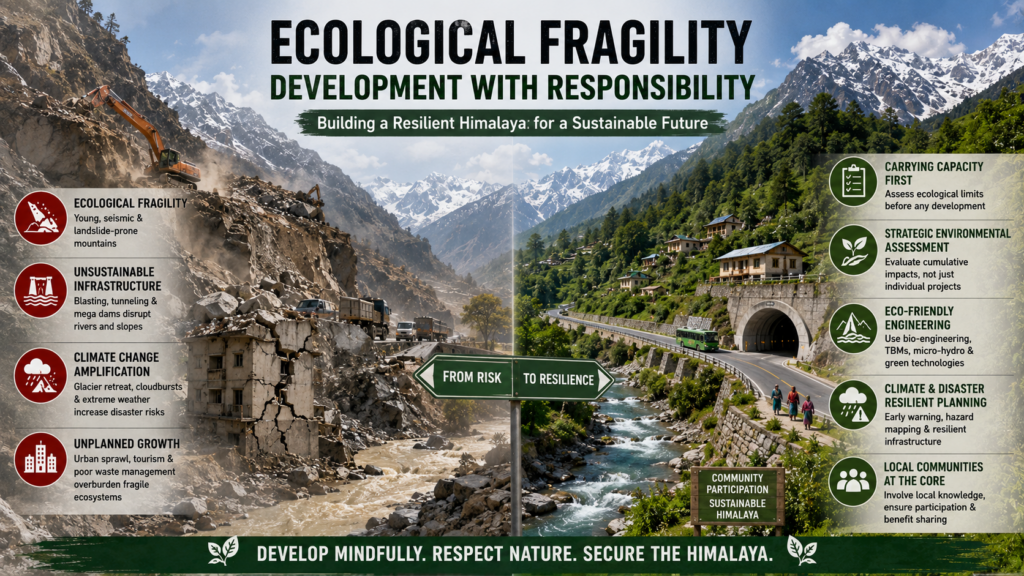
- Geological Instability vs. Heavy Excavation: The Himalayas are prone to frequent seismic activity and landslides. Large-scale blasting, slope cutting for multi-lane highways (e.g., Char Dham Highway), and tunneling destabilize fragile rock strata, causing widespread land subsidence as seen in Joshimath.
- Hydrological Disruption vs. Mega Hydro Projects: Damming glacial rivers and tunneling through mountains diverts natural aquifers, dries up local springs, and creates artificial reservoirs. This amplifies the risk of Glacial Lake Outburst Floods (GLOFs) and flash floods, as demonstrated in the 2021 Chamoli disaster.
- Climate Change Amplification: Global warming accelerates glacier retreat and increases cloudburst frequency. Deforestation for infrastructure strips away natural soil binders, turning normal seasonal rainfall into catastrophic debris flows.
- Unplanned Tourism and Urban Sprawl: Rapid building construction, inadequate solid waste management, and untreated sewage discharge overburden narrow mountain valleys, compromising local ecosystems and river health.
Guiding Principles for Sustainable Development in High-Risk Mountain Regions
- Rigorous Carrying Capacity Assessments: Development must be capped based on scientific evaluation of an ecosystem’s maximum stress threshold before launching mega-projects or expanding urban settlements.
- Strict Strategic Environmental Assessment (SEA): Shift from isolated project-level Environmental Impact Assessments (EIAs) to region-wide SEAs that evaluate cumulative environmental impacts across entire river basins and mountain chains.
- Adoption of Eco-Friendly Engineering: Implement eco-sensitive techniques like bio-engineering for slope stabilization, tunneling using tunnel boring machines (TBMs) instead of open blasting, and micro-hydro projects over mega-dams.
- Climate-Resilient & Disaster-Safe Planning: Incorporate real-time GLOF early warning systems, strictly enforce landslide vulnerability zone mapping, and mandate earthquake-resistant infrastructure codes.
- Local Community Governance & Indigenous Knowledge: Involve native mountain communities in planning and monitoring, leveraging traditional water harvesting, local architectural practices, and natural resource management.
Development in the Himalayas cannot follow the plains’ template; it demands a shift from resource-exploitative growth to a bio-regional model that treats ecological stability as a precondition for security and progress.
|