
|
IN NEWS: Govt. promises permanent solution to Gorkha issue, sets up committee
QUESTION: The recent Gorkha issue has renewed the debate on accommodating regional aspirations within India’s federal framework. In this context, Examine the constitutional and institutional mechanisms available for greater regional autonomy in India. (15 Marks)
ANSWER: India’s federalism accommodates diversity through differentiated political and administrative arrangements. The recent decision of the Centre to constitute a committee under Pankaj Kumar Singh to work towards a “permanent political solution” to the Gorkha identity issue within the constitutional framework has once again highlighted the challenge of reconciling regional aspirations with national unity.
- Constitutional mechanisms for accommodating regional aspirations
Territorial reorganisation as the primary mechanism
- The Constitution provides considerable flexibility to respond to territorial aspirations.
- Articles 2–4 empower Parliament to create new States and alter the area, boundaries or names of existing States. Thus, State reorganisation itself is an important instrument of conflict resolution within Indian federalism.
Asymmetric federalism for distinctive regional identities
- Where complete Statehood may not be necessary, the Constitution provides differentiated governance arrangements.
- Fifth Schedule provides special administration and safeguards for Scheduled Areas through mechanisms such as Tribes Advisory Councils and special responsibilities of Governors.
- Sixth Schedule provides substantially greater autonomy through Autonomous District and Regional Councils in Assam, Meghalaya, Tripura and Mizoram, including powers relating to land, forests, customary practices, local administration and limited taxation.
- Article 244A provides for creation of an Autonomous State within Assam with a legislature and/or Council of Ministers, demonstrating the possibility of an intermediate arrangement between ordinary State administration and full Statehood.
- Articles 371–371J provide differentiated constitutional arrangements for States such as Nagaland, Mizoram, Manipur, Sikkim and Karnataka.
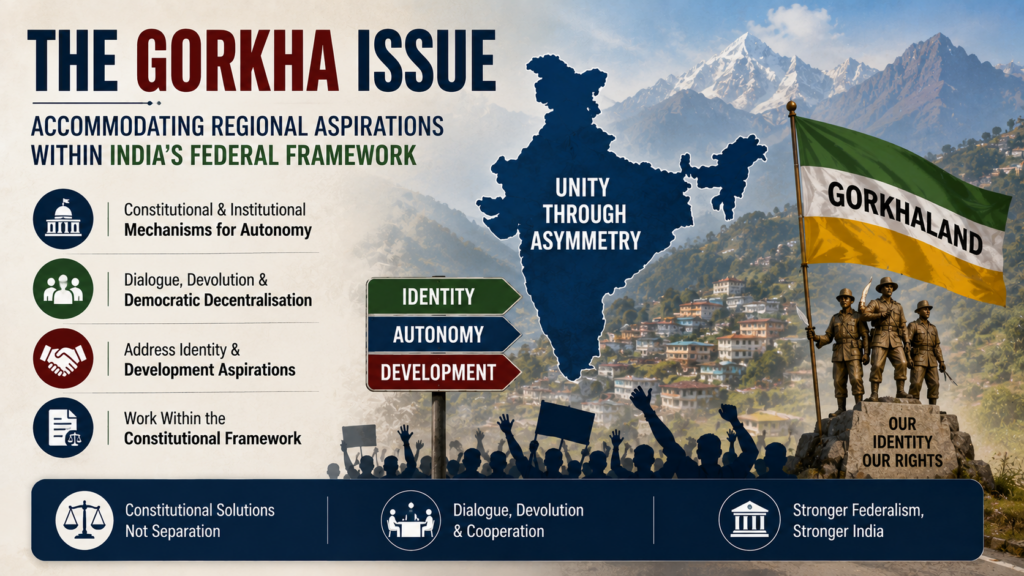
This illustrates the principle of “unity through asymmetry” that different regions can have different institutional arrangements while remaining within the Union.
Democratic decentralisation
- Regional aspirations can also be addressed by taking governance closer to the people.
- The 73rd and 74th Constitutional Amendments constitutionalised Panchayats and Municipalities.
- In Scheduled Areas, the PESA Act, 1996 strengthens the role of Gram Sabhas in matters involving customary practices, community resources and local development.
Thus, effective decentralisation can reduce perceptions of political exclusion and administrative centralisation.
- Institutional Mechanisms for Greater Regional Autonomy
Statutory Autonomous Councils: Created via State or Tripartite Acts (e.g., Gorkhaland Territorial Administration Act, 2012) to grant administrative, executive, and financial powers over specific subjects like education, agriculture, and roads without granting full statehood.
Inter-State Council (ISC): A constitutional body under Article 263 that serves as a presidential forum to investigate, discuss and deliberate on inter-state and Centre-state policy coordination.
Zonal Councils: Statutory bodies established under the States Reorganisation Act, 1956 to promote regional integration and address shared inter-state infrastructure, security and economic friction.
Finance Commission: A constitutional body under Article 280 that uses horizontal devolution criteria (e.g., demographic distance, income gap, forest cover) to address regional economic disparities.
NITI Aayog (Regional Councils): Institutional platforms created under NITI Aayog to address specific, shared regional development issues across contiguous groups of states or ecologically fragile regions (such as the Himalayan states)
Challenges and Limitations in Operation
- Financial Dependency: Bodies like the Gorkhaland Territorial Administration (GTA) or Karbi Anglong Autonomous Council rely on state governments for fund transfers, leading to administrative paralysis when political rivalries occur.
- Overlapping Jurisdiction: Friction between state administration officials (e.g., District Collectors) and elected ADC representatives causes institutional gridlock.
- Asymmetric Devolution Deficit: Sixth Schedule councils hold legislative power, whereas Fifth Schedule TACs remain purely advisory bodies dominated by the Governor and State Cabinet.
- Sub-State Marginalization: Minorities within autonomous council territories (non-tribals or smaller ethnic groups) often face secondary marginalization, leading to demands for nested sub-autonomy.
Gorkha issue: the larger lesson
The present initiative demonstrates that regional aspirations need not always culminate in territorial separation. A graded approach which ranges from greater devolution and autonomous institutions to, where necessary, State reorganisation can provide constitutional avenues for accommodation.
However, autonomy arrangements must ensure genuine transfer of powers, adequate finances, democratic accountability and clarity of jurisdiction. Otherwise, institutions such as the GTA may fail to satisfy underlying political aspirations.
Way forward
- Institutionalise continuous Centre–State–regional dialogue.
- Ensure 3Fs — functions, funds and functionaries for autonomous institutions.
- Address both identity and developmental grievances.
- Make autonomy arrangements democratically accountable.
- Evaluate statehood demands objectively rather than purely politically.
- Follow a constitutional, consultative and flexible federal approach.
India’s federal success lies not in suppressing regional aspirations but in institutionalising their accommodation. The Gorkha issue therefore illustrates a broader principle: responsive federalism can transform regional identity from a challenge to national unity into a strength of India’s plural democracy
|
SOURCE: The Hindu e-paper Govt. promises permanent solution to Gorkha issue