
SYLLABUS: Science and Technology, Internal security
General Studies – : III Science and Technology- Developments and their Applications;
Internal Security Challenges; Role of Technology in Internal Security.
IN NEWS: Saving faces-Use of facial recognition equipment at protest sites is worrisome
QUESTION:
What is Facial Recognition Technology (FRT)? Discuss its applications in policing and internal security. (15 Marks)
ANSWER:
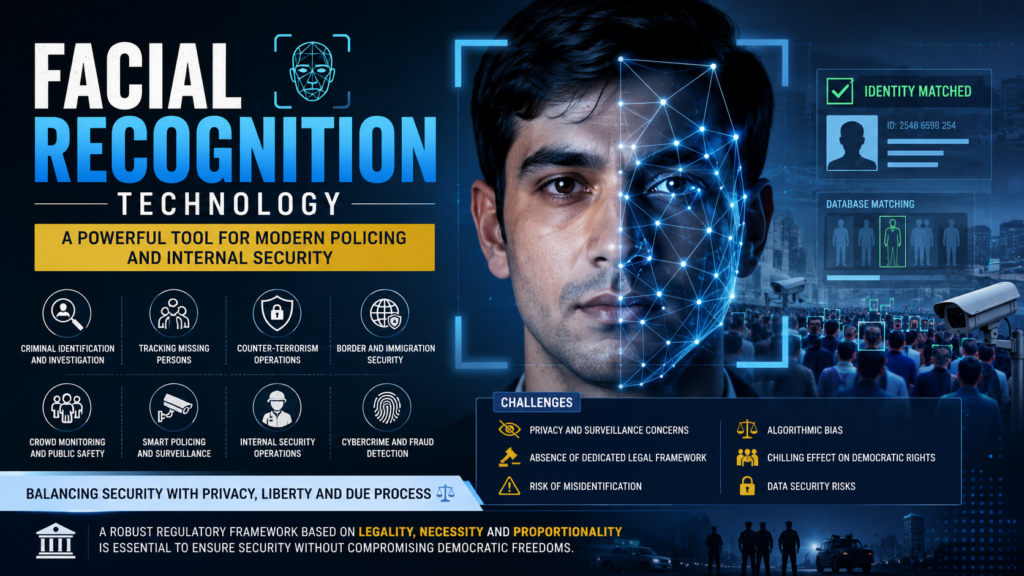
Facial Recognition Technology (FRT) is an AI-based biometric technology that identifies or verifies individuals by analysing and mapping unique facial features. It creates a digital facial template and matches it against existing databases to establish identity.Facial Recognition Technology (FRT) operates through 1:1 verification (authentication) and 1:N identification (searching against a database). In India, systems such as the Automated Facial Recognition System (AFRS) of the National Crime Records Bureau (NCRB) are being developed to enhance law enforcement and internal security capabilities.
Applications of FRT in Policing and Internal Security
1. Criminal Identification and Investigation
- Helps identify criminals, suspects and repeat offenders from CCTV footage and surveillance videos.
- Assists police in solving crimes by matching facial images with criminal databases.
2. Tracking Missing Persons
- Enables identification of missing children, trafficked persons and unidentified bodies.
- Used by law enforcement agencies for reunification and victim identification.
3. Counter-Terrorism Operations
- Assists in identifying terror suspects and monitoring persons on watchlists.
- Enhances intelligence gathering and threat assessment capabilities.
4. Border and Immigration Security
- Facilitates automated identity verification at airports, seaports and border checkpoints.
- Detects forged identities and prevents illegal infiltration.
5. Crowd Monitoring and Public Safety
- Used during large gatherings, festivals, elections and public events.
- Helps identify wanted individuals and potential security threats in real time.
6. Smart Policing and Surveillance
- Integration with CCTV networks enables real-time monitoring and rapid response.
- Supports predictive policing and crime prevention efforts.
7. Internal Security and Anti-Insurgency Operations
- Assists in identifying insurgents, extremist elements and organised crime networks.
- Improves surveillance in sensitive and conflict-prone regions.
8. Cybercrime and Financial Fraud Detection
- Supports digital identity verification in banking and e-governance systems.
- Helps detect identity theft and fraudulent activities.
Challenges Associated with FRT
1. Privacy and Surveillance Concerns
- Mass surveillance may infringe the Right to Privacy recognized in Justice K.S. Puttaswamy v. Union of India (2017).
2. Absence of Dedicated Legal Framework
- India lacks a specific law regulating deployment, storage and use of facial recognition data.
3. Risk of Misidentification
- False positives can result in wrongful arrests and harassment.
4. Algorithmic Bias
- Accuracy may vary across gender, age and demographic groups.
5. Chilling Effect on Democratic Rights
- Excessive surveillance may discourage participation in protests and public assemblies.
6. Data Security Risks
- Leakage or misuse of biometric data can have irreversible consequences.
Way Forward
- Enact a Dedicated Legal Framework for FRT
- Ensure Compliance with Puttaswamy Privacy Principles
- Establish Independent Oversight Mechanisms
- Mandate Transparency and Accountability
- Strengthen Data Protection and Cybersecurity Safeguards
- Develop Standards to Minimise Algorithmic Bias
- Restrict Use to Necessity, Legality and Proportionality Principles
Facial Recognition Technology has emerged as a powerful tool for modern policing and internal security by improving identification, surveillance and crime prevention capabilities. However, its deployment must be balanced with constitutional guarantees of privacy, liberty and due process. A robust regulatory framework based on legality, necessity and proportionality is essential to ensure that security objectives do not undermine democratic freedoms.
|
SOURCE: The Hindu e-paper – Saving Faces